


Latest NEWS
FIBO Cologne 2026: Strategic Reality for Exhibitors Beyond the Exhibition Days

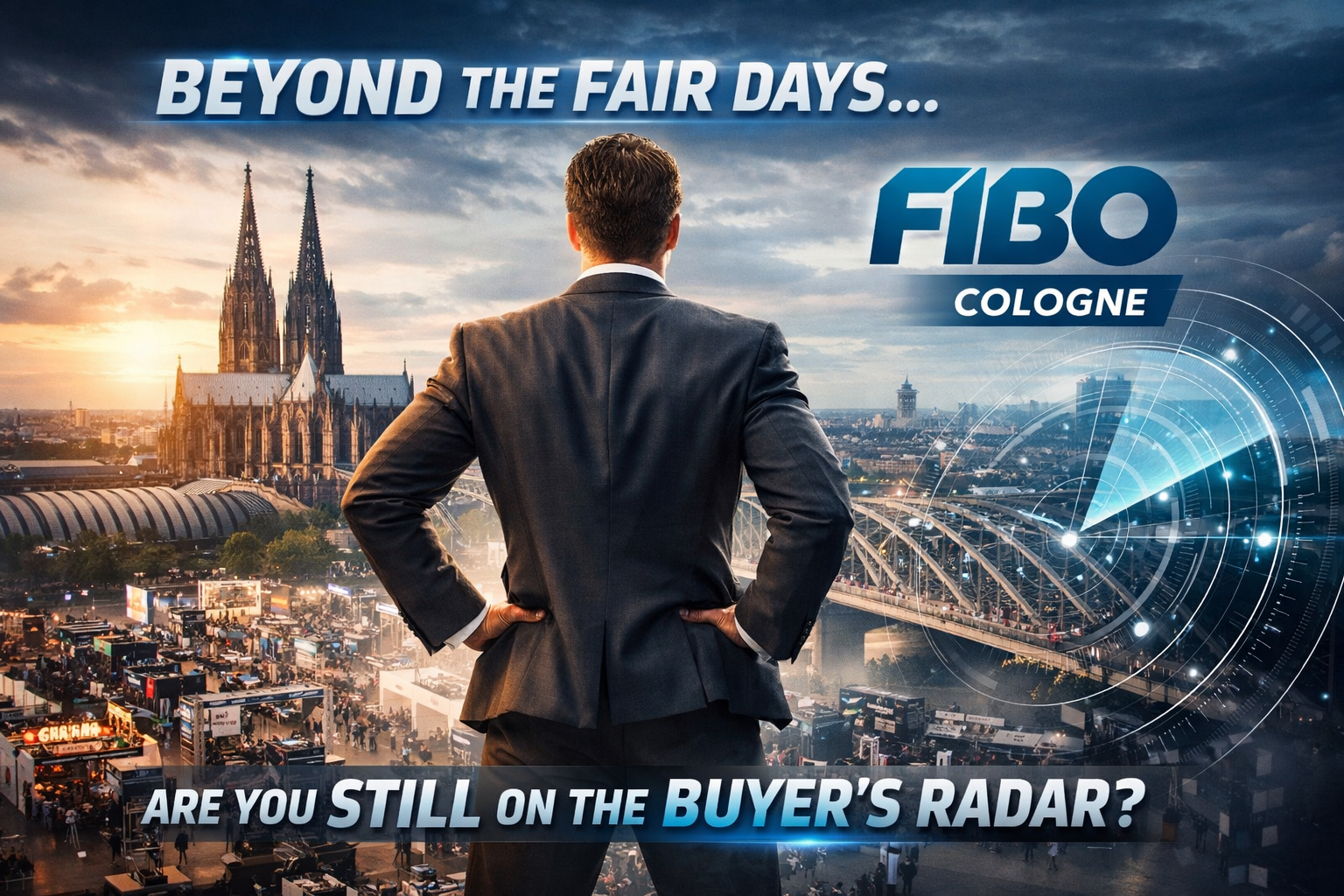
Contextual Opening — Where Assumptions Usually Break
 Most exhibitors evaluate FIBO Cologne 2026 based on what happens inside the halls during four exhibition days.
German and European buyers rarely do.
Within the German exhibition ecosystem, trade fairs function less as selling moments and more as verification checkpoints. Presence is noted, compared, and then tested again long after the exhibition ends. From a visibility perspective, FIBO is not a moment in time — it is one reference point inside a much longer evaluation cycle.
The critical gap appears after the halls close: exhibitors assume visibility continues; buyers quietly move into comparison mode.
What Participation Does Not Guarantee:
- It does not guarantee sustained engagement. The engagement curve peaks during the fair and declines precipitously without a deliberate architecture for post-fair thought leadership and continuous touchpoints, a core principle of any effective 365-day trade fair strategy.
- It does not guarantee conclusive trust. Initial interest must be matured through post-event evidence that a buyer can find autonomously to satisfy stringent internal due diligence, a process heavily influenced by underlying German buyer behavior at trade fairs.
- It does not guarantee a defensible advantage over non-exhibitors. Competitors can effectively engage the concentrated FIBO audience through targeted digital outreach, partner events around the fair, and a robust omnichannel presence, often achieving deeper integration into the buyer’s long-term research process. This underscores why treating FIBO Cologne as an isolated event is a strategic miscalculation.
Verified Data Snapshot (AUMA Reference)
According to official AUMA data:
-
Established: 1985
-
Exhibitors: 943 companies
-
Visitors: 154,890 total
-
117,537 domestic
-
37,353 international
-
-
Exhibition Space: 192,800 m²
Source: AUMA — official German trade fair statistics
🔗 https://www.auma.de/en/find-your-fair/details/?tfd=cologne_fibo_229406 (nofollow, noopener)
Structural interpretation:
These figures confirm that FIBO Cologne 2026 operates as a global validation platform for the fitness, health, and wellness industry. However, scale alone does not translate into sustained market presence. High density increases comparison pressure rather than guaranteeing recall.
The Visibility Gap After FIBO Ends
Exhibitor visibility typically peaks during the exhibition week and declines sharply once the event concludes. This is not caused by poor follow-up tactics but by how buyers structurally behave.
German buyers rarely finalize supplier decisions on-site. Instead, they:
-
Validate initial impressions later
-
Cross-check suppliers across multiple fairs
-
Search for consistent market presence rather than single-event signals
Without continued reference points, exhibitors fade into the background of a crowded supplier landscape — regardless of booth quality or foot traffic.
FIBO Cologne 2026 Within a Multi-Fair Buyer Search Journey
FIBO Cologne does not exist in isolation.
Buyers active in fitness, wellness, and health technology typically evaluate suppliers across several German and European fairs, not one.
From a buyer’s perspective:
-
FIBO establishes category relevance
-
Subsequent fairs confirm seriousness and continuity
-
Absence elsewhere weakens perceived commitment
This is why “one successful FIBO appearance” rarely closes deals. Buyers expect repeated signals across the ecosystem, not a single peak moment.
What FIBO Cologne 2026 Signals — and What It Does Not
What participation in FIBO validates
-
Market relevance within the global fitness and wellness sector
-
Operational capability to compete in a high-density environment
-
Willingness to be benchmarked against international competitors
What participation in FIBO Cologne does not guarantee
-
Ongoing visibility after the exhibition ends
-
Buyer recall during long decision cycles
-
Preference over similarly positioned exhibitors
Presence confirms legitimacy. It does not secure continuity.
Decision-Oriented FAQ
Does exhibiting at FIBO automatically increase long-term market visibility in Germany?
Not necessarily. Visibility typically declines within weeks unless reinforced through additional market reference points and continued presence signals.
How long does exhibitor visibility usually last after FIBO?
In most cases, visibility persists 4–8 weeks, depending on follow-up intensity and whether the exhibitor appears in other buyer reference environments.
Which exhibitors are structurally mismatched with FIBO?
Companies relying on short-term ROI expectations or single-event sales cycles are often misaligned. Fitness buyers in Germany operate on extended evaluation timelines.
If FIBO is not sufficient alone, what is the strategic alternative?
Shifting focus from event-centric exposure to ecosystem-level visibility, where suppliers remain discoverable and comparable beyond exhibition dates.
Strategic Reference Links
-
Main FIBO exhibition reference page:
🔗 https://bhowco.de/exhibition-centers-in-germany/messe-cologne-center/fibo-cologne/ -
Trade fair visibility framework:
🔗 https://bhowco.de/trade-fair-visibility-germany/ -
365-day ecosystem strategy:
🔗 https://bhowco.de/365-day-trade-fair-strategy/ -
Structural presence and long-term reference layer:
🔗 https://bhowco.de/add-directory-listing/
Exhibitor Reality Check — Practitioner Input
Practitioner input helps transform this page from a static article into a living industry reference.
After exhibiting at FIBO, how long did your visibility realistically persist once the fair ended — and what concrete signal confirmed that decline or continuation?
Practitioner input helps turn this page into a living reference rather than a static article.
Practical Information
-
🌐 Official website: https://www.fibo.de (nofollow, noopener)
-
🏛️ Established: 1985
-
📍 Location: Cologne, Germany
-
🏭 Focus: Fitness, Health, Wellness
Final Reality Statement
The relevant question is not whether FIBO was successful —
but whether visibility remained once the exhibition hall was empty.

