Latest Insights
B2B Germany: How International Companies Enter the German Market Through Trade Fairs and Continuous Presence


B2B Germany: Enter German Market Through Trade Fairs
International companies often believe entering Germany starts with finding customers. In reality, it starts with building credibility. The German B2B market operates on trust, not transaction speed. Understanding this distinction is the foundation of any successful market entry strategy.
This guide explains how international companies build trust, remain visible after trade fairs, and stay under consideration throughout the German B2B buying process.
Visibility helps buyers find you. Presence helps buyers trust you. Trade fairs create visibility. Continuous presence creates international trust and long-term business opportunities.
Key Takeaways
- Germany is a trust-driven B2B market
- Trade fairs create visibility. Buying decisions happen later.
- Supplier evaluation continues after the exhibition
- Continuous presence reduces perceived risk
- Buyers compare suppliers long after the event ends
- Protecting your trade fair investment requires year-round presence
Why Germany Remains Europe’s Most Important B2B Market
Germany is not just Europe’s largest economy—it is the gateway to the entire European industrial ecosystem. Germany’s role as a global industrial and investment hub is well-documented, attracting businesses from around the world seeking market access and partnerships. Major trade fair venues like Messe Frankfurt, Koelnmesse, and Deutsche Messe AG host large-scale events such as Automechanika, Anuga, and Hannover Messe, drawing a global audience of industry professionals for networking, market insights, and business partnerships.
Key characteristics of the German B2B market include:
- Industrial strength: Germany leads in automotive, engineering, pharmaceuticals, and technology sectors
- Export orientation: Over 50% of German GDP comes from exports
- Quality focus: German buyers prioritize quality and reliability over price
- Long-term relationships: Business partnerships are built over years, not transactions
German companies buy differently than their international counterparts. The decision-making process is structured, thorough, and collaborative. When a German company considers a new supplier, they evaluate across multiple dimensions, and the process often takes several weeks to months.
How German B2B Buyers Actually Make Decisions
Understanding how German buyers think is more important than knowing how to sell to them. Procurement behavior in Germany follows distinct patterns that international suppliers often misunderstand. For a deeper understanding of how international buyers evaluate suppliers, we recommend exploring our dedicated guide.
They Research Before They Talk
German buyers do their research before speaking to suppliers. According to a 2012 Google study, 66% of B2B buyers use internet research before a purchase. More recent research from the 6sense 2024 Buyer Experience Report indicates that B2B buyers are nearly 70% through their purchasing process before engaging with sellers.
By the time a buyer approaches a supplier, a significant portion of the decision-making process has already been completed. This means your digital presence matters before the first conversation. Potential suppliers who are not findable through online research are eliminated before the evaluation begins.
The Evaluation Window Is Extended
German companies take time to make decisions. According to a study on software purchasing decisions by OMR and Appinio, if there is a need for new software, it often takes several weeks to months until suitable solutions have been identified. Once there is a shortlist, potential providers must first be compared – which can also take several weeks to months. This extended timeline is not hesitation—it is thoroughness. German procurement teams systematically evaluate options, build internal consensus, and verify claims before committing.
Trust Is the Foundation
Trust is not a nice-to-have in German B2B relationships; it is a core operational requirement. A study from the German automotive sector shows that higher trust is associated with both higher quality of parts and more competition among suppliers. German buyers prefer suppliers they believe will act to maintain the mutual relationship. This is particularly important for long-term procurement relationships where switching costs are significant.
Team Decisions, Not Individual Choices
Software decision-makers in Germany rarely embark on the buyer journey alone. As the OMR study notes, the decision for new software is often a team effort, involving those who will work with the tool. This collaborative approach means your value proposition must convince multiple stakeholders, not just a single decision-maker.
How International Companies Build Trust in Germany
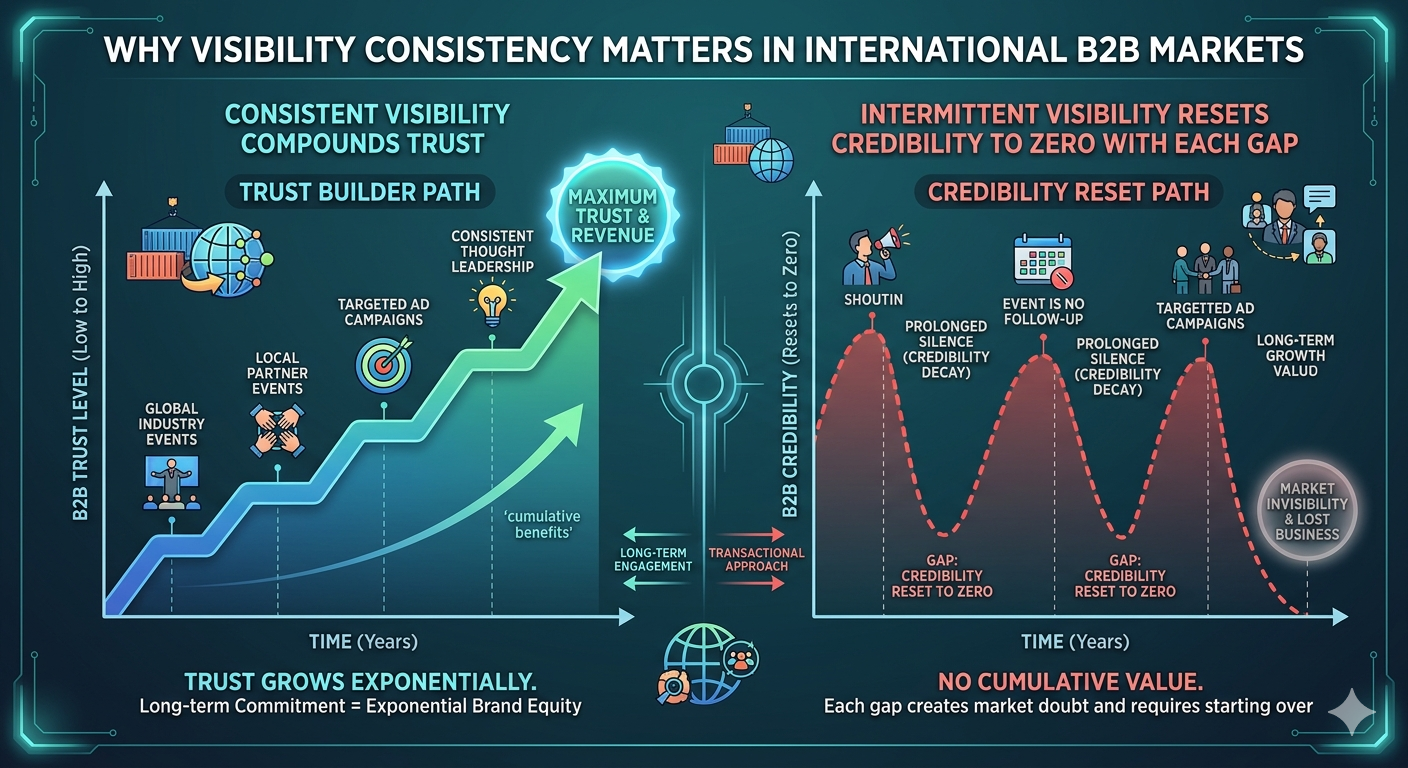
Trust in the German B2B market is built through consistent, visible commitment—not through aggressive sales tactics. Visibility helps buyers find you. Presence helps buyers trust you.
Local Presence Matters
Having a local presence signals long-term commitment to the market. The French scaleup Naboo, which entered the German market, chose Hamburg because “we are closer to the companies for which we develop our solution” and because “Hamburg is, after all, the gateway to the world”.
Similarly, market research firm B2B International established a permanent office in Düsseldorf after 16 years of developing activity in Germany, noting that 70 percent of their international projects involve research within Germany.
Local representation does not always require a physical office, but it does require visible evidence of commitment: local partners, clear logistics, and responsiveness.
Operational Infrastructure
German buyers evaluate operational capability carefully. Logistics provider FM Logistic’s acquisition of German industrial logistics specialist Schaflein illustrates this: the buyer was attracted by Schaflein’s technical expertise, high degree of automation, and recognized know-how (Source: FM Logistic press release).
Similarly, GigaCloud Technology expanded its German fulfillment network to six centers, noting that “Europe continues to show strong potential as a growth market for us”. Infrastructure investment signals serious commitment.
Compliance and Privacy
Germany has stricter privacy regulations than almost any other market. Email rules are particularly restrictive under the GDPR and German competition law (UWG)—you cannot email new contacts without their explicit consent. This affects how international companies must approach outreach and lead generation.
Why German Trade Fairs Are Different From Other International Exhibitions
Germany holds a unique position in the global trade fair industry. Two-thirds of all leading trade fairs worldwide take place in Germany. According to AUMA’s 2024 Key Figures, Germany hosted a total of 322 trade fairs, with over 204,000 exhibitors (domestic and foreign combined) and 11.7 million visitors.
What makes German trade fairs distinctive?
- Global reach: German fairs attract a higher percentage of international decision-makers than most other exhibition markets
- Industry specialization: Germany hosts the world’s leading fairs for specific sectors—Hannover Messe for industry, ITB Berlin for travel, Automechanika for automotive
- Infrastructure quality: World-class exhibition centers with excellent transport connections
However, the traditional trade fair model is evolving. The structural question facing the industry is no longer sentimental: what economic function does the trade fair still fulfill when purchasing behavior has long since migrated to digital channels?
The answer lies in understanding the trade fair’s changing role—from an acquisition channel to a confirmation and relationship-building channel. For guidance on how to choose the right German trade fair for your business, we have prepared a comprehensive resource.
Why Buyers Forget Most Exhibitors
Protect Your Trade Fair Investment. Because buyers continue evaluating long after the exhibition ends.
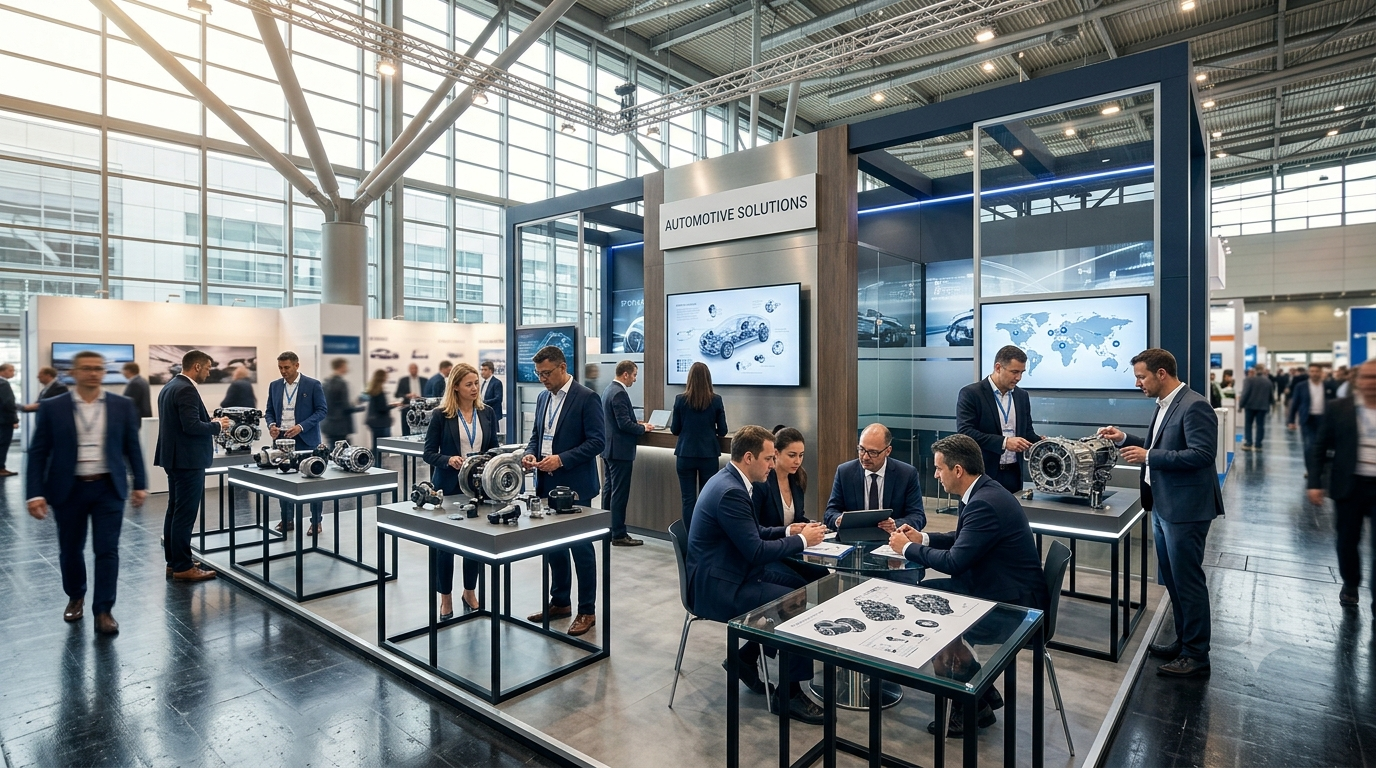
Most international exhibitors invest heavily in their booth, their team, and their presence during the exhibition. Then they pack up and go home. And buyers forget them.
Why? Because the exhibition is only the beginning of supplier evaluation, not the end. Buyers don’t make decisions during the fair—they collect information. The actual evaluation happens weeks or months later, when the exhibitor is no longer present.
Visibility helps buyers find you. Presence helps buyers trust you. Without presence after the fair, even the best first impression fades.
What Happens After the Exhibition: The Silent Evaluation Phase
The exhibition is only the beginning of supplier evaluation. This is perhaps the most important concept for international exhibitors to understand.
After the fair ends, buyers return to their offices. They catch up on work that accumulated during their absence. Then, they begin the silent evaluation phase—comparing suppliers, verifying claims, and building internal consensus. This process can take weeks or months.
This is why visibility alone is no longer enough. Visibility attracts attention. Presence sustains trust during supplier evaluation.
During this phase, buyers check:
- Digital presence: Is the supplier findable? Is their information current?
- Supplier profiles: Is the company profile complete and accurate?
- Professional networks: Is the company active on LinkedIn and other platforms?
- Certifications and compliance: Does the supplier meet German standards?
- Case studies: Is there evidence of successful implementation?
- Local representation: Is there a commitment to the German market?
The post-exhibition supplier evaluation process is often silent. Buyers rarely announce they are evaluating. They simply observe, compare, and eliminate suppliers who fail to meet their criteria.
Maintaining accurate and accessible information throughout the supplier evaluation journey is essential for remaining in consideration when procurement decisions are finally made.
Why Continuous Presence Matters More Than Exhibition Presence
Protect Your Trade Fair Investment. Because buyers continue evaluating long after your exhibition ends.
A trade fair creates a first impression. Continuous presence keeps you under consideration.
Buyers remember suppliers they continue to encounter after the exhibition. Presence reduces perceived risk during supplier evaluation. Companies that disappear after the exhibition become harder to compare and easier to forget.
Most exhibitors invest in the exhibition itself. Successful exhibitors also invest in what happens after it.
Our guide on extending your trade fair presence throughout the year explains how exhibitors can maintain momentum between fairs.
Ask Yourself
If a buyer searched for your company today…
- Would your company still be visible three months from now?
- Would buyers still remember you?
- Would they trust what they found?
- Would they compare you with confidence?
- What would they actually find?
How German Buyers Evaluate International Suppliers
Understanding the evaluation criteria used by German procurement teams helps international suppliers prepare effectively.
Technology and Innovation
German companies are increasingly open to technology-driven solutions, but they evaluate carefully. The ADAMOS case study shows how a consortium-based approach can help navigate the complexities of B2B market entry in Germany—overcoming challenges like operational complexity, data sensitivity concerns, and fear of lock-in.
Bargaining Power and Switching Costs
Research on German automotive procurement reveals that trust effects differ by technology type. For low-tech parts, higher trust leads to higher quality and more competition among suppliers. For high-tech parts, these effects do not appear, even when the buyer procures parts from the same supplier (Source: Research thesis on trust in procurement). This suggests that for complex, high-technology products, buyers may rely more on formal contracts and technical specifications than on relationship-based trust.
Cross-Cultural Adaptation
Successful German market entry requires cultural adaptation. As Fabrice Martin notes, “a lot of startup sales tips come from the US or the UK” and “some don’t fit the way German buyers think or buy”.
German buyers expect:
- Detailed, specific information
- Evidence of reliability and security
- Clear compliance with regulations
- Patience with extended evaluation processes
B2B Germany Beyond Trade Fairs
Trade fairs are an important entry point to the German market, but they are not the only channel. A comprehensive market entry strategy includes:
Digital Presence and Content
German buyers find suppliers through search, professional networks, and directory platforms. Maintaining a current, professional digital presence is essential.
Supplier Profiles
Being listed on platforms that German procurement teams use provides credibility and discoverability. A permanent exhibitor profile keeps your company visible throughout the supplier evaluation journey. Build your year-round exhibitor presence with a permanent supplier profile that supports buyer evaluation.
Local Representation Infrastructure
Whether through physical offices, local partners, or virtual presence, evidence of market commitment reduces perceived risk.
LinkedIn and Professional Networks
Active engagement on professional platforms signals market involvement and provides touchpoints during the evaluation period.
Common Mistakes International Companies Make
Understanding common mistakes helps international suppliers avoid costly missteps:
- Waiting until the exhibition starts: German buyers research before the fair. Pre-show visibility is essential.
- Ignoring post-event visibility: The buying process continues after the exhibition closes. Without continued presence, leads go silent.
- Only collecting business cards: Systematic follow-up and engagement are required to convert interest into business.
- Treating Germany as one market: Different regions, industries, and buyer types have distinct expectations.
- No structured follow-up: Without a systematic follow-up process, leads are lost during the evaluation window.
- Using generic sales approaches: German buyers expect detailed, specific, customized communication.
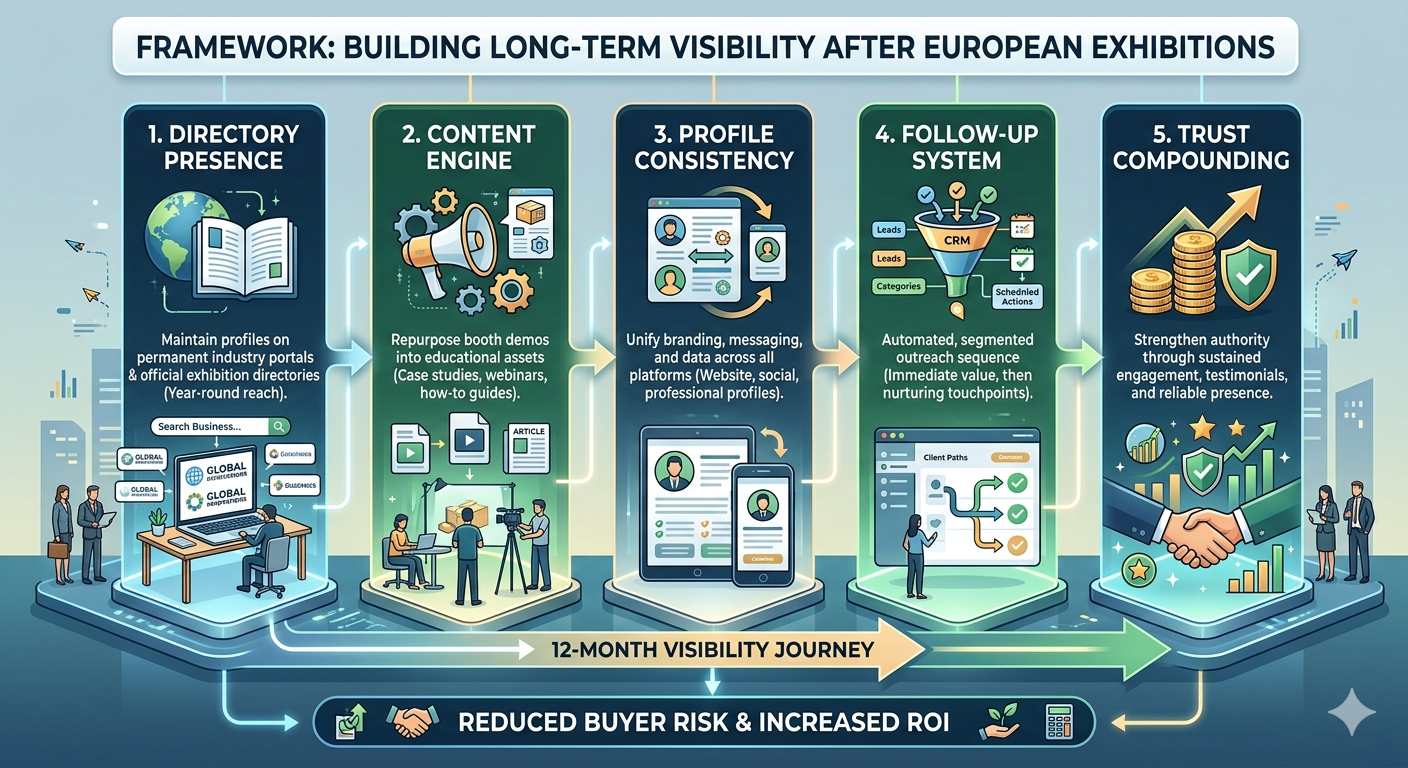
B2B Germany Strategy Framework
This framework helps international companies structure their German market entry approach:
Phase 1: Discover
- Build digital presence (website, directory listings, LinkedIn)
- Research German buyers and their behavior
- Identify the right trade fairs and channels
Phase 2: Be Found
- Ensure your company appears in relevant searches
- Maintain complete, accurate supplier profiles
- Create content that demonstrates market understanding
Phase 3: Stay Present
- Maintain visibility between trade fairs
- Publish regular updates and market observations
- Engage with potential buyers through professional networks
Phase 4: Support Evaluation
- Provide detailed information buyers need
- Make it easy to compare your offering
- Respond promptly to inquiries
Phase 5: Earn Trust
- Demonstrate long-term market commitment
- Provide evidence of reliability and capability
- Build relationships, not just transactions
Phase 6: Win Business
- Closing decisions occur after thorough evaluation
- Maintain presence even after the deal
- Continue building the relationship
Frequently Asked Questions
Why do international exhibitors lose opportunities after German trade fairs?
Because most companies treat the exhibition as the end of the sales process rather than the beginning of the supplier evaluation journey. They invest in the booth and the presence during the fair, but fail to invest in what happens after buyers return home. This leads to lost opportunities during the silent evaluation window when buyers are actually comparing suppliers.
Why isn’t exhibiting at a trade fair enough?
Because exhibitions create visibility for only a few days, while buyers evaluate suppliers over weeks or months. Without continuous presence after the exhibition, suppliers become harder to compare, easier to forget, and more likely to be excluded during procurement decisions.
What is continuous presence in B2B Germany?
Continuous presence means maintaining a visible, findable, and credible market presence between trade fairs. It includes updated supplier profiles, regular content publication, professional network engagement, and evidence of long-term market commitment. Continuous presence signals reliability and reduces perceived risk for international buyers.
Why is a supplier profile important after a trade fair?
A supplier profile keeps your company information available throughout the buyer evaluation journey—not just during the exhibition. Buyers compare suppliers silently over weeks or months. A complete, accurate, and findable supplier profile supports that evaluation and keeps your company in consideration when procurement decisions are made.
How important are trade fairs for entering the German market?
Trade fairs remain important, but their role is changing. They are no longer primary acquisition channels—buyers often research before the fair. Instead, trade fairs serve as platforms for in-depth discussions, relationship-building, and confirmation of decisions made through digital research. The companies that benefit most integrate their trade fair presence with year-round visibility.
How do German buyers research suppliers before trade fairs?
German buyers begin with online research—a 2012 Google study found that 66% of B2B buyers use internet research before a purchase, and many consult professional networks and review platforms. More recent data from the 6sense 2024 Buyer Experience Report shows that B2B buyers are nearly 70% through their purchasing process before engaging with sellers. By the time they enter a trade fair hall, a significant portion of their decision process is complete. This is why digital presence before the fair is essential.
What happens after a German trade fair?
After the fair ends, buyers return to their offices, catch up on work, and begin the silent evaluation phase. They compare suppliers, verify claims, and build internal consensus over weeks or months. This is why maintaining presence after the exhibition is essential—buyers are still evaluating when the fair is long over.
How long is the typical German B2B buying process?
The buying process varies by industry, procurement complexity, and internal approval processes. Research shows that identifying suitable solutions takes several weeks to months, and comparing shortlisted providers takes additional weeks to months. The key point is that buyer evaluation rarely ends when the exhibition closes.
What role does trust play in German B2B procurement?
Trust is central to German B2B procurement. Research shows that higher trust leads to higher quality and more competition among suppliers. Trust is built through consistent presence, reliable information, and evidence of long-term commitment. German buyers choose suppliers they believe will maintain the mutual relationship.
Do German buyers prefer local suppliers?
German buyers do not necessarily prefer local suppliers, but they do prefer suppliers who demonstrate commitment to the market. Companies that appear only for trade fairs and then disappear are perceived as higher risk. Those with consistent presence—even without a physical office—are viewed more favorably.
How do I enter the German B2B market without opening a local office?
Many international companies enter Germany without a physical office. The key is demonstrating commitment through other means: local partners, logistics arrangements, responsive customer support, and visible digital presence. Supplier profiles and professional content signal engagement with the market.
Can LinkedIn and content marketing replace trade fairs?
LinkedIn and content marketing are complementary, not replacements. They provide visibility during the long evaluation window between trade fairs. However, they cannot replicate the concentrated access to decision-makers or the experiential element of seeing products in person. The most effective strategy integrates both.
Is Germany a single B2B market or multiple regional markets?
Germany has regional variations in business culture, industrial specialization, and procurement practices. Hamburg differs from Munich, which differs from the industrial Ruhr region. International companies should adapt their approach to the specific regions they target.
What should international exhibitors do immediately after a trade fair?
Immediately after the fair, maintain presence. Update supplier profiles, publish relevant content, and ensure information remains current and findable. The evaluation window is beginning, not ending. Companies that disappear during this period lose opportunities to buyers who remain visible.
Conclusion: From Trade Fair Moment to Year-Round Presence
Protect Your Trade Fair Investment. Because buyers continue evaluating long after your exhibition ends.
BHOWCO helps international exhibitors remain visible throughout the supplier evaluation journey. A permanent supplier profile keeps your company comparable, credible, and discoverable long after the exhibition ends.
Trade fairs create visibility, but continuous presence creates international trust and long-term business opportunities.
Companies don’t succeed in Germany because they attend trade fairs. They succeed because they remain present after buyers return home. For international exhibitors, success is no longer defined by what happens inside the exhibition hall. It is defined by what buyers continue to see, verify, and remember after they leave it.
Explore more: German Trade Fair Hub — your gateway to international B2B visibility.