Latest Insights
How Trade Fair Follow-Up Builds Global B2B Credibility


How Trade Fair Follow-Up Builds Global B2B Credibility
You met a buyer at a trade fair. The conversation was excellent. You promised to follow up. Then you sent a generic email. Or you sent nothing at all. Or you sent aggressive sales messages that felt desperate. Each of these trade fair follow-up approaches damages credibility. But the right follow-up builds it. Trade fairs create visibility. Continuous presence creates international trust and long-term business opportunities. This article explains how trade fair follow-up builds global B2B credibility — and why most exhibitors accidentally destroy the credibility they worked to create.
Here is a truth that experienced international exporters learn over time: follow-up is not an administrative task. It is a credibility signal. Buyers judge your reliability, professionalism, and commitment by how you follow up. Poor follow-up suggests poor operations. Excellent follow-up suggests excellent operations. The difference is not in the product. It is in the process.
Quick Credibility Audit: Does Your Follow-Up Build or Destroy Trust?
Answer these questions honestly about your current follow-up approach:
- ☐ Do you personalize each follow-up message based on conversation details? (Yes/No)
- ☐ Do you remove sales pressure from early follow-up messages? (Yes/No)
- ☐ Does your follow-up extend beyond 60 days? (Yes/No)
- ☐ Do you maintain visibility between follow-up messages? (Yes/No)
- ☐ Do buyers respond positively to your follow-up approach? (Yes/No)
If you answered “No” to three or more questions, your follow-up is likely damaging your credibility. The framework below reverses this.
The Credibility Signal of Follow-Up
Trade fair follow-up is one of the most visible credibility signals in international B2B. Buyers pay close attention to how you follow up because it predicts how you will operate as a supplier. A buyer who receives a generic, sales-pressured email infers that your company operates generically and with pressure. A buyer who receives a personalized, value-driven message infers that your company operates with attention to detail and respect for client relationships.
The follow-up is not separate from your brand. It is your brand in action. Every message you send either builds credibility or erodes it. There is no neutral follow-up.
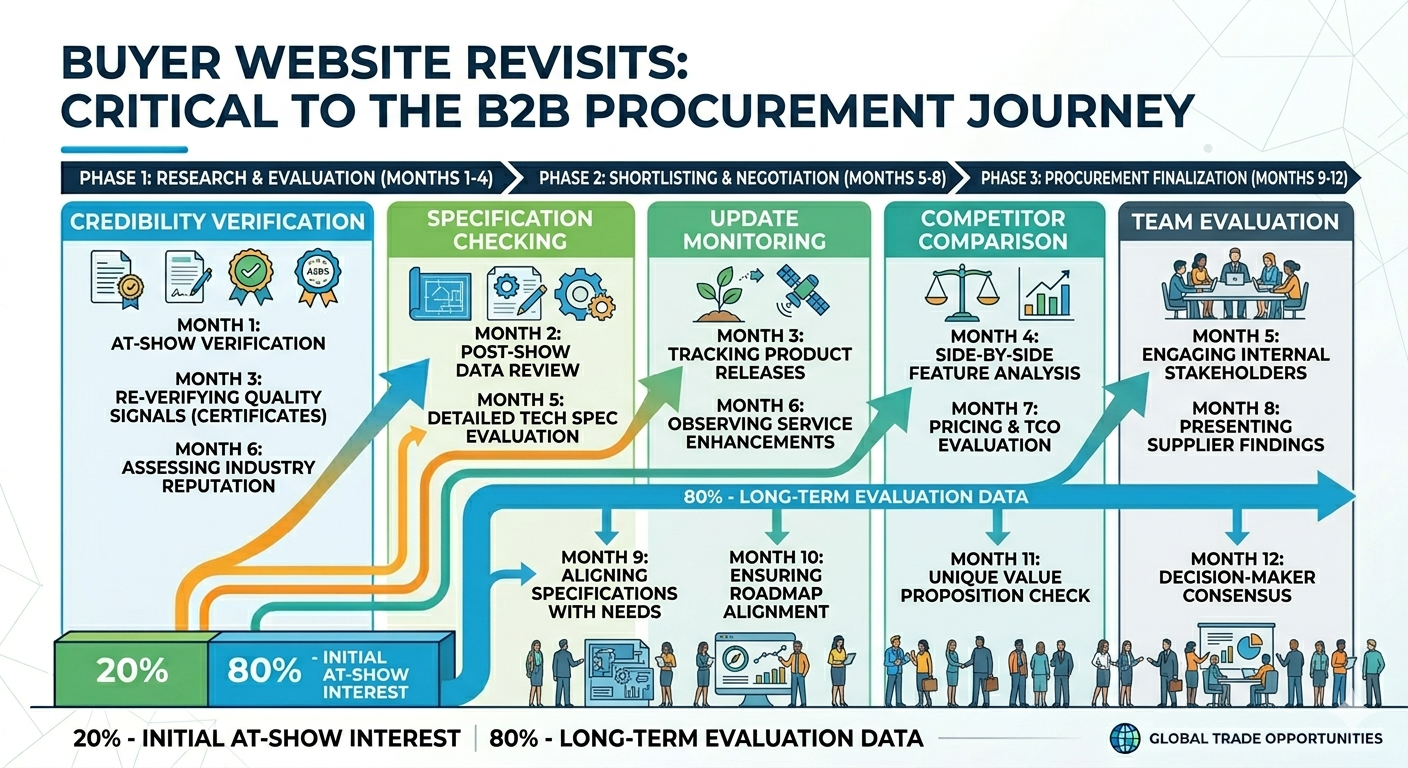
A recurring pattern across international trade fairs is that buyers consistently evaluate follow-up quality as a proxy for supplier reliability. Poor follow-up is interpreted as poor operations. Excellent follow-up is interpreted as operational excellence. The buyer cannot see your factory. They can see your follow-up.
For a deeper understanding of how buyers evaluate suppliers during follow-up, read this guide to buyer behavior at trade fairs.
The Five Phases of Credibility-Building Follow-Up
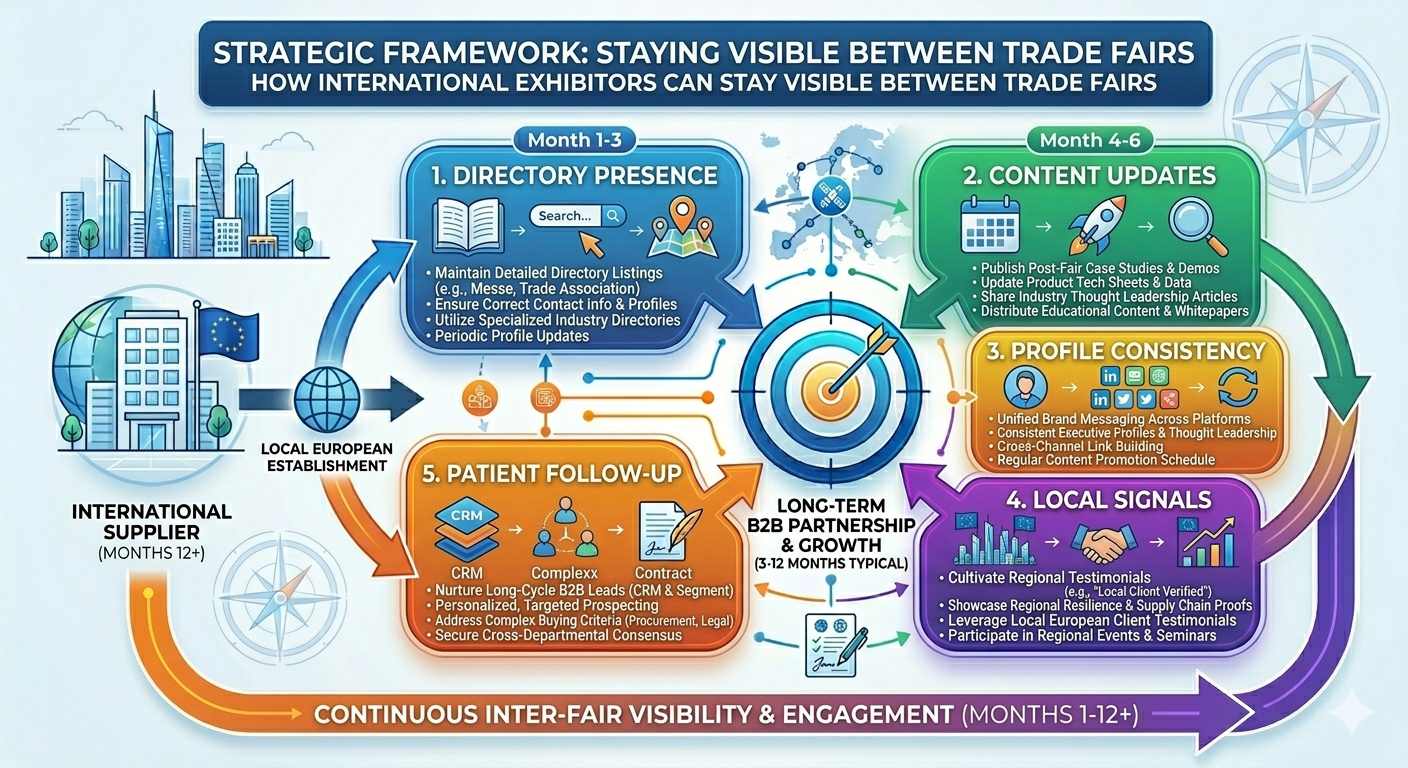
Based on observation of successful international suppliers, here is a five-phase framework for trade fair follow-up that builds global B2B credibility:
Phase 1: Immediate Acknowledgment (Days 1-4)
Credibility signal: Attention to detail, respect for buyer’s time.
A brief, personalized message referencing a specific conversation from the trade fair. No attachments. No sales pressure. No meeting requests. Just acknowledgment and a link to your permanent directory profile. This message signals that you listened and that you respect their post-event workload.
What not to do: Generic templates, attachments, or immediate sales asks. These signal low effort or desperation.
Phase 2: Value-Driven Nurturing (Weeks 2-8)
Credibility signal: Expertise, client focus, patience.
Send 2-3 short messages spaced 10-14 days apart. Each message contains one useful insight: a market observation relevant to their industry, a case study from a similar company, or a tool that solves a problem they mentioned. No sales asks. No meeting requests. Just value.
What not to do: Product brochures or pricing sheets. These signal selling, not serving.
Phase 3: Ambient Visibility (Weeks 9-16)
Credibility signal: Ongoing engagement, reliability, commitment.
Direct messages become less frequent (one every 4-6 weeks). But your visibility should not decrease. Update your permanent directory listing monthly. Publish short market observations. Ensure that when buyers search during silent evaluation, they find recent activity and current information. This ambient visibility works as passive follow-up, building credibility without direct outreach.
What not to do: Stop all activity because no one is responding. Silence erodes credibility.
Phase 4: Patient Check-In (Weeks 16-24)
Credibility signal: Professionalism, long-term perspective, lack of desperation.
A single check-in message that explicitly removes pressure. “No need to reply. Just letting you know we remain active in the European market. Our updated profile is available here when your team reaches evaluation stage.” This message signals confidence and patience — both highly credible traits.
What not to do: Aggressive follow-ups demanding responses. Desperation destroys credibility.
Phase 5: Long-Term Positioning (Months 6-12)
Credibility signal: Stability, commitment, partnership orientation.
By this stage, your consistent follow-up and visibility have built credibility. Buyers who are ready reach out. Your response speed and professionalism at this stage confirm the credibility you have built. Buyers who are not ready yet see your continued presence as evidence of long-term commitment.
What to do: Be responsive. Be professional. Be patient. For guidance, read how to turn trade fair leads into long-term B2B clients.
For practical guidance on maintaining visibility between follow-up messages, read how trade fair visibility works year-round.
What Credibility-Building Follow-Up Looks Like in Practice
Based on observation of successful international suppliers, here is what effective trade fair follow-up that builds global B2B credibility actually looks like:
- First message within 48 hours: personalized, no sales ask, includes directory profile link
- Second message at week 2-3: value insight, no sales ask
- Third message at week 5-6: another value insight or case study, no sales ask
- Fourth message at week 10-12: check-in, explicitly no reply needed, profile update reminder
- Ongoing ambient visibility: monthly directory updates, regular content, consistent presence
- Patient response to inbound inquiries: fast, professional, no pressure
Before your next trade fair, ensure you have completed all preparation steps with the exhibitor checklist for German trade fairs.
How Poor Follow-Up Destroys Credibility
Poor trade fair follow-up destroys credibility in predictable ways. Generic template emails signal that you treat buyers as numbers, not partners. Aggressive sales messages signal desperation and lack of respect for buyer timelines. Stopping follow-up after a few attempts signals that your commitment is shallow. No follow-up at all signals that you are unprofessional or uninterested. Each of these signals erodes credibility. Some buyers will never consider you again after poor follow-up.
The cost is not just lost opportunities from that specific buyer. It is the accumulated reputation damage from every poor follow-up interaction. Credibility destroyed by poor follow-up is difficult to rebuild.
For help selecting which trade fairs deserve your follow-up investment, read how to choose the right trade fair for your strategy.
Frequently Asked Questions
- How does follow-up build credibility? – Signals operational excellence, attention to detail, respect for buyer timelines.
- Biggest credibility mistake? – Generic, sales-pressured emails followed by silence.
- How long should follow-up last? – Extended period to align with procurement timelines.
- Can automation work? – Yes, if personalized and value-driven. Generic automation destroys credibility.
- How does BHOWCO help? – Permanent visibility that reinforces follow-up credibility.
Conclusion: Follow-Up Is Credibility in Action
Trade fair follow-up is not an administrative task to check off after an exhibition. It is a credibility-building opportunity that continues for months. Every message you send either builds trust or erodes it. Personalized, patient, value-driven follow-up signals professionalism, reliability, and long-term commitment. Generic, pressured, or abandoned follow-up signals the opposite.
Trade fairs create visibility. Continuous presence creates international trust and long-term business opportunities. The exhibitors who build global B2B credibility are not the ones with the best booths. They are the ones whose follow-up demonstrates the same excellence, patience, and client focus that their operations claim. Follow-up is not separate from your brand. It is your brand in action.
BHOWCO exists to support that credibility-building follow-up. Your permanent directory listing provides the passive visibility that reinforces your messages, giving buyers evidence of your credibility whenever they search — between follow-ups, during silent evaluation, and when they are finally ready to buy.
Build global B2B credibility with a permanent BHOWCO directory listing