Latest Insights
How to Follow Up Trade Fair Leads Without Losing Buyer Interest


How to Follow Up Trade Fair Leads Without Losing Buyer Interest
You collected many follow up trade fair leads at your last exhibition. Your CRM is full of scanned badges and business cards. Now comes the part most international exhibitors get wrong: the follow-up. Too aggressive, and buyers disappear. Too passive, and they forget you existed. Too generic, and you look like every other exhibitor. There is a better way. Trade fairs create visibility. Continuous presence creates international trust and long-term business opportunities. This guide shows you exactly how to follow up trade fair leads in a way that respects procurement timelines while keeping your company top-of-mind.
Here’s a reality check: most buyers don’t want a sales call the day after a trade fair. They want space. But they also want to know you’re still there when they’re ready. The difference between successful and unsuccessful follow-up is understanding this tension.
Quick Self-Assessment: How Are You Following Up Now?
Before reading further, honestly answer these questions about your current approach:
- ☐ Do you send the same follow-up template to every lead? (Yes/No)
- ☐ Do you stop follow-up after a few attempts? (Yes/No)
- ☐ Do you mention something specific from your conversation? (Yes/No)
- ☐ Do you have a way to stay visible between follow-up messages? (Yes/No)
- ☐ Do you know which leads are in active evaluation vs. dormant? (Yes/No)
The right follow-up strategy respects buyer timing while maintaining visibility. The wrong strategy annoys buyers or disappears entirely.
Why Most Trade Fair Follow-Up Fails
The standard approach to follow up trade fair leads looks something like this: send a generic “nice to meet you” email within 24 hours, send a product brochure a week later, then give up when there’s no response. This fails for three specific reasons.
First, timing misalignment. Procurement teams in cross-border B2B markets operate on evaluation cycles that extend over weeks or months. Your early follow-up arrives when buyers are still clearing operational backlogs. Your later follow-up arrives when they’re finally starting to review notes. Your silence arrives exactly when they might be ready to talk.
Second, value absence. Most follow-up messages ask for something — a meeting, a decision, a response. They don’t offer anything useful. Buyers who received many follow-up emails after a trade fair remember only the ones that helped them do their jobs better.
Third, visibility collapse. Between follow-up messages, your company disappears entirely from the buyer’s awareness. When they finally reach evaluation stage, they search for you, find nothing recent, and assume you’re no longer actively in their market.
For a deeper understanding of how buyers behave after exhibitions, read this guide to international buyer behavior.
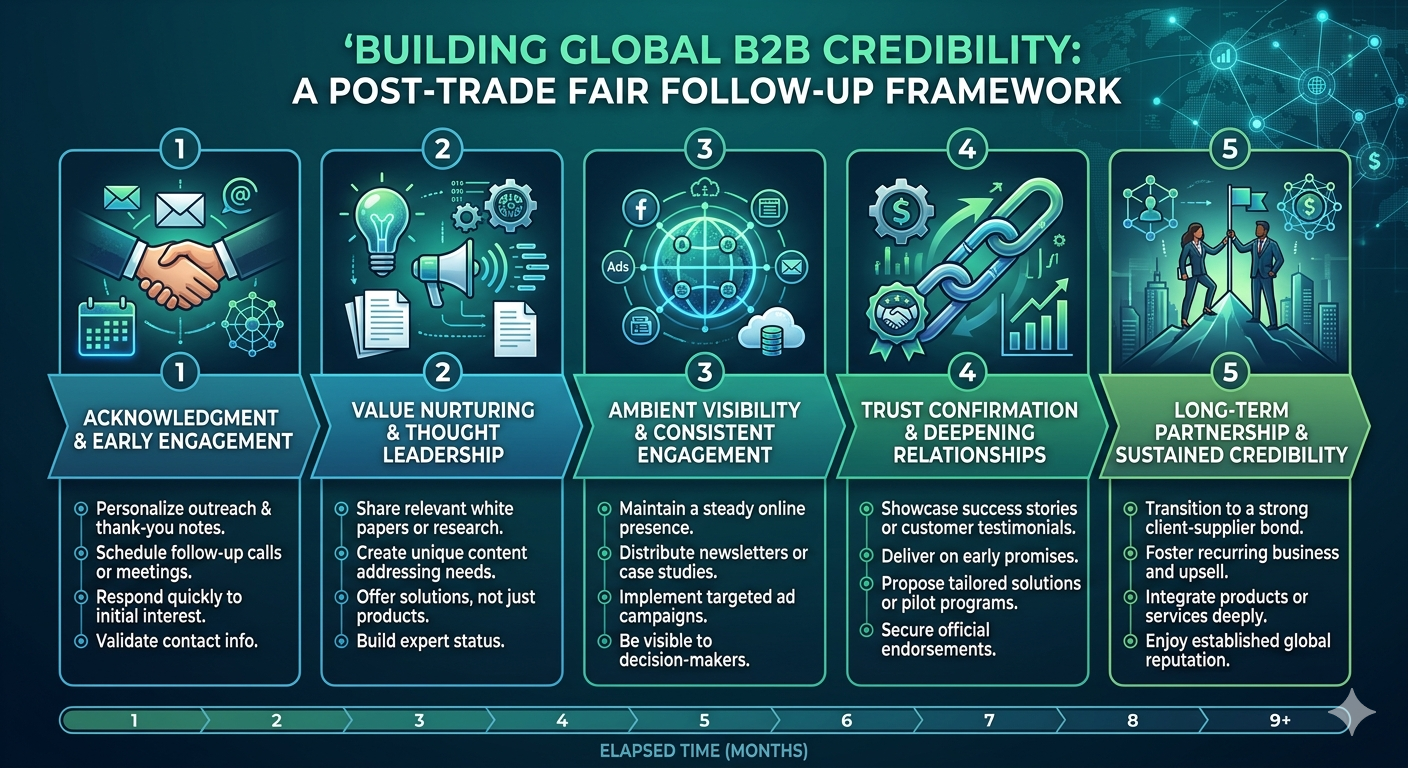
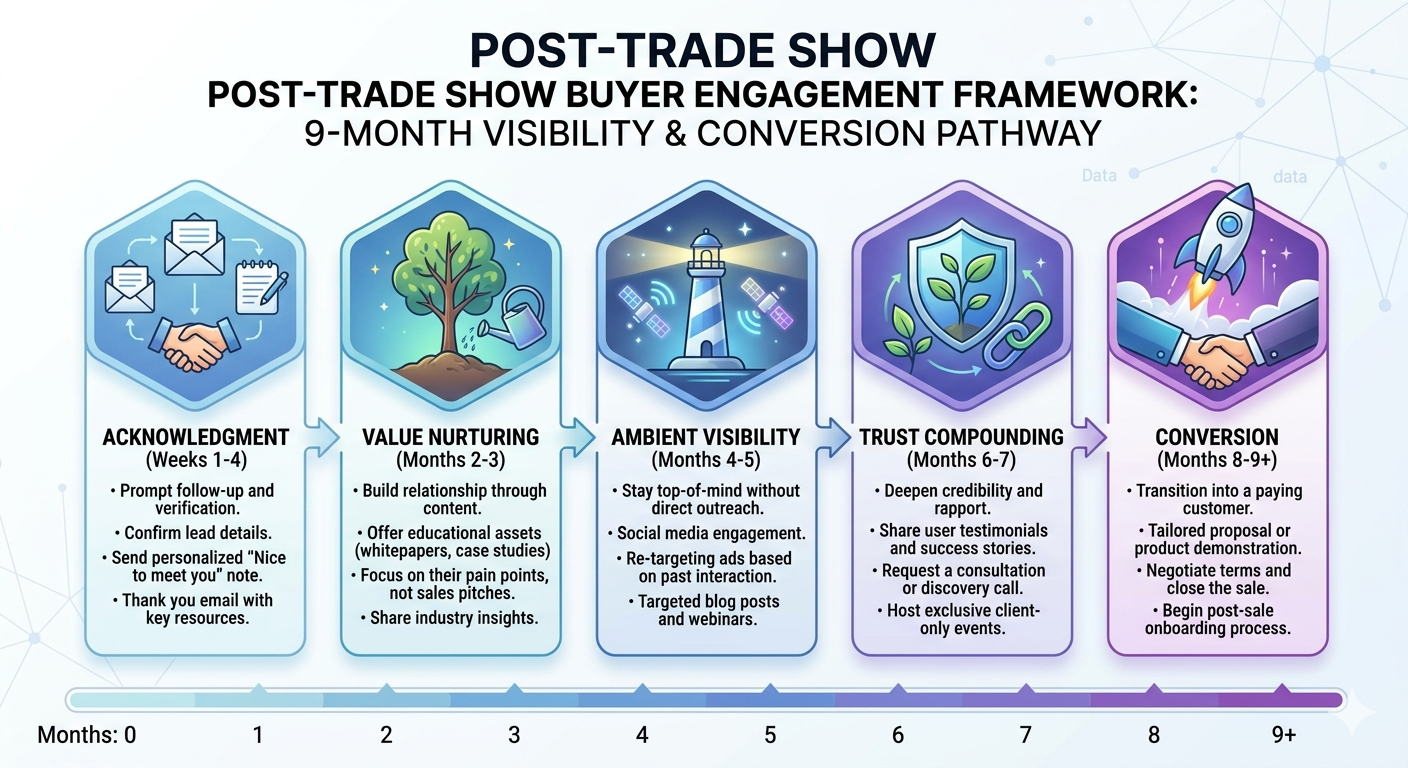
The 4-4-4 Follow-Up Framework for Trade Fair Leads
This framework has emerged from observing successful international exhibitors across multiple exhibition cycles. It’s not aggressive. It’s not passive. It’s strategically patient.
First 4 Days: The Acknowledgment
Within days of the trade fair closing, send a brief, personalized acknowledgment. This is not a sales message. It’s a simple: “Great meeting you at [booth location]. Here’s the specific thing we discussed about [their challenge].” Attach nothing except a link to your permanent directory profile where buyers can find you later. Keep it brief. No PDFs. No calendar invites. Just acknowledgment and a low-pressure way to stay connected.
Why this works: It respects the buyer’s post-event backlog while establishing that you listened and remember them specifically.
Next 4 Weeks: The Value Interval
In the following weeks, send a few pieces of genuinely useful content. Not product brochures. Not pricing sheets. Things like: a short observation about a trend relevant to their industry, a link to a tool that solves a problem they mentioned, or a brief case study from a similar company. Each message should be quick to read. Each should contain zero direct sales asks.
Why this works: You become a useful signal in a noisy inbox, not another vendor asking for time.
First 4 Months: The Ambient Visibility Phase
Over the following months, direct follow-up messages become less frequent. But your visibility should not decrease. This is where permanent directory presence matters. Buyers who entered silent evaluation need to find you when they search. Your BHOWCO directory listing ensures you remain discoverable even when you’re not actively emailing. Update your profile monthly with recent activity or market observations.
Why this works: It matches the actual procurement timeline. Buyers evaluate when they’re ready, not when you email.
For practical guidance on maintaining visibility between exhibitions, see how trade fair visibility works year-round.
What to Write in Each Follow-Up Message
Generic templates don’t work. But here are three message architectures that consistently perform better than average — based on observation, not hype.
The Acknowledgment Message (Days 1-4)
Subject: Great meeting you at [Trade Fair Name]
Body: “[Buyer Name], it was good talking at [booth location] about [specific challenge they mentioned]. As promised, here’s where you can find our company information when you’re ready: [link to your permanent directory profile]. No need to reply. Just wanted to make sure you had this for your records.”
The Value Message (Weeks 2-4)
Subject: [Industry Trend] observation from [Trade Fair Name]
Body: “You mentioned [specific problem] during our conversation at [Trade Fair Name]. Since then, we’ve been seeing [one specific observation]. Thought you might find this useful. No need to respond — just sharing in case it helps your planning.”
The Check-In Message (Weeks 8-12)
Subject: Still here when you’re ready
Body: “Following up from our conversation at [Trade Fair Name]. No pressure at all — just letting you know we’re still active in the market and available when your team reaches evaluation stage. Our updated company profile is always here: [link to profile]. Hope your post-show period has been productive.”
Before your next exhibition, make sure you’ve completed all preparation steps with the exhibitor checklist for trade fairs.
The Single Biggest Mistake in Trade Fair Follow-Up
Here’s what experienced international exhibitors learn after several cycles: the biggest mistake is not weak messaging. It’s having no visibility between messages.
You can send the perfect follow-up sequence. But if a buyer searches for your company weeks after the trade fair and finds outdated profiles, no recent activity, and no permanent presence — your perfect emails won’t matter. Trust erodes silently. The buyer moves to a supplier who appears consistently present.
A recurring pattern across European procurement is that buyers consistently value year-round discoverability in supplier selection. The exhibition opens the door. Continuous presence closes it.
How to Know If Your Follow-Up Is Working
Forget open rates and click-through rates for a moment. Here are three better indicators that your follow-up strategy is actually working:
- Inbound inquiries from previous trade fair leads — without you emailing first
- Profile views on your directory listing — especially from companies you met
- Short reply cycles — “not ready yet but will reach out” is actually a positive signal
For help selecting which trade fairs deserve your follow-up investment, read how to choose the right trade fair.
Frequently Asked Questions
How many times should I follow up with trade fair leads?
Aim for multiple touchpoints over an extended period. The first within days, value messages in the following weeks, and check-ins later. Between direct messages, maintain passive visibility through directory profiles so buyers can find you when they’re ready.
What’s the best way to follow up trade fair leads without being annoying?
Remove all sales pressure from your messages. Offer value without asking for anything in return. Respect that procurement timelines are longer than sales timelines. And crucially, maintain visibility between messages so buyers don’t forget you exist during silent evaluation periods.
Should I call trade fair leads or just email?
For cross-border B2B, email typically works better for initial follow-up. Phone calls can feel intrusive during the early evaluation phase. Use email for early follow-up, then consider a single call only for leads that showed strong purchase intent at the booth.
How long should I wait before following up after a trade fair?
Send an acknowledgment within days. Then wait before the next message. The gap between first and second message is important — it signals that you’re not desperate and you respect their post-event workload.
What if a trade fair lead never responds to follow-up?
Silence doesn’t mean rejection. Many procurement teams evaluate suppliers without ever responding to outreach. Your job is to remain visible and discoverable so that when they’re ready, you’re findable. A permanent directory listing ensures this without requiring email replies.
How does BHOWCO help with trade fair lead follow-up?
BHOWCO provides a permanent, discoverable directory profile that works between your follow-up messages. When buyers enter silent evaluation, they can find your updated company information without you needing to email them. See how BHOWCO supports year-round visibility.
- How many follow-ups? – Multiple touchpoints over time.
- Best way to avoid annoyance? – Remove sales pressure, offer value.
- Should I call or email? – Email works better early. Calls later for strong leads.
- When to send first message? – Within days, then wait.
- What if leads never respond? – Stay visible. They may reach out later.
- How does BHOWCO help? – Permanent visibility between follow-ups.
Conclusion: Follow-Up Is a Bridge, Not a Destination
How you follow up trade fair leads matters. But what matters more is what exists between your follow-up messages. A perfect email sequence with no visible presence behind it will fail. A mediocre follow-up with strong year-round visibility will often succeed. Because buyers don’t buy when you email. They buy when they’re ready — and they buy from suppliers who remained visible during their silence.
Trade fairs create visibility. Continuous presence creates international trust and long-term business opportunities. Your follow-up strategy should reflect this reality: patient, value-driven, and backed by permanent discoverability.
Ensure buyers can find you between follow-ups with a permanent BHOWCO directory listing