Latest Insights
How Trade Fair Visibility Reduces Buyer Risk in B2B Markets


How Trade Fair Visibility Reduces Buyer Risk in B2B Markets
Every B2B purchase involves risk. The buyer risks product quality, delivery reliability, after-sales support, and their own reputation within their organization. Trade fair visibility is one of the most effective ways to reduce that perceived risk. When buyers see your brand consistently — at exhibitions, in directories, and through ongoing presence — they conclude you are legitimate, reliable, and worthy of trust. Trade fairs create visibility. Continuous presence creates international trust and long-term business opportunities. This article explains how trade fair visibility reduces buyer risk in B2B markets and how to build a visibility strategy that accelerates procurement decisions.
Here is a truth that experienced international exporters understand: buyers do not buy products. They buy confidence that the product will work, the delivery will arrive, and the support will be there when needed. Risk reduction is the actual job of B2B marketing. Trade fair visibility is one of the most efficient risk-reduction tools available.
Quick Risk Audit: Is Your Visibility Reducing Buyer Risk?
Answer these questions from a buyer’s perspective:
- ☐ Can buyers verify your company’s legitimacy through trade fair participation? (Yes/No)
- ☐ Does your directory profile show evidence of ongoing market commitment? (Yes/No)
- ☐ Can buyers find recent updates and activity from your brand? (Yes/No)
- ☐ Do you appear alongside established industry players at major exhibitions? (Yes/No)
- ☐ Is your information consistent across all platforms where buyers verify? (Yes/No)
Each “Yes” reduces buyer risk. Each “No” leaves risk unaddressed. In B2B procurement, unaddressed risk means no contract.
The Risk Problem in Cross-Border B2B Purchasing
International buyers face higher risk than domestic buyers. They worry about time zone delays, language barriers, customs complications, legal recourse, and long-distance support. These concerns are rational. They are also addressable — but not through product specifications or pricing. Risk is reduced through visible evidence of reliability and commitment.
Trade fair visibility addresses specific risk dimensions that other marketing channels cannot easily reach:
Legitimacy Risk: Is this a real company? Trade fair participation signals that the organizer has vetted the exhibitor. Buyers infer: if they are at Hannover Messe, they are likely legitimate. This quality signal transfers trust from the exhibition organizer to your brand.
Performance Risk: Will the product work as promised? Trade fair visibility allows buyers to see products in person, ask questions, and observe booth professionalism. Physical presence signals confidence in product quality.
Reliability Risk: Will the supplier deliver on time? Consistent trade fair participation over multiple years signals reliability. Buyers assume that a company that invests in long-term visibility is likely to be a stable, dependable partner.
Support Risk: Will someone be available when problems arise? Visible local presence — directory listings, local contact information, regional partnerships — signals accessible support. Buyers feel safer choosing suppliers they can find and reach.
Reputation Risk: Will choosing this supplier damage the buyer’s internal credibility? Trade fair visibility signals that other buyers have vetted this supplier. The buyer can justify their decision by pointing to the supplier’s established market presence. Risk is shared and therefore reduced.
A recurring pattern across European B2B procurement is that buyers consistently report that visible trade fair presence reduces their perceived risk when evaluating new suppliers. The visibility itself is a risk-reduction tool.
For a deeper understanding of how buyers evaluate suppliers, read this guide to buyer behavior at trade fairs.
The Five Risk-Reduction Mechanisms of Trade Fair Visibility
Based on observation of buyer behavior across multiple industries, trade fair visibility reduces buyer risk through five specific mechanisms:
1. Quality Signals (Third-Party Validation): Major trade fairs have rigorous selection processes. Being accepted as an exhibitor signals that your company meets minimum quality standards. This third-party validation transfers trust from the exhibition organizer to your brand. Buyers do not need to verify your legitimacy from scratch. The trade fair has already done it for them.
What to do: Highlight your exhibition participation on your website and directory profile. Mention the years you have exhibited.
2. Verification Opportunities (Due Diligence): Trade fairs allow buyers to see products, meet teams, and observe professionalism in person. This direct verification reduces uncertainty. Buyers who have seen your booth and spoken to your team have less performance risk to worry about.
What to do: Ensure your booth presentation and team professionalism reflect the quality you claim.
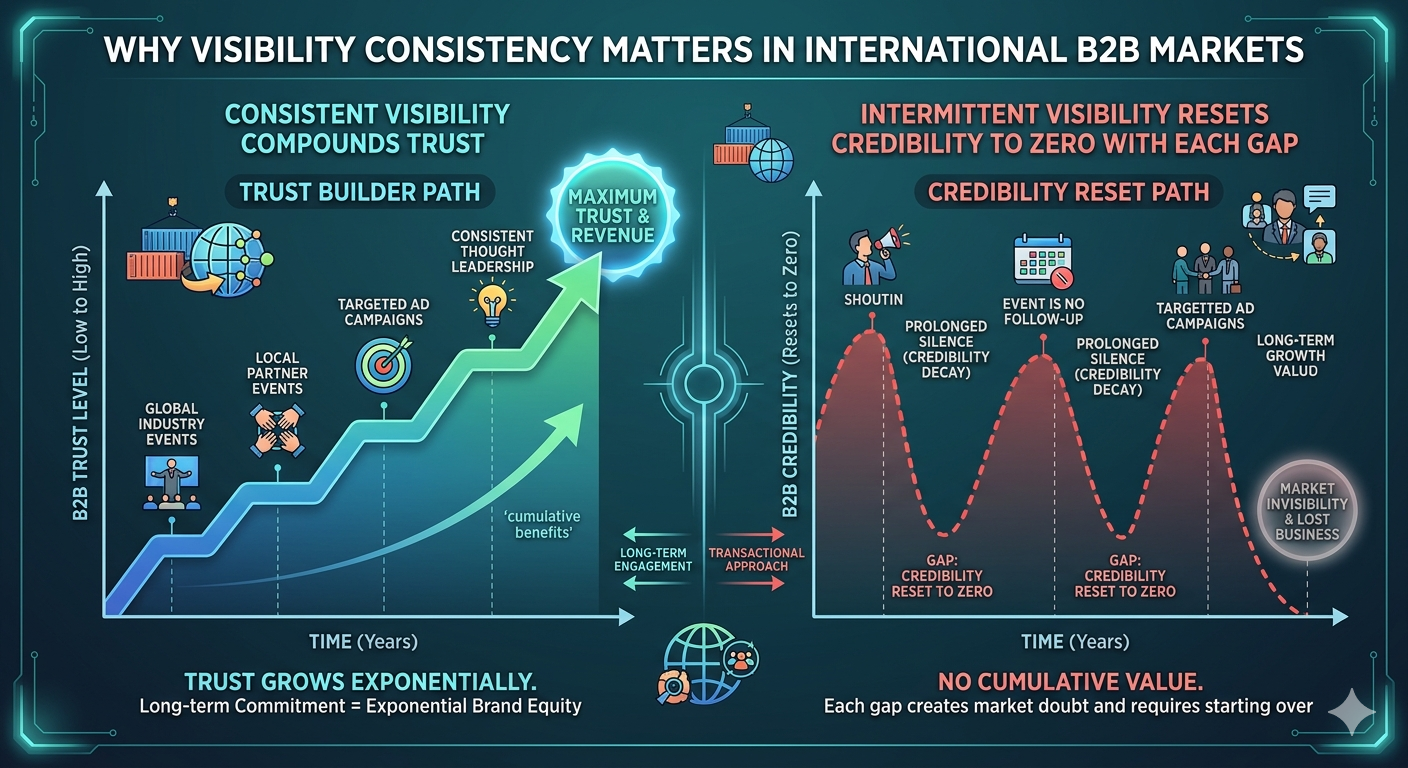
3. Commitment Evidence (Long-Term Signals): Consistent participation in trade fairs over multiple years signals long-term market commitment. Buyers infer that a company investing in ongoing visibility is likely to remain in the market. This reduces support risk and reliability concerns.
What to do: Exhibit consistently at the same major trade fairs over multiple years. Announce your participation schedule publicly.
4. Peer Validation (Associative Trust): Being in the same halls as established industry leaders positions your brand at a similar level. Buyers see your booth near Siemens, Bosch, or other trusted names and infer comparable credibility. This associative trust reduces the buyer’s reputation risk.
What to do: Choose hall locations that align with your brand positioning. For guidance, read how to choose the right trade fair for your strategy.
5. Ongoing Presence (Continuous Reassurance): Visibility between trade fairs — through permanent directory listings, regular content, and consistent updates — provides continuous risk reassurance. Buyers who search and find recent activity know your company is still active and accessible.
What to do: Maintain a permanent BHOWCO directory listing updated monthly. For practical guidance, read how trade fair visibility works year-round.
How Visibility Reduces Risk at Each Stage of Procurement
Buyer risk is not static. It changes throughout the procurement process. Trade fair visibility reduces risk at each stage when maintained continuously.
Initial Awareness Stage (Risk: Legitimacy): Buyer asks: Is this a real company? Trade fair visibility answers: Yes, the organizer vetted them. Risk reduced.
Research Stage (Risk: Performance): Buyer asks: Will the product work? Trade fair visibility answers: See it in person, meet the team. Risk reduced.
Evaluation Stage (Risk: Reliability): Buyer asks: Will they deliver on time? Trade fair visibility answers: They have exhibited consistently for years. Risk reduced.
Decision Stage (Risk: Reputation): Buyer asks: Will choosing them damage my credibility? Trade fair visibility answers: Other buyers trust them. They are an established presence. Risk reduced.
Post-Purchase Stage (Risk: Support): Buyer asks: Will someone be there if problems arise? Trade fair visibility answers: Their online presence is active. Local contact information is available. Risk reduced.
What Risk-Reducing Visibility Looks Like in Practice
Based on observation of successful international suppliers, here is what effective risk-reducing trade fair visibility actually looks like:
- Consistent participation at the same 2-3 major trade fairs over multiple years
- Permanent directory profiles that are updated monthly with current information
- Regular content publication (every 30-45 days) demonstrating market engagement
- Professional booth presentation that signals quality and capability
- Clear local contact information and service area descriptions
- European client references and case studies visible on directory profiles
Before your next trade fair, ensure you have completed all preparation steps with the exhibitor checklist for German trade fairs.
The Cost of Invisibility: Unaddressed Risk
When international suppliers lack trade fair visibility, buyer risk remains unaddressed. The consequences are predictable: longer sales cycles as buyers verify information independently, lower win rates as perceived risk exceeds tolerance, difficulty securing initial pilot orders, reduced pricing power as buyers demand risk discounts, and missed opportunities from risk-averse procurement teams.
Visibility is not a marketing expense. It is a risk-reduction investment. The ROI of visibility is measured in faster decisions, higher win rates, and stronger pricing power.
For help selecting which trade fairs maximize risk-reduction visibility, read how to choose the right trade fair for your strategy.
Frequently Asked Questions
- How does visibility reduce risk? – Five mechanisms: quality signals, verification, commitment evidence, peer validation, ongoing presence.
- What risk types are addressed? – Legitimacy, performance, reliability, support, and reputation risk.
- Can digital visibility alone work? – Yes, but physical + digital is most effective.
- Effect on procurement timelines? – Typically shortens timelines.
- How does BHOWCO help? – Year-round visibility that continuously reduces risk.
Conclusion: Visibility Is Risk Reduction
Trade fair visibility is not just about being seen. It is about reducing the risk that prevents buyers from choosing you. Quality signals, verification opportunities, commitment evidence, peer validation, and ongoing presence work together to address legitimacy, performance, reliability, support, and reputation risk. When risk is reduced, procurement accelerates. Contracts close faster. Relationships form more easily.
Trade fairs create visibility. Continuous presence creates international trust and long-term business opportunities. The suppliers who win in European B2B markets are not necessarily the ones with the best products or lowest prices. They are the ones who most effectively reduce buyer risk through consistent, verifiable, ongoing visibility.
BHOWCO exists to provide that risk-reducing visibility infrastructure. Your permanent directory listing works continuously, reassuring buyers that your company is legitimate, active, and accessible — turning risk into trust, and trust into contracts.
Reduce buyer risk with a permanent BHOWCO directory listing