Latest Insights
The Trust Multiplier Effect: Why German Trade Fair Presence Signals Global Professionalism


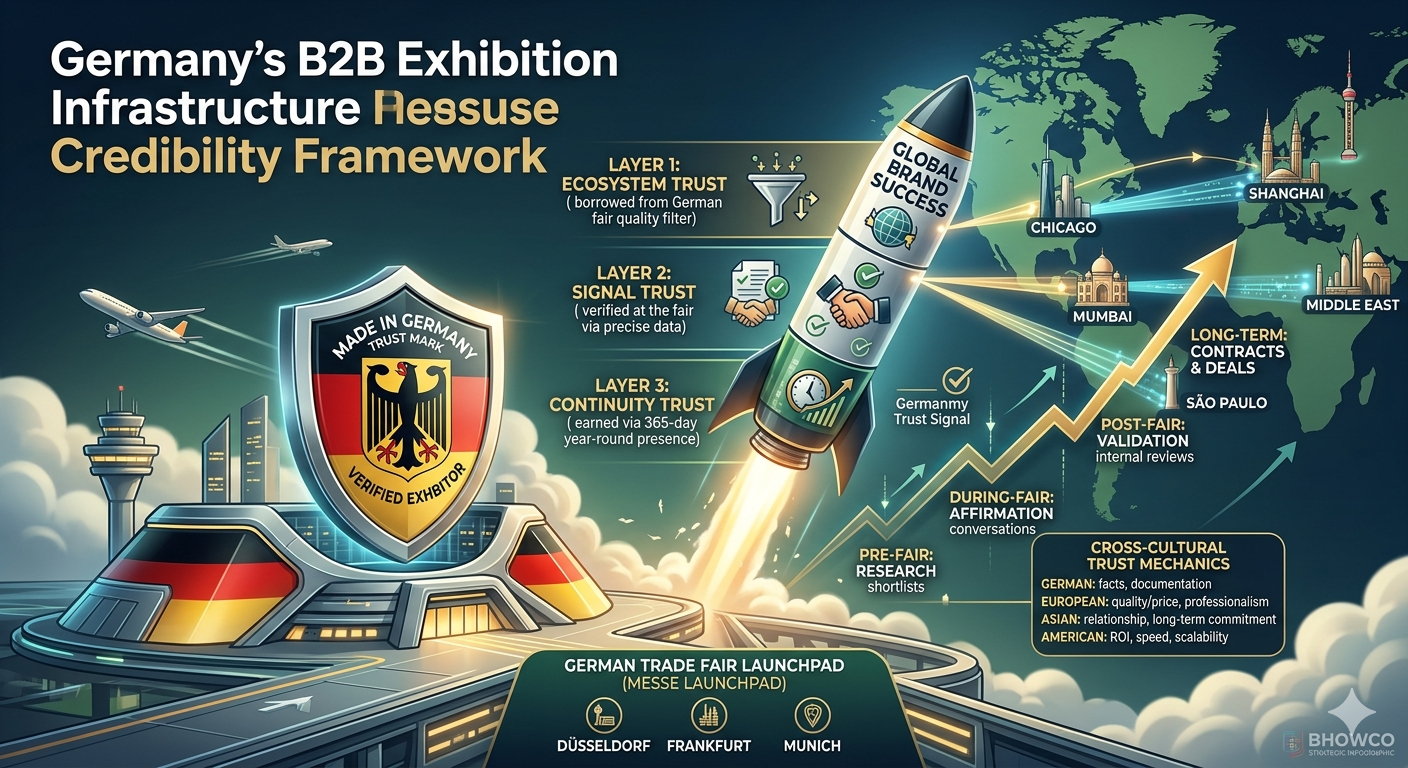
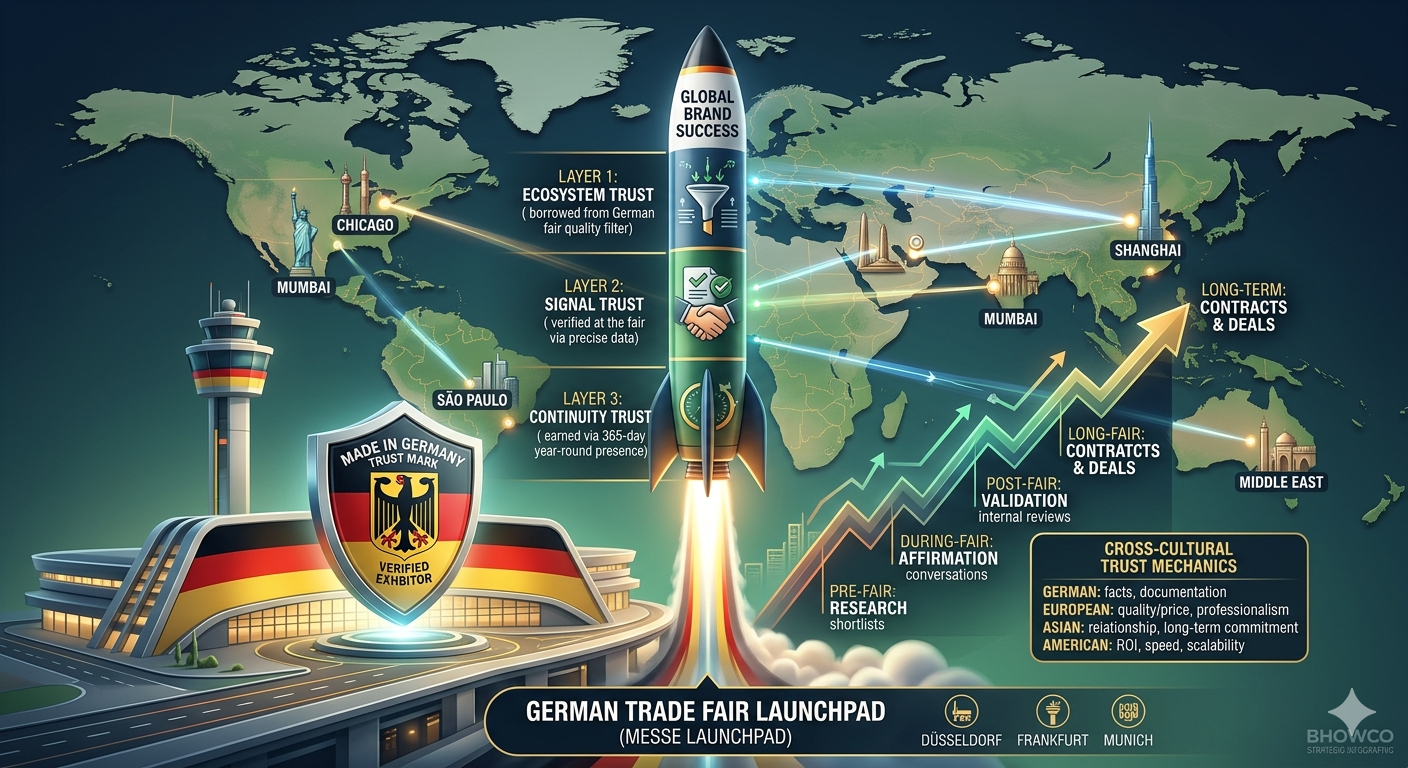
Trust Multiplier Effect – German Trade Fair Credibility
Imagine two identical companies. Same products. Same pricing. Same team size. Same target buyers.
One exhibits at Hannover Messe, MEDICA, or Automechanika Frankfurt. The other does not.
Which company do global buyers trust more?
The answer is so obvious that it almost does not need stating. Buyers trust the company that exhibits in Germany. Not because German booths magically improve product quality. Not because German soil has special properties. But because German trade fair presence functions as a trust multiplier — a signal of global professionalism that buyers interpret as proof of capability, stability, and partnership readiness.
This article reveals the psychology behind the trust multiplier. You will learn why exhibition participation signals professionalism, how buyers unconsciously weight German presence in their decisions, and exactly how to leverage this trust multiplier for year-round credibility — not just 4-day visibility.
1. The Trust Multiplier Effect: Why Buyers Overweight German Exhibition Presence
Behavioural economics has a concept called the halo effect. When you see one positive signal, you unconsciously assume other positive qualities exist even without evidence.
German trade fair presence triggers a powerful halo effect in international B2B buyers.
Here is what happens in the buyer’s mind when they see your brand at Messe Frankfurt, Hannover Messe, or any major German trade fair:
Signal 1: Financial Capability
Exhibiting at a major German trade fair requires significant investment. Booth space, travel, materials, staffing — the costs add up quickly. Buyers unconsciously reason: “Only companies with stable finances can afford this investment.” Your presence signals financial health without you saying a word.
Signal 2: Long-Term Commitment
Companies that think transactionally do not invest in German trade fairs. They buy online leads. They run digital ads. They chase short-term wins. Exhibition participation requires planning, patience, and a long-term orientation. Buyers interpret this as commitment to the market and to partnership relationships.
Signal 3: Quality Verification Willingness
German trade fairs are high-scrutiny environments. Your products, messaging, and staff are evaluated constantly. Buyers reason: “Only companies confident in their quality submit to this scrutiny.” Your willingness to be evaluated becomes evidence of quality itself.
Signal 4: Global Infrastructure
International buyers need partners who can serve multiple markets. A company that exhibits in Germany signals that it has the infrastructure to support European, Asian, and American clients. Your presence implies global capability even before you demonstrate it.
These four signals combine to create the trust multiplier. Each signal individually is valuable. Together, they compound. Buyers who see German trade fair presence on your track record unconsciously assign higher credibility to everything else you do.
As the 365-Day Visibility System explains: “You can buy visibility for 3 days at Messe Frankfurt. Credibility takes 365.” The trust multiplier gives you borrowed credibility. What you do with it determines whether you keep it.
2. The Psychology of Signal Cost: Why Expensive Trust Signals Work
There is a concept in evolutionary biology called costly signalling theory. The basic insight is simple: a signal is only credible if it is costly to fake.
A peacock’s tail is expensive to grow and maintain. It signals genetic fitness because only healthy peacocks can afford the cost. A cheap, easy-to-fake signal would not be credible.
German trade fair presence works exactly the same way in B2B procurement.
High Cost = High Credibility
Exhibiting at a major German trade fair is genuinely expensive. Not just in money, but in time, attention, and organisational focus. This cost is what makes the signal credible. Any company could claim “we are a global leader” on their website. But not every company can actually appear at Hannover Messe year after year.
Low Cost Signals Are Ignored
This is why buyers ignore most marketing claims. “World-class quality” costs nothing to write. “Global partnership” costs nothing to publish. These signals are easy to fake, so buyers discount them completely. German trade fair presence cannot be faked. You are either there or you are not.
Consistency Compounds Cost
A single exhibition appearance signals something. Multiple years of consistent participation signal much more. Each additional year increases the cumulative cost, which increases the credibility of the signal. This is why returning exhibitors are trusted more than first-timers, all else being equal.
The costly signalling framework explains why German trade fair presence is such a powerful trust multiplier. It is not magic. It is not cultural coincidence. It is rational buyer psychology. Buyers trust signals that are expensive to fake. German exhibition participation is expensive to fake. Therefore, buyers trust companies who exhibit in Germany.
This is also why 365-Day B2B Visibility Packages are structured as annual commitments. Consistency across time is what transforms an expensive signal into an unshakeable credibility asset.
This framework draws on Michael Spence’s Nobel Prize-winning work on signaling theory —
the same economic principle explaining why costly, hard-to-fake signals (like a university degree, or exhibiting at a major German trade fair)
credibly convey quality that cheap claims cannot.
3. Signal Decay: Why Your Credibility Expires Without Continuous Presence
Here is the part of the trust multiplier that most exhibitors never consider.
Trust signals do not last forever. They decay. They fade. They lose power over time.
If you exhibited at Hannover Messe in a previous year but have not been visible since, that signal has lost most of its credibility. Buyers ask themselves: “Why did they stop? Did they go out of business? Did they reduce their global commitment? Did their quality decline?”
The absence of continued presence actively erodes past credibility.
The Decay Timeline
Research on B2B trust signals suggests the following rough decay timeline for German trade fair credibility:
Shortly after the fair: Peak credibility. Your presence signals current capability.
Over time: Moderate decay. Buyers begin to wonder about your continued commitment.
Extended period: Significant decay. Past presence no longer signals current capability.
Longer period: Minimal credibility. Buyers assume your absence signals negative change.
The Continuity Solution
The only way to prevent signal decay is continuous presence. Not necessarily physical exhibition presence every single month. But consistent, visible, verifiable presence in the digital layer of Germany’s exhibition infrastructure.
This is exactly what the 365-Day Visibility System provides. Your BHOWCO profile serves as the continuity signal that bridges between physical exhibitions. Buyers see that you are not just a past participant. You are a current, active, committed player in the German exhibition ecosystem.
The Decay Multiplier Effect
Signal decay does not just reduce past credibility. It actively harms future credibility. A company that exhibited once years ago and then vanished is trusted less than a company that never exhibited at all. The gap between promise and follow-through creates negative trust. Buyers prefer no signal to a faded signal.
If you exhibit in Germany, you are making a commitment. That commitment does not end when the fair ends. It extends across the days between fairs. Your credibility depends on sustaining the signal, not just sending it once.
4. From Signal to Substance: Converting Borrowed Trust into Earned Credibility
The trust multiplier gives you borrowed credibility. Buyers assume positive qualities because you exhibit in Germany.
But borrowed credibility is not enough to win contracts. It gets you into consideration. It does not close deals.
To convert borrowed trust into earned credibility, you need specific behaviours before, during, and after the fair.
Pre-Fair: Earn Credibility Through Discovery
As detailed in the Exhibition Centers in Germany guide, pre-fair positioning determines whether you enter the fair as a known entity or an unknown. Buyers who discover you before the fair have already begun their verification process. They arrive at your booth with positive assumptions. This pre-fair discovery is the first conversion of borrowed trust into earned credibility.
During-Fair: Earn Credibility Through Consistency
Your booth messaging must match your digital presence exactly. Inconsistency destroys trust faster than anything else. If buyers find contradictions between what you publish online and what they see at the fair, they will conclude your borrowed trust was undeserved. Consistency is how you prove you belong in the ecosystem.
Post-Fair: Earn Credibility Through Continuity
This is where most exhibitors fail — and where the real credibility is earned. Buyers who met you at the fair will spend the following months internally validating you. Your continued visibility during this phase is what separates serious global partners from temporary exhibitors. Post-fair continuity is how you transform borrowed trust into durable credibility.
The BHOWCO platform is specifically designed to support this conversion process. Your 365-day profile provides the evidence base buyers need during internal validation. It converts your expensive signalling into documented credibility that procurement teams can take back to their organisations.
5. The Multiplier in Action: Comparing Exhibition Presence Across Scenarios
To understand the trust multiplier’s practical impact, compare four different exhibitor scenarios. All companies have identical products, pricing, and capability. The only difference is their German trade fair presence strategy.
Scenario A: No Exhibition Presence
Trust multiplier: Zero. Buyers have no costly signal to interpret. The company must prove credibility entirely through other means — claims on website, customer references, price competition. This is the hardest path to global B2B trust. Most buyers will choose a competitor with exhibition presence all else being equal.
Scenario B: One-Time Exhibition, No Continuity
Trust multiplier: Temporary, then decaying. The company receives borrowed trust during and immediately after the fair. But without continuity, the signal decays rapidly. Over time, credibility becomes lower than Scenario A because the gap between past presence and current absence creates negative inference.
Scenario C: Annual Exhibition, No 365-Day Digital Presence
Trust multiplier: Moderate, with gaps. The company receives annual boosts of borrowed trust. But between fairs, credibility decays significantly. Buyers who research between fairs find limited evidence of continued commitment. The company wins during fair season but loses during the rest of the year.
Scenario D: Annual Exhibition + 365-Day Digital Presence
Trust multiplier: Compounding. The company receives the annual borrowed trust boost from physical exhibition. Between fairs, the 365-day digital presence sustains credibility. Signal decay is prevented. Each year, the cumulative credibility is higher than the previous year. This is the compounding path to global B2B authority.
Companies with consistent visibility often see stronger engagement from global buyers, with a substantial portion of qualified leads originating outside the initial fair region. The trust multiplier is real. Your strategy determines whether you access it temporarily or compound it permanently.
6. Building Your Trust Multiplier Strategy: A Practical Framework
Understanding the trust multiplier is valuable. Building a strategy to activate it is essential.
Here is exactly how to build a trust multiplier strategy that compounds over time.
Element 1: Select Your Anchor Fair
Choose one major German trade fair in your industry to anchor your credibility strategy. Research international attendance percentages, buyer origins, and competitor participation. Commit to this fair for multiple consecutive years. Consistency across years is what transforms presence from signal into asset.
Element 2: Build Your Pre-Fair Discovery Engine
Months before the fair, publish content optimised for buyer research keywords. Ensure your digital presence answers the questions buyers ask during initial verification. Enter the fair as a known entity. The trust multiplier starts working before you ever arrive at the fairgrounds.
Element 3: Execute Consistency During the Fair
Your booth, materials, and staff must perfectly align with your digital presence. Train your team to answer verification questions, not deliver sales pitches. Provide documentation buyers can use during internal validation. Every interaction should be designed for the long decision cycle.
Element 4: Activate 365-Day Continuity Infrastructure
This is the element most exhibitors skip — and the element that makes the trust multiplier compound rather than decay. Establish permanent digital presence within the German exhibition ecosystem through BHOWCO’s 365-day profile. Maintain consistent visibility during the buyer’s internal validation phase. Be discoverable when competitors go silent.
Element 5: Measure and Optimise Signal Strength
Track your trust multiplier metrics: pre-fair discovery rate, post-fair engagement retention at intervals, sales cycle acceleration compared to non-exhibition channels, and international search visibility across your target markets. Each metric tells you how effectively you are converting borrowed trust into earned credibility.
The trust multiplier is not automatic. German trade fair presence gives you the opportunity. Your 365-day strategy determines whether you seize it.
Frequently Asked Questions
What exactly is the trust multiplier in German trade fairs?
The trust multiplier is the psychological effect where buyers unconsciously assign higher credibility to companies that exhibit at major German trade fairs. Because exhibition participation is expensive and difficult to fake, buyers interpret it as a signal of financial capability, long-term commitment, quality confidence, and global infrastructure. This borrowed trust multiplies the credibility of everything else you do.
How long does German trade fair credibility last after a single exhibition?
Peak credibility lasts for a period after the fair. Significant decay begins over time. Without continued presence, past exhibition participation can even create negative trust signals — buyers wonder why you stopped exhibiting. Continuous 365-day visibility prevents this decay and maintains credibility across the full buyer decision cycle.
Can small companies access the trust multiplier with limited budgets?
Yes. The trust multiplier works through costly signalling, but cost is relative. A small company’s investment in a modest booth at a targeted German fair represents significant commitment relative to their size. Buyers recognise this. Consistency matters more than booth size. A small company that exhibits consistently over time often builds more credibility than a large company that exhibits once with an enormous booth.
How does BHOWCO help sustain trust between physical exhibitions?
BHOWCO provides the 365-day digital infrastructure that prevents signal decay between fairs. Your permanent profile serves as continuity evidence for buyers during their internal validation phase. It keeps you visible across time zones and decision timelines. It transforms your exhibition presence into a year-round credibility asset that compounds with each passing year.
What destroys the trust multiplier most quickly?
Three things destroy the trust multiplier rapidly: inconsistency between your digital presence and booth messaging, aggressive selling instead of verification support, and post-fair silence. The fastest destroyer is disappearing after the fair. Buyers interpret silence as instability, and instability is the opposite of the global professionalism your exhibition presence originally signalled.
How many years of consistent exhibition participation are needed for maximum trust multiplier effect?
The trust multiplier compounds most significantly over multiple years. Initial participation establishes credibility. Continued participation confirms you are not a one-time participant. Over time, you shift from participant to fixture in the buyer’s mental map. Companies that exhibit consistently over an extended period enjoy a trust advantage that new entrants cannot easily overcome.
German trade fair presence is not just visibility. It is a trust multiplier.
Buyers interpret your exhibition participation as proof of financial capability, long-term commitment, quality confidence, and global infrastructure. This borrowed trust multiplies your credibility across every other dimension of your B2B brand.
But the trust multiplier does not last forever. It decays without continuity. It fades without 365-day presence. It disappears when you vanish after the fair.
Your competitors will attend the same fairs. They will spend similar money. They will claim similar credibility.
And then most of them will let the trust multiplier decay. They will let their borrowed trust fade. They will start from zero at every fair.
You can choose differently. You can sustain your credibility. You can compound your trust multiplier. You can be the brand buyers trust because you never left.
Explore how German trade fair presence can become your permanent trust multiplier.
→ Find your network hub
→ Master the 365-day visibility system
→ Build your permanent trust infrastructure