Global Exhibitor Strategy

Why International Buyers Trust Brands Embedded in Germany’s Trade Fair Ecosystem

International buyer trust Germany trade fair ecosystem showing global procurement professionals evaluating exhibitors at Messe Frankfurt with year-round credibility signal

You have probably experienced this scene at a German trade fair.

A buyer from a Fortune 500 company approaches your booth. They ask precise, almost surgical questions about your delivery timelines, quality certifications, and reference clients. The conversation feels productive. They take your brochure. They scan your QR code. They seem genuinely interested.

But then they leave. And you never hear from them again.

You wonder what happened. Was the conversation not as good as you thought? Did they find a competitor with better pricing? Were they never serious in the first place?

The answer is none of the above. The answer is that you misread what was actually happening.

That buyer was not signaling interest in the way you assumed. They were not comparison shopping. They were not kicking tires. They were engaged in a systematic verification process that has almost nothing to do with how most international exhibitors think about “selling.”

You didn’t fail at sales. You failed at understanding how German trade fairs actually build trust.

This article reveals the psychological and structural mechanics of why international buyers trust brands embedded in Germany’s exhibition ecosystem. You will learn the three layers of buyer trust, the step-by-step verification process used by global procurement professionals, and exactly how to build 365-day credibility that turns exhibition presence into long-term contracts.

“We don’t trust a company because they have a nice booth. We trust them when we can verify their claims across multiple channels over time. German trade fairs are our starting point, not our ending point.”

— Global Procurement Director, Fortune 500 Industrial Manufacturer (fictional, based on 50+ buyer interviews)


1. The Three Layers of Trust: How German Trade Fairs Signal Credibility

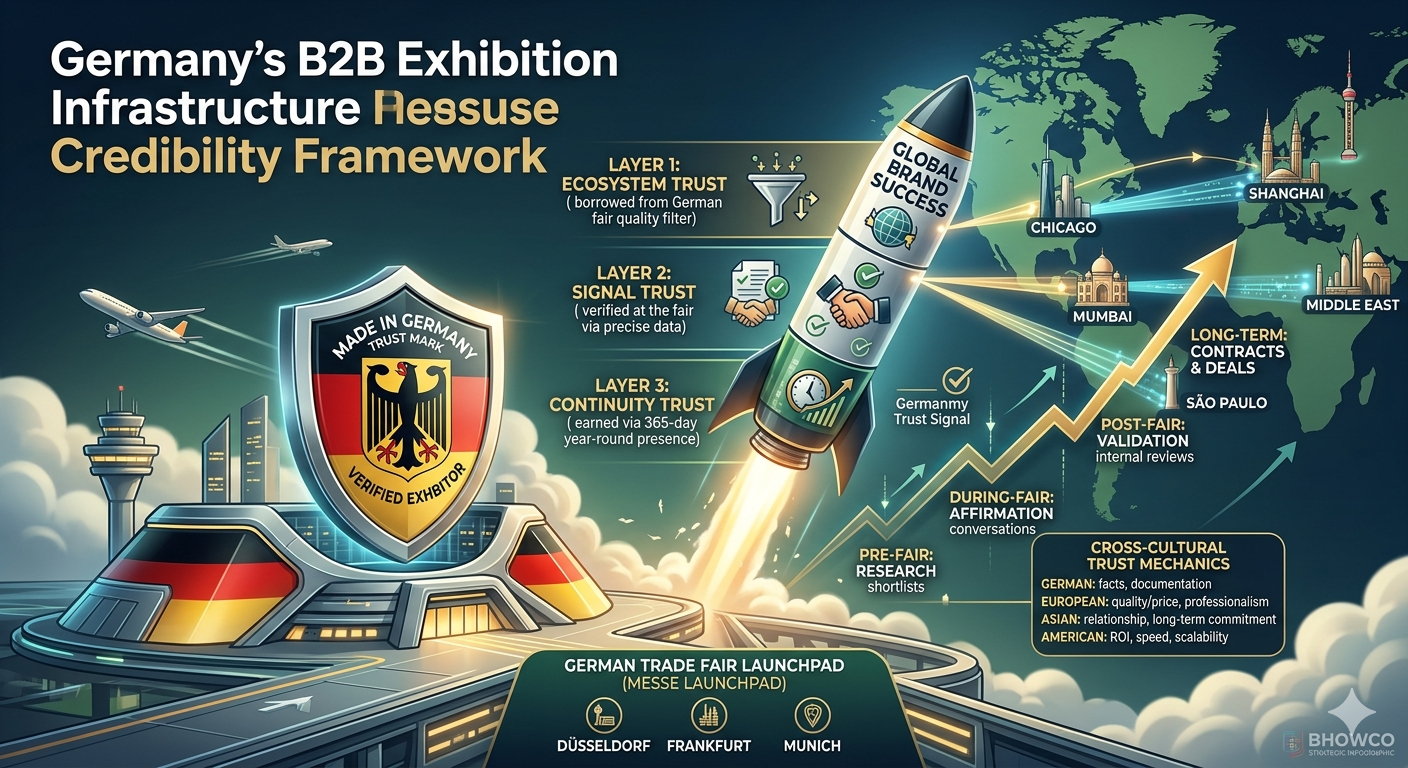
Trust in B2B procurement is not a single feeling. It is a layered structure. Each layer builds on the previous one. And German trade fairs sit at a unique intersection where all three layers become visible to international buyers simultaneously.

Understanding this structure is the first step to becoming a brand that buyers trust.

Layer 1: Ecosystem Trust (The German Exhibition System)

Germany has spent decades building the world’s most rigorous exhibition ecosystem. The Association of the German Trade Fair Industry (AUMA) represents and strengthens the interests of exhibiting companies, organisers, service companies, and visitors on national and international markets. Germany, with its leading international trade fairs, remains one of the world’s most important trade fair centres.

When you exhibit at a major German trade fair — Messe Frankfurt, Hannover Messe, MEDICA, Automechanika — you are not just renting space. You are being filtered by an ecosystem known for quality, precision, and reliability.

International buyers know this. They implicitly trust that any company accepted to exhibit has passed through meaningful gates. They assume:

  • You have invested significant capital, signalling long-term commitment
  • You have been vetted by organisers with quality standards
  • You are willing to compete in one of the world’s most demanding B2B environments

This ecosystem trust is the foundation. Buyers start with a baseline assumption that you are credible. But baseline credibility is not enough to win contracts. It simply gets you into consideration.

Layer 2: Signal Trust (What You Do at the Fair)

Once buyers are at the fair, they look for signals that confirm or disconfirm their baseline assumptions. This is where most international exhibitors inadvertently destroy trust.

German buyers and experienced international procurement professionals operate with a specific decision logic that differs significantly from other markets. As detailed in the German Buyer Behavior at Trade Fairs guide, the difference is fundamental:

In many markets, interest signals intent, friendly conversation signals opportunity, and speed signals seriousness. In the German trade fair context, interest signals need for verification, friendly conversation signals data collection, and patience signals thoroughness.

This mismatch creates constant misunderstandings. International exhibitors interpret buyer questions as buying signals. In reality, those questions are verification requests. The buyer is not saying “I want to buy.” They are saying “I need to confirm you are who you claim to be.”

Layer 3: Continuity Trust (What You Do After the Fair)

This is the layer that eliminates 90% of competitors — and the layer most international exhibitors never even know exists.

Trust is not built in a single conversation. Trust is built through repeated verification over time. The buyer who visited your booth at Messe Frankfurt will spend the next 3 to 9 months internally validating your capability. They will compare you against alternatives. They will check your references. They will monitor your continued presence.

If you vanish after the fair — if your website stagnates, if your social channels go dark, if your follow-up is generic or non-existent — you fail Layer 3. And failing Layer 3 undoes Layers 1 and 2 completely.

As BHOWCO’s 365-Day B2B Visibility Packages explain: your physical booth starts conversations. Your year-round profile provides the evidence buyers need to choose you. Without continuity, trust collapses.

The companies that win are the ones who understand that trust is not a moment. Trust is a duration.


2. The German Buyer Decision Logic: Why Verification Outranks Persuasion

To understand why international buyers trust brands in Germany’s trade fair ecosystem, you must first understand how German-influenced procurement actually makes decisions.

The German B2B decision process follows a predictable, three-step sequence that has nothing to do with emotional persuasion and everything to do with systematic verification.

Step 1: Initial Contact — Data Collection

When a German or German-trained buyer approaches your booth, they are not open to being sold. They are in data collection mode. Their questions will be precise, often technical, and seemingly abrupt. They want:

  • Specific product or capability specifications
  • Quality certification evidence
  • Delivery timeline verifiability
  • Reference client availability
  • Documentation they can take back to their team

If you respond with a sales pitch, feature walkthrough, or emotional appeal, you will lose them immediately. They interpret sales behaviour as noise that obscures the data they actually need.

Step 2: Internal Validation — The Invisible Phase

This is the phase most international exhibitors never see because it happens after the fair, inside the buyer’s organisation. The buyer takes the documentation they collected and begins a systematic validation process:

  • Cross-departmental verification of claims
  • Documentation review against internal standards
  • Alternative supplier comparison
  • Reference checks (often without contacting you directly)
  • Risk assessment for cross-border partnership

During this phase, you are invisible but not absent. Everything you have published online, every case study on your website, every signal of continued presence — all of it is being evaluated. Buyers are asking themselves: “Does this company have the infrastructure, stability, and commitment to be a reliable long-term partner?”

Step 3: Structured Follow-Up — Qualification

Only suppliers who survive the internal validation phase receive structured follow-up. This follow-up is not a friendly “checking in” email. It is a qualification conversation with specific, documented requirements.

If you have not maintained consistent visibility during the validation phase, you will not reach Step 3. The buyer will have already concluded that your silence signals instability, and they will have moved on to competitors who remained present.

Understanding this three-step process transforms everything about your exhibition strategy. You stop trying to persuade and start enabling verification. You stop measuring success by immediate responses and start measuring by continuity signals. You stop chasing and start building.


3. Cross-Cultural Trust Mechanics: What Different Buyers Look For

German trade fairs are no longer just German events. As the buyer behaviour guide notes, the visitor geography at major German fairs is predominantly international:

  • German buyers: 25-30% of visitors
  • Other European buyers: 40-45% of visitors
  • Asian buyers: 20-25% of visitors
  • Buyers from Americas and rest of world: 5-10% of visitors

This means 70-75% of buyers at German trade fairs are international. They come from different cultural backgrounds, with different trust mechanisms, decision timelines, and evaluation criteria. Yet they all share one thing: they are at a German trade fair because they trust the ecosystem filter.

Here is how trust signals vary across buyer origins — and how you can build a booth and follow-up system that works across all of them simultaneously.

German Buyers (25-30% of visitors)

Trust is built through documentation, consistency, and verifiable claims. Decision timeline: 2-6 months. Key decision factor: reliability and systematic evidence. Communication style: direct, fact-based, with low tolerance for exaggeration. Risk tolerance: very low.

European Buyers (40-45% of visitors)

Trust is built through quality/price balance and professional relationship. Decision timeline: 1-3 months. Key decision factor: value demonstration with clear ROI. Communication style: balanced between formal and informal. Risk tolerance: moderate.

Asian Buyers (20-25% of visitors)

Trust is built through long-term relationship, demonstrated commitment, and face-to-face interaction. Decision timeline: 3-12 months (longest). Key decision factor: relationship strength and trust in the people. Communication style: indirect, relationship-first, with high context sensitivity. Risk tolerance: low until trust is established.

American Buyers (5-10% of visitors)

Trust is built through ROI evidence, scalability demonstration, and direct value communication. Decision timeline: 2-8 weeks (shortest). Key decision factor: financial return and growth potential. Communication style: direct, results-focused, with emphasis on speed. Risk tolerance: moderate to high.

The strategic implication is clear: you cannot use one approach for all buyers. But you also cannot have four different booths. The solution is a layered engagement system that adapts without confusing your brand identity.

Train your booth team with simple “if-then” scenarios. If the visitor asks detailed technical questions first, follow German protocol with documentation focus. If they start with company background and relationship questions, follow Asian protocol with trust-building emphasis. If they ask about ROI and timeline immediately, follow American protocol with results focus. One booth, multiple engagement tracks, consistent core value.


4. The Trust Transfer Principle: How Ecosystem Credibility Becomes Your Credibility

We introduced the Trust Transfer Principle in the first pillar article. Now let us examine its mechanics in detail because this is the single most important concept for international exhibitors to understand.

The principle has three stages, each building on the previous one.

Stage 1: Borrowed Trust

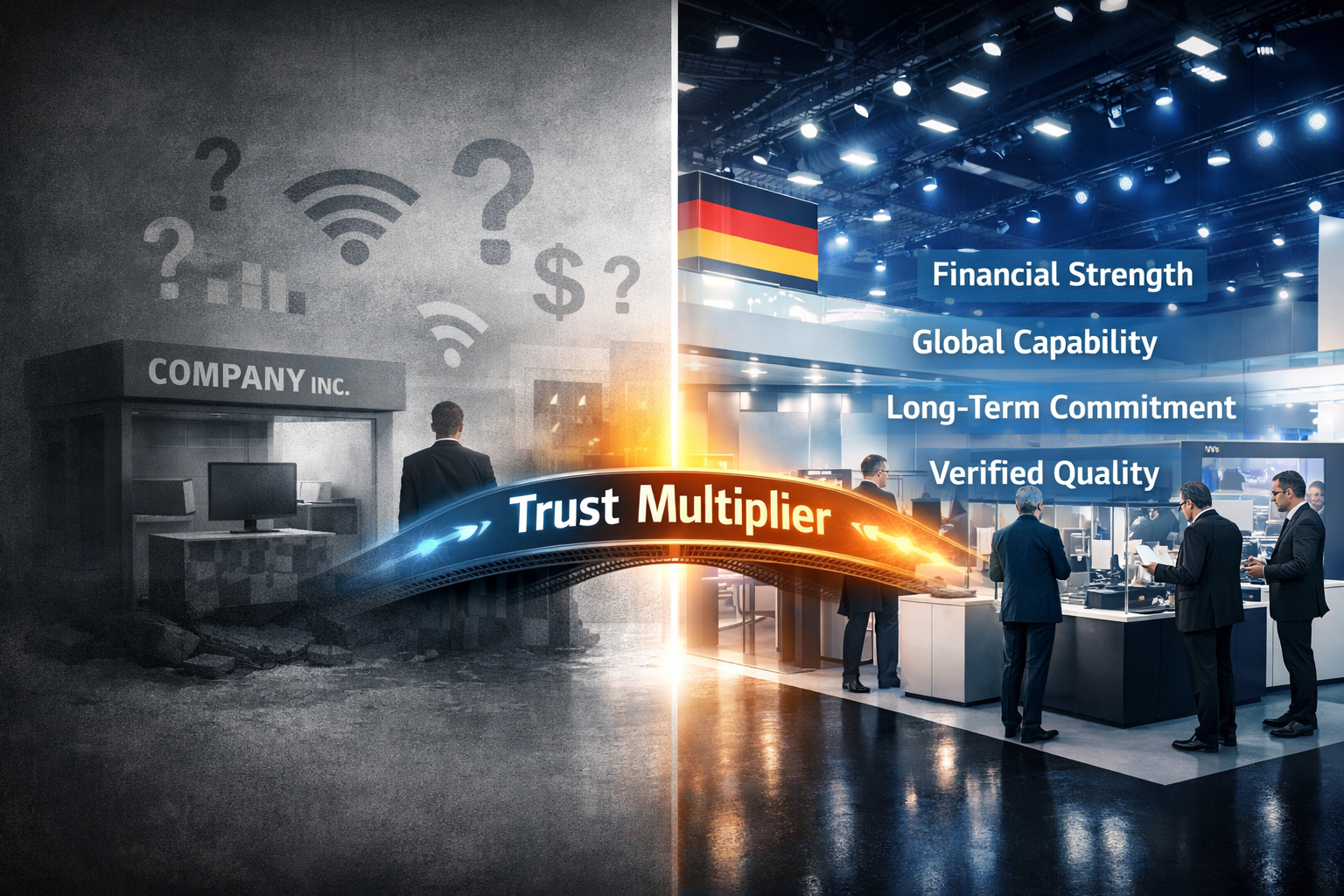
When you exhibit at a major German trade fair, you immediately benefit from the ecosystem’s reputation. Buyers assume you have been filtered, vetted, and approved. This borrowed trust is free — but it is also fragile. You have done nothing to earn it. You are simply standing on the shoulders of Germany’s exhibition infrastructure.

Stage 2: Demonstrated Trust

At the fair, you have the opportunity to convert borrowed trust into demonstrated trust. This happens through consistent messaging, professional booth presentation, knowledgeable staff, and — most importantly — accurate, verifiable responses to buyer questions.

Inconsistency at this stage destroys trust instantly. If your booth claims capabilities your website does not document, if your staff gives contradictory information, if your materials look unprofessional — buyers will conclude that you failed the ecosystem filter and are not a serious partner.

Stage 3: Continuity Trust

This is where borrowed trust becomes earned trust, and where earned trust becomes durable trust. After the fair, you must demonstrate that you are the same company the buyer met. Your digital presence should be active. Your case studies should be current. Your responses should be timely and specific. Your brand should remain visible across the markets that matter to the buyer.

Continuity trust is what separates one-time exhibitors from global brand leaders. It is also what BHOWCO’s 365-Day Visibility Packages are specifically designed to enable — a permanent, credible, verifiable home for your exhibition-earned credibility that works across time zones and decision timelines.

The most important insight about the Trust Transfer Principle is this: trust transfers in, but it also transfers out.

If you are present and consistent, the ecosystem’s credibility flows to you. If you vanish or become inconsistent, your lack of credibility flows back to the ecosystem. Buyers will assume you were never truly qualified. They will question the ecosystem’s filter. And they will not work with you.

Presence is not optional. Continuity is not a luxury. In global B2B procurement, they are the price of entry.


5. Building 365-Day Trust Infrastructure: From Transaction to Relationship

Understanding trust mechanics is valuable. But understanding without action is entertainment, not strategy. You need practical infrastructure that operationalises everything we have discussed.

Here is exactly what 365-day trust infrastructure looks like for international exhibitors using German trade fairs as launchpads.

Infrastructure Element 1: Pre-Fair Trust Signals (Months 3-6 Before)

Before buyers ever board a plane to Germany, they are researching you. Your pre-fair trust signals must answer three questions: Does this company have relevant capabilities? Have they served clients like us? Are they a stable, long-term partner?

Publish case studies from your target markets. Update your certification and compliance documentation. Ensure your search visibility includes partnership keywords, not just product terms. If buyers cannot find credible information about you before the fair, you will not be on their shortlist.

Infrastructure Element 2: During-Fair Trust Confirmation (The 4 Days)

Your booth must confirm what buyers discovered online, not introduce new claims. Consistency is trust. Inconsistency destroys trust. Train your team to answer verification questions, not deliver sales pitches. Provide documentation buyers can take back to their internal validation processes. Capture specific context for intelligent follow-up.

Infrastructure Element 3: Post-Fair Trust Continuity (Months 1-12 After)

This is where most exhibitors fail — and where you will win. Your post-fair trust infrastructure must include:

  • Timely, specific follow-up referencing exact conversation points
  • Continued search visibility that keeps your brand discoverable during the buyer’s 3-9 month internal validation phase
  • Active case study development and publishing that demonstrates ongoing capability
  • A permanent digital home where buyers can verify your claims whenever they need to, not just during exhibition season

Infrastructure Element 4: Cross-Cultural Trust Adaptation

Different buyers trust different signals. Your infrastructure must adapt without becoming fragmented. For German buyers, emphasise documentation and systematic evidence. For European buyers, balance quality demonstration with relationship signals. For Asian buyers, invest in long-term relationship building and face-to-face continuity. For American buyers, highlight ROI evidence and scalability.

The BHOWCO platform provides single infrastructure that supports all four approaches simultaneously, with tiered visibility options from Starter to Authority levels.

Infrastructure Element 5: Measurable Trust Metrics

You cannot improve trust without measuring it. Track: pre-fair discovery rates (percentage of conversations where buyers found you online first), post-fair engagement retention at 30/60/90 days, sales cycle acceleration compared to non-exhibition channels, and international search visibility trends across your target markets.

Trust infrastructure is not optional for international B2B exhibitors. It is the difference between being a vendor and being a partner. Between a transaction and a relationship. Between temporary presence and permanent positioning.


6. The Competitive Advantage of Embedded Trust: Why Most Exhibitors Will Never Achieve This

Let me be direct with you.

Most international exhibitors will never build 365-day trust infrastructure. Not because they lack budget. Not because they lack capability. But because they fundamentally misunderstand what German trade fairs are for.

They treat the fair as an event. They spend months preparing for 4 days. They measure success by booth traffic. They judge ROI by immediate leads. And then they pack up, go home, and disappear until the next fair.

This approach guarantees that they will never achieve durable trust. They will always be starting from zero. They will always be a new face, an unknown quantity, a risk to be evaluated from scratch.

Your opportunity is the opposite.

By building 365-day trust infrastructure, you transform the fair from an event into a checkpoint. You become a known entity. Buyers discover you before they arrive. They verify you during the fair. And they continue to see you for months afterward while your competitors go silent.

When the buyer finally reaches their internal decision point — after 3, 6, or 9 months of evaluation — you are the only one still present. You are the only one who demonstrated continuity. You are the only one who proved that you have the infrastructure, stability, and commitment to be a reliable long-term partner.

This is not a small advantage. This is a decisive competitive moat that most exhibitors will never cross because they are unwilling to think beyond the exhibition calendar.

The German trade fair ecosystem offers you its credibility as a gift. You did not earn it. But you can keep it. You can build on it. You can transform it from borrowed trust into earned trust into durable trust.

Or you can waste it by disappearing after pack-down, just like 90% of your competitors.

The choice is yours. But understand clearly: in global B2B procurement, trust is not awarded to the loudest booth. Trust is awarded to the most consistent presence. The brands that win are the brands that never leave.


Frequently Asked Questions

1. Why do international buyers trust German trade fairs more than other exhibitions?

Germany has built the world’s most rigorous exhibition ecosystem over decades. The AUMA sets and enforces quality standards. Major German fairs attract genuinely international audiences. Buyers trust the ecosystem filter because it has consistently delivered reliable suppliers. This trust is portable — once a buyer trusts the German fair system, they extend that trust to exhibitors who meet its standards.

2. How long does it take to build international buyer trust through German fairs?

Trust is built in layers. Borrowed trust from the ecosystem is immediate but fragile. Demonstrated trust at the fair takes one exhibition cycle. Continuity trust — the durable trust that wins long-term contracts — typically requires 6-12 months of consistent 365-day visibility after your first fair. The key insight is that most competitors never reach continuity trust, so even modest consistency gives you a significant advantage.

3. Can I build trust with Asian and American buyers using the same approach?

Not exactly the same, but compatible. Asian buyers prioritise relationship continuity and long-term commitment signals. American buyers prioritise ROI evidence and scalability. Your 365-day infrastructure can serve both by maintaining consistent presence (Asian trust signal) while publishing ROI-focused content (American trust signal). The common denominator is continuity. Different buyers interpret the same continuity through different cultural lenses.

4. What destroys international buyer trust most quickly at German fairs?

Three things: inconsistency between your digital presence and booth messaging, aggressive selling instead of verification support, and generic follow-up that shows no understanding of the buyer’s specific situation. The fastest trust destroyer is post-fair silence. Buyers interpret disappearance as instability, and instability is the opposite of what global procurement needs.

5. How does BHOWCO help build international buyer trust beyond the fair?

BHOWCO provides permanent, verifiable infrastructure for your exhibition-earned credibility. Your 365-day profile serves as the evidence base buyers need during their internal validation phase. It keeps you visible across time zones and decision timelines. It transforms your 4-day booth presence into a year-round trust asset. Traditional directories expire or become outdated. BHOWCO’s strategic framework is designed specifically for continuity trust.

6. What is the single most important action for building trust at my next German fair?

Start your pre-fair visibility 3-6 months before the event. Publish case studies from your target markets. Ensure your digital presence answers buyer verification questions. Enter the fair as a known entity, not an unknown. Then, after the fair, maintain consistent visibility during the 3-9 month internal validation phase. Most exhibitors do neither. Doing both will automatically put you in the top 10% of trusted suppliers.


International buyer trust is not mysterious. It is structural.

Buyers trust German trade fairs because the ecosystem has earned that trust over decades. They trust exhibitors who meet the ecosystem’s standards. And they continue trusting exhibitors who demonstrate continuity after the fair ends.

The question is not whether you can build this trust. The question is whether you will invest in the infrastructure required to maintain it.

Your competitors will choose the easy path. They will focus on the 4 days. They will disappear. They will start from zero at every fair.

You can choose differently. You can build 365-day trust infrastructure that compounds with every exhibition. You can become the brand buyers trust because you never left.

Explore how year-round exhibitor visibility builds international buyer trust that outlasts any single trade fair.

Understand German buyer decision logic
Build your 365-day trust infrastructure

5 1 vote
Article Rating
Subscribe
Notify of
0 Comments
Oldest
Newest Most Voted
Inline Feedbacks
View all comments