Latest Insights
Germany Is Not Your Market, It’s Your Global Brand Launchpad


Germany as Global Brand Launchpad – Why the “German Market” Trap Destroys International ROI
You invested significant budget in a booth at Messe Frankfurt. Your team brought brochures in multiple languages. You trained your staff for weeks. You collected many business cards from decision-makers across Europe, Asia, and the Americas.
Now, months later, only a fraction of those contacts remember your name. Follow-up emails went unanswered. Internal meetings at prospect companies stalled. And despite your exhibition investment, your pipeline looks nearly identical to before the fair.
You didn’t fail at selling. You failed at positioning.
Most international exhibitors make a critical strategic error that costs them hundreds of thousands in lost opportunity: they treat Germany as a final market. They localize their messaging for German buyers. They measure success by German booth traffic. They assume the German market is their target.
This is a fundamental misunderstanding of how global B2B buyers actually use German trade fairs.
Germany was never your market. Germany was never the destination. Germany is your global brand launchpad.
The brands that win aren’t the ones with the biggest booths or the flashiest giveaways. They understand a deeper truth that escapes most exhibitors: German trade fairs are global credibility engines, not local selling opportunities. What happens on the fairgrounds in Düsseldorf, Frankfurt, or Munich sends an immediate signal to buyers in Shanghai, Chicago, Mumbai, and São Paulo.
This article will transform how you think about German exhibition participation. You will learn why the “German market” trap destroys international ROI, how the Trust Transfer Principle converts temporary visibility into lasting credibility, and exactly how to build a 365-day positioning strategy that leaves your invisible competitors behind.
1. The Strategic Mistake: Why the “German Market” Trap Destroys International ROI
The global exhibition industry has a dirty secret that no one talks about. Most exhibitors burn a significant portion of their annual B2B marketing budget on a timeline that represents a small fraction of the buyer’s actual decision journey.
Let me be more specific. International B2B buyers evaluating potential partners, suppliers, or technology vendors operate on extended decision cycles. This timeline includes initial research, capability verification, internal validation, cross-functional alignment, compliance review, and finally, contract negotiation.
A German trade fair lasts a few days. That is a tiny fraction of the buyer’s decision timeline.
Now ask yourself honestly: why would you concentrate so much of your international marketing budget on such a small window?
The answer is psychological, not strategic. Exhibitors feel pressure to “do something big” for the fair. They invest in larger booths, better locations, more staff, and expensive giveaways. These investments feel productive in the moment. But they create a dangerous illusion of progress while leaving the rest of the buyer’s journey completely uncontested.
Here is what actually happens to exhibitors who treat Germany as a market rather than a launchpad:
- The “Booth Only” Trap: You buy premium visibility for a few days. But visibility without continuity is not trust-building. It is performance art. Buyers see you, then forget you.
- The “German First” Fallacy: You translate your website, brochures, and pitch into German. But the buyers who truly matter for global expansion aren’t German. They are international procurement teams who flew in from around the world specifically because German trade fairs act as global aggregation points.
- The Vanishing Act: You dismantle your booth, fly home, and go silent for months while you “recover” from exhibition season. Buyers interpret this silence as instability, lack of global infrastructure, or worse — a company that couldn’t convert booth conversations into actual capability.
Germany was never your final destination. Germany was always your springboard to global credibility. But most exhibitors use a rocket ship as a parking lot. They park their brand in a premium German exhibition space for a few days, then drive it back to obscurity.
The strategic shift you need is simple to understand but difficult to execute: stop measuring success by what happens at the fair and start measuring by what happens in the months after the fair ends.
2. The Trust Transfer Principle: How German Trade Fairs Lend You Global Credibility
Why does a global buyer trust a company simply because they exhibit at Hannover Messe, MEDICA, or Automechanika Frankfurt?
The answer is not obvious, and understanding it changes everything about your exhibition strategy.
Germany has spent decades building the world’s most rigorous, respected, and selective exhibition ecosystem.
The “Made in Germany” reputation
for quality, precision, and reliability — a well-documented phenomenon in international marketing research known as the country-of-origin effect — extends beyond manufactured goods.
It applies to the trade fair floor itself.
When a global buyer sees your brand at a major German trade fair, they unconsciously apply a mental shortcut. They assume, often correctly, that you have passed through a meaningful filter. You didn’t just buy a booth at any event. You invested capital, resources, and strategic attention to participate in one of the world’s most demanding B2B environments.
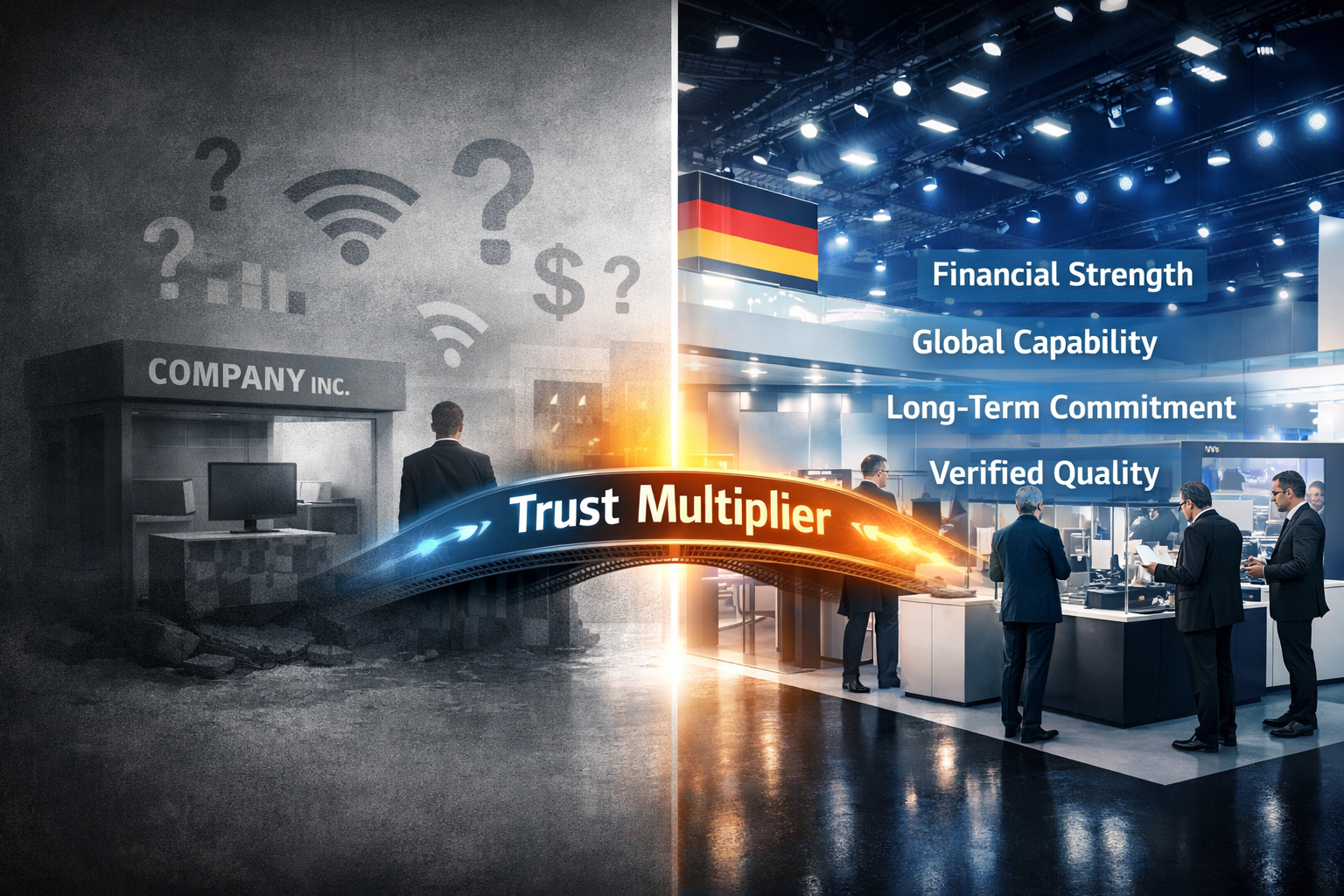
This is what I call The Trust Transfer Principle.
Stage 1: Filtering
German trade fair organisers maintain high standards. They curate exhibitors. They enforce quality expectations. Buyers know this. When you appear on the floor plan, you have already been pre-vetted by an ecosystem known for rigor.
Stage 2: Association
Your booth sits alongside global market leaders, established suppliers, and innovative startups. This physical proximity creates cognitive association. Buyers mentally group you with the credible companies around you. You borrow reputation without paying for it — except through your presence.
Stage 3: Portability
Trust established at a German trade fair is not geographically limited. The buyer from Shanghai who saw you in Frankfurt doesn’t view you as “good for Germany.” They view you as a verified international player. That trust travels home with them. It applies to your capabilities in Asia, the Americas, Africa, and the Middle East.
Here is the blind spot most exhibitors never see: trust transfers in, but it also transfers out.
If you vanish after the fair — if your digital presence goes silent, if your website stops updating, if your social channels go dark — buyers draw a devastating conclusion. They assume your silence signals something deeper. Perhaps you lacked the long-term capability to sustain international relationships. Perhaps the booth was a facade. Perhaps you are not a serious global partner after all.
Absence after presence is not neutral. In global B2B psychology, it is actively negative. Buyers interpret it as inconsistency, and inconsistency is the enemy of trust.
As explained in the 365-Day Visibility System: “Silence after the fair is not neutral. It signals lack of commitment to the relationship.” The buyers who trusted you at the fair will quietly remove you from consideration if you cannot demonstrate the same presence when the exhibition halls are empty.
3. From Short-Term Visibility to Year-Round Positioning: The Three-Phase Framework
Companies that successfully use Germany as a global brand launchpad don’t do anything magical. They don’t have infinite budgets or celebrity spokespeople. They simply extend their timeline. They understand that the fair is not an isolated event — it is one phase within a continuous, year-round positioning cycle.
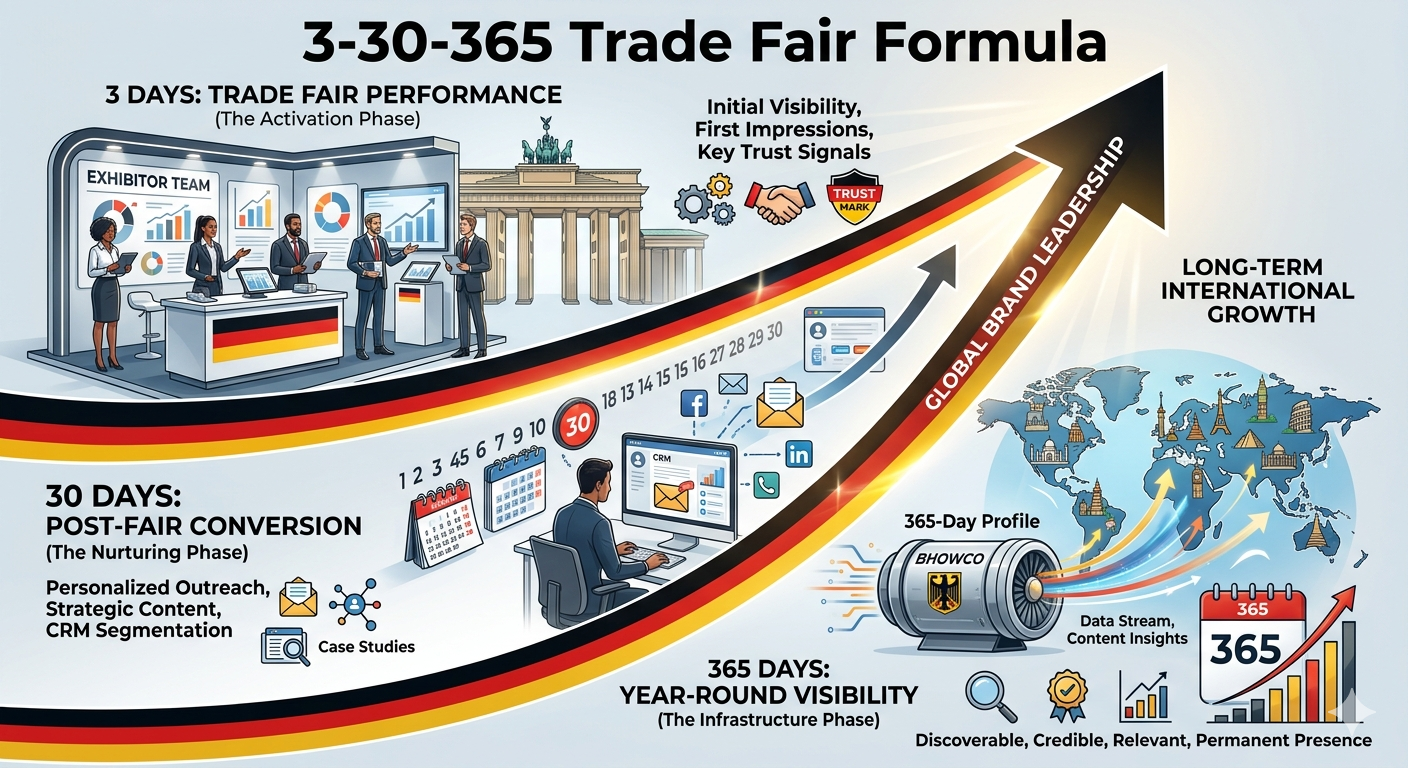
Here is the exact three-phase framework used by sophisticated international exhibitors who consistently outperform their competitors:
Phase 1: Pre-Fair Positioning (Months Before the Fair)
Most exhibitors start planning close to the fair. They book travel, order booth materials, and schedule staff. By then, it is already too late.
Global buyers begin their research well before the fair. They identify potential partners. They compare capabilities. They build a shortlist of companies to visit before they ever board a plane to Germany.
If you are not visible during this research window, you enter the fair at a significant disadvantage. You are not on the shortlist. You are an unknown quantity. Buyers may visit your booth if they have time, but you are not a priority.
What pre-fair positioning actually requires:
- Search visibility for partnership keywords (not just product terms). Buyers search for “industrial sensor supplier Europe” not “buy sensor now.”
- Content that demonstrates global capability. Case studies from multiple regions. Testimonials from international clients. Evidence of cross-border operations.
- Consistent digital presence across the markets you target. If you want buyers from Asia to trust you, they need to see you active during their business hours, in their language contexts, addressing their specific challenges.
Companies with strong pre-fair positioning enter German trade fairs as “known entities.” Buyers arrive at their booths already partially convinced. The booth conversation simply confirms what the buyer already discovered online.
Phase 2: During-Fair Activation (The Exhibition Days)
Your booth at the fair serves one purpose and one purpose only: confirmation, not persuasion.
Global buyers at German trade fairs are not there to be sold. They are there to validate. They want to verify that the company they researched online actually exists. They want to meet the people behind the website. They want to assess the intangible signals — professionalism, responsiveness, cultural fit — that no digital presence can fully convey.
What during-fair activation requires:
- Consistency between your digital presence and your physical booth. Your messaging, branding, and value proposition must match exactly. Inconsistency signals amateurism or worse — deception.
- Conversations focused on partnership, not products. Buyers don’t need another feature walkthrough. They need to understand how you will reduce their risk, improve their supply chain, or accelerate their market entry.
- Systems for capturing context, not just contacts. The companies that win don’t just scan badges. They record what was discussed, what the buyer’s specific challenges are, and what follow-up would actually help the buyer’s internal decision process.
Warning: what destroys credibility instantly at the fair is aggressive selling. In global B2B, high pressure is interpreted as desperation. Desperation signals low market demand. Low market demand signals poor capability. You lose trust in seconds.
Phase 3: Post-Fair Continuity (Extended Period After the Fair)
This is where most exhibitors fail completely.
The fair ends. The booth comes down. The staff fly home. And then… silence. For weeks or months, nothing happens. Buyers who had promising conversations wait for follow-up that never comes. Or worse, they receive generic emails that add no value and demonstrate no understanding of their specific situation.
Meanwhile, the buyer’s internal decision process continues. They research alternatives. They compare options. They build consensus internally. And you are nowhere to be found.
What post-fair continuity actually requires:
- Timely, specific follow-up that references exact conversation points. Not “nice to meet you” but “you mentioned concerns about delivery timelines to Southeast Asia — here is how we solved this for a similar client.”
- Continuous year-round visibility that keeps your brand present during the long months of internal deliberation. Buyers need to see you active, publishing insights, winning new clients, expanding capabilities. This doesn’t require daily content. It requires consistent, credible signals that you remain a serious global player.
- A permanent digital home for your exhibition-earned credibility. This is exactly why BHOWCO built its global brand infrastructure. Not as an advertising directory, but as a permanent asset where buyers can verify your capabilities, see your case studies, and confirm your global presence whenever they need to — not just during exhibition season.
The gap between Phase 2 and Phase 3 is where most international ROI dies. Close that gap, and you automatically outperform most of your competitors.
4. The Competitive Advantage: Your Competitors’ Invisibility Is Your Opportunity
This section contains the strategic insight that changes everything about how you should think about German trade fairs.
Your competitors are also at the fair. They also have nice booths. Their brochures are also glossy. Their giveaways are also clever. On the surface, during those few days, everyone looks roughly equal.
But here is what almost no exhibitor realizes: many of them will disappear completely after pack-down.
They will go silent for months. Their websites will stagnate. Their social channels will go dark. Their follow-up will be generic or non-existent. They will treat the fair as an isolated transaction rather than a relationship beginning.
While your competitors vanish, you have a choice.
You can continue to appear in search results. You can publish insights that demonstrate your expertise. You can maintain active case studies that prove your global capability. Your brand can remain visible across European, Asian, and American time zones.
Months after the fair, when the buyer has finally aligned internal stakeholders and secured budget and is ready to sign a contract — who do you think they will call?
They will call the brand that never left.
Not because you had the best giveaway. Not because your booth was the biggest. But because you were the only one still present when they were finally ready to buy.
In global B2B, absence is not neutral. It is interpreted actively as:
- Lack of financial stability (if you can’t afford year-round presence, are you a reliable long-term partner?)
- Lack of long-term commitment (if you disappear after the fair, will you disappear after the contract is signed?)
- Lack of global infrastructure (if you can’t maintain international visibility, can you truly support international clients?)
Presence, by contrast, is interpreted as reliability, scale, partnership readiness, and global capability. Every day you remain visible while your competitors go dark, you build a compounding advantage that no amount of booth spending can overcome.
This is how global procurement actually works. Buyers need to reduce risk. Visible suppliers are perceived as lower risk. Invisible suppliers are perceived as higher risk. The decision is evolutionary, not strategic. Your job is to make it easy for the buyer to choose you by simply being there when others are not.
5. Building Your 365-Day Global Brand Infrastructure
You now understand the strategic mistake, the trust transfer principle, the three-phase framework, and the competitive advantage of persistence. The only remaining question is practical: how do you actually build the infrastructure required for year-round global brand positioning?
The answer depends on your current capabilities, but the core components are consistent across all successful international exhibitors.
Component 1: A Permanent Digital Home for Your Exhibition Credibility
Your website is not enough. Generic corporate sites don’t communicate exhibition expertise. You need dedicated infrastructure that signals to global buyers: “We are serious about German trade fairs as part of our global strategy.” This includes exhibition-specific case studies, pre-fair content, post-fair follow-up systems, and continuous visibility across the markets that matter to you.
Component 2: Pre-Fair Content That Attracts the Right Buyers
Well before your next German trade fair, you should publish content specifically designed for international buyers’ research phase. This includes white papers on industry challenges, case studies of successful cross-border partnerships, and educational material that demonstrates your expertise without asking for anything in return.
Component 3: During-Fair Systems That Capture Context, Not Just Contacts
Your booth staff needs simple, repeatable systems for recording what matters. Not just company names and emails, but specific challenges, timeline expectations, decision criteria, and personal context that enables intelligent follow-up.
Component 4: Post-Fair Continuity That Outlasts Your Competitors
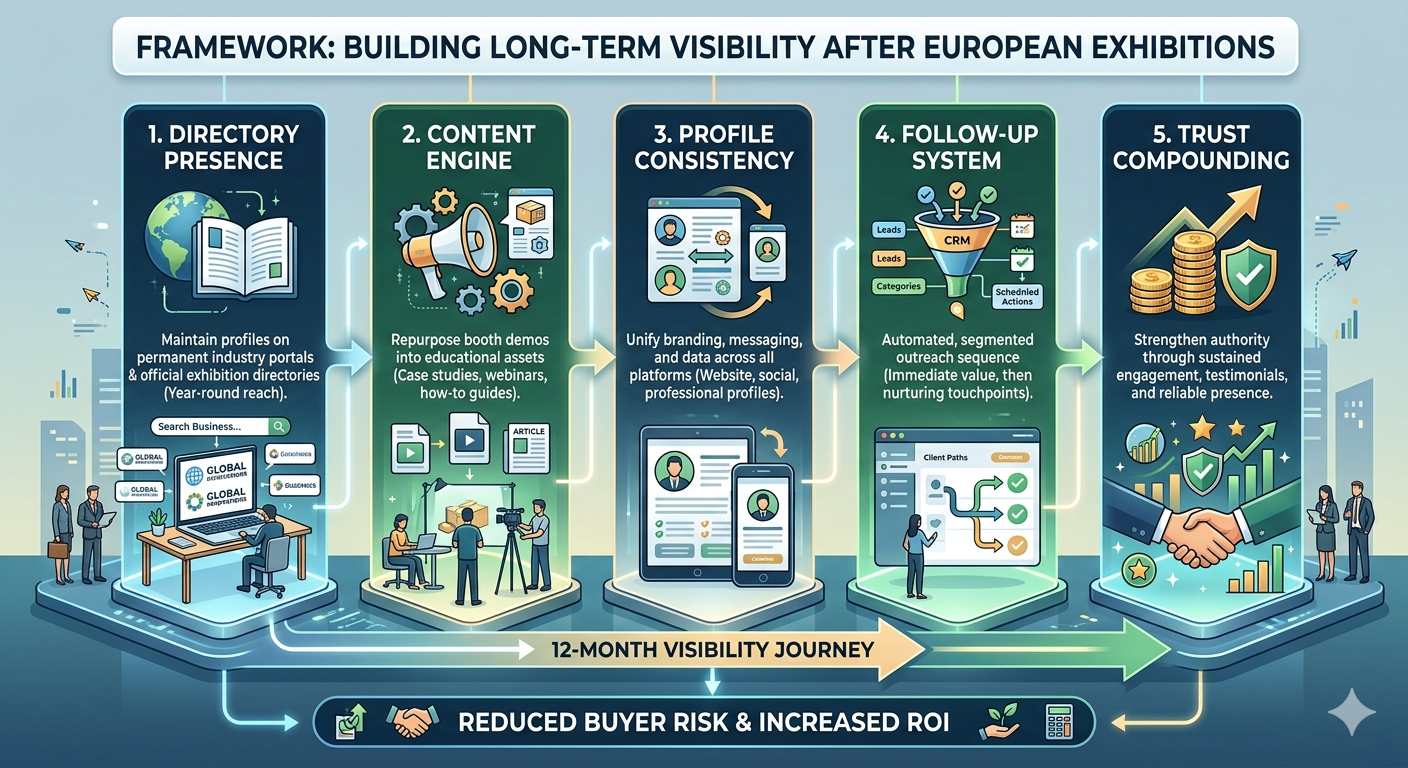
Automated but personalised follow-up sequences. Continuous publishing of relevant insights. Active case study development from exhibition conversations. And most importantly, sustained search visibility that ensures your brand remains discoverable throughout the buyer’s extended decision cycle.
Component 5: Year-Round Visibility Metrics That Measure What Matters
Stop measuring success by booth traffic or business cards collected. Start measuring by: international search visibility trends, qualified lead volume from target regions, post-fair engagement retention at intervals, sales cycle acceleration compared to non-exhibition channels, and the growth of your global referral network.
The 365-Day Visibility System was built specifically to provide this infrastructure for international exhibitors who want to use Germany as a launchpad rather than treating it as a market. It transforms temporary exhibition participation into permanent global positioning.
6. Measuring Success: KPIs That Actually Predict Global Growth
You cannot improve what you do not measure. But most exhibitors measure the wrong things. Booth traffic, brochure distribution, and business card counts are vanity metrics. They feel good in the moment but predict almost nothing about long-term international success.
If you are serious about using Germany as a global launchpad, you need to track KPIs that actually correlate with export growth, buyer trust, and international market expansion.
KPI 1: Pre-Fair Discovery Rate
What percentage of your exhibition conversations started with the buyer saying “we found you online before the fair”? If this number is low, your pre-fair positioning needs work. If it is high, you have a significant competitive advantage.
KPI 2: Post-Fair Engagement Retention
Track how many exhibition contacts remain engaged at intervals after the fair. If you can maintain meaningful retention, you will dramatically outperform your competitors.
KPI 3: Sales Cycle Acceleration
Compare the time-to-decision for buyers who discovered you at a trade fair versus other channels. In most B2B sectors, trade fair-sourced deals close faster because initial trust is already established. If your fair-sourced deals are not closing faster, your post-fair continuity is broken.
KPI 4: International Search Visibility Trends
Track your organic search visibility in target markets (Europe, Asia, Americas) over time. Growth in international search visibility is a leading indicator of future export revenue. Stagnation or decline predicts the opposite.
KPI 5: Global Referral Network Growth
Measure how many new market introductions, partnership inquiries, or inbound collaboration requests you receive from your exhibition activity. These are the highest-value outcomes because they compound over time.
The companies that consistently win at international expansion don’t just exhibit in Germany. They use German trade fairs as accelerators within a year-round global positioning strategy. And they measure what actually matters.
Frequently Asked Questions
What is the minimum investment required for 365-day global brand positioning?
The investment varies by industry and target markets, but the strategic principle is consistent: you should allocate at least as much budget and attention to pre-fair and post-fair activity as you allocate to the fair itself. The companies that fail are the ones who spend everything on the exhibition days and nothing on the visibility infrastructure that extends that investment across the rest of the year.
How long does it take to see results from 365-day visibility?
Most exhibitors see measurable improvements in pre-fair discovery rates within months. Post-fair engagement retention typically improves within the first complete exhibition cycle. Full ROI impact on international revenue usually appears in subsequent exhibition cycles, as the compounding effects of persistent visibility accumulate. This is a long-term asset, not a short-term tactic.
Can small or mid-sized companies compete with enterprise budgets?
Yes, and this is one of the most important insights in global B2B. Large enterprises have brand awareness but often suffer from fragmented, inconsistent post-fair follow-up. Small and mid-sized companies that execute a focused, consistent year-round strategy can absolutely outperform larger competitors who vanish after the fair. Consistency beats budget in post-exhibition engagement.
How does BHOWCO differ from traditional exhibition directories?
Traditional directories are static listings that expire or become outdated. They provide no strategic guidance, no visibility infrastructure, and no continuity between exhibitions. BHOWCO is a year-round visibility ecosystem that helps you maintain continuous presence before, during, and after German trade fairs. It transforms temporary exhibition participation into permanent global positioning infrastructure.
Which German trade fairs are best for global brand launchpad strategy?
The best fairs are those with significant international attendance in your specific industry sector. Hannover Messe (industrial technology), MEDICA (medical technology), Automechanika (automotive), IFA (consumer electronics), and Ambiente (consumer goods) are classic examples, but the right fair depends entirely on your target buyers. Research the international attendance patterns before committing.
How do I convince internal stakeholders to invest in 365-day visibility?
Show them the math. Most exhibition budgets are approved based on short-term pipeline expectations. But the long-term ROI of persistent positioning compounds while competitors vanish. Calculate the cost of lost opportunities from post-fair silence — buyers who were interested but forgot you, buyers who chose competitors who stayed visible, buyers who assumed your silence indicated instability. Then compare that to the investment in year-round infrastructure.
Germany was never your final destination. It is your takeoff runway.
The question is not whether you exhibit in Germany. The question is whether you disappear after the fair — or whether you use it to build permanent international credibility that compounds year after year.
Your competitors will choose the easy path. They will spend everything on short-term visibility. They will go silent. They will start from zero at the next fair.
You can choose differently. You can build infrastructure that turns each exhibition into a permanent asset. You can remain visible while others vanish. You can win the long game of global B2B trust.
Explore how year-round exhibitor visibility strengthens global buyer trust and accelerates international growth.
→ Discover the 365-Day Visibility System
→ Build your global brand infrastructure