Latest Insights
Why 4 Days at a Trade Fair Are Not Enough for Global Positioning


Trade Fair Positioning Strategy – 4 Days Are Not Enough
Four days. That is all you get. Ninety-six hours. From the moment the exhibition opens to the moment the last buyer leaves the hall.
In those four days, you can impress. You can inform. You can collect business cards. You can have conversations that feel productive and promising.
But here is the truth that most exhibitors refuse to accept: four days are completely insufficient for a trade fair positioning strategy.
Not because your booth is inadequate. Not because your team is unprepared. Not because your products are uncompetitive.
Because of something far more fundamental and far less controllable: human memory decay.
Within weeks of the fair ending, most buyers will have forgotten the details of your conversation. Within months, many will have forgotten your brand entirely. When procurement decisions are finally made, you will be invisible — not because you failed at the fair, but because you failed at everything that came after.
This article reveals the psychology of buyer memory decay, why four days cannot overcome natural forgetting curves, and the post-exhibition strategy that maintains brand recall across the full procurement cycle. A strong trade fair positioning strategy requires continuity, not just presence.
The Psychology of Buyer Memory Decay: Why Forgetting Is Inevitable
To understand why four days are not enough, you must first understand how human memory actually works.
The Forgetting Curve
Psychological research has consistently demonstrated that without reinforcement, human memory decays exponentially within the first days and weeks after learning.
The forgetting curve shows that within hours of learning, a significant portion of new information is forgotten. Within days, forgetting accelerates. Within weeks, without reinforcement, most specific details are lost.
This is not a flaw in your booth presentation. This is how human brains work. Your carefully crafted value proposition, your compelling case studies, your memorable booth experience — all of it decays along the forgetting curve unless you intervene strategically.
Why Trade Fair Memories Are Particularly Vulnerable
Trade fairs are information-dense environments. Buyers meet dozens or hundreds of exhibitors in a single day. They attend presentations. They collect brochures. They scan QR codes. They have back-to-back conversations.
This cognitive overload accelerates forgetting. The brain cannot prioritise which information to retain when everything feels equally urgent. Without reinforcement, most trade fair interactions are lost within days, not weeks.
The Interference Effect
After the fair, buyers return to their normal work environments. They answer emails. They attend internal meetings. They solve problems unrelated to your product category. Each new piece of information interferes with the retention of what they learned at the fair.
This interference effect means that your exhibition investment is actively competing with the buyer’s daily work for memory space. And the buyer’s daily work usually wins.
The Verbatim vs. Gist Distinction
Memory research distinguishes between verbatim memory (exact details) and gist memory (general impression). Trade fair interactions primarily create gist memory — a vague sense that “we met someone interesting.” Verbatim memory of your specific claims, pricing, or differentiators decays almost immediately.
This is why buyers often remember meeting you but cannot remember what you actually do. Your gist memory survived. Your verbatim memory did not.
The implication is clear: if you rely solely on the 4-day fair experience, you are relying on a memory system that is designed to forget you. Strategic reinforcement is not optional. It is required by the biology of the human brain.
The 4-Day Illusion: Why Exhibition Presence Feels More Valuable Than It Is
If four days are not enough, why do exhibitors continue to believe they are?
The answer lies in a psychological bias called the availability heuristic. When something feels vivid and immediate, we overestimate its importance and durability.
The Vividness Trap
During the fair, everything feels significant. The energy is high. The conversations are engaging. The booth is crowded. This vividness creates an illusion of impact. Exhibitors leave the fair believing they have made lasting impressions.
But vividness does not predict durability. The most emotionally intense fair conversation decays just as fast as the most mundane one without reinforcement. Feelings are not memory. Energy is not retention.
The Recency Illusion
The fair is the most recent thing you have done. Your team is still debriefing. The follow-up list is still being processed. The energy has not yet dissipated. This recency creates the illusion that the fair’s impact will persist.
Buyers, however, have already moved on. Their recency is different. They are back at their desks, dealing with their own priorities. The fair is already fading into the past for them, even as it remains present for you.
The Effort Justification Bias
You invested significant budget in the fair. Your team worked for months. Your organisation devoted significant attention. This investment creates psychological pressure to believe the effort was worthwhile.
Believing that four days are enough is emotionally comforting. Accepting that four days are insufficient requires uncomfortable changes to budget, strategy, and infrastructure. Most exhibitors choose comfort over effectiveness.
The Metric Mismatch
Exhibitors measure what is easy, not what matters. Booth traffic is easy to count. Business cards are easy to collect. Conversation counts are easy to record.
These metrics create the illusion of success. But they do not measure memory retention. They do not measure brand recall. They do not measure whether buyers will remember you when procurement decisions are being made.
As the 365-Day Visibility System explains: “You can buy visibility for 3 days at Messe Frankfurt. Credibility takes 365.” The 4-day illusion convinces exhibitors that visibility equals credibility. It does not. Visibility without continuity is forgotten. A trade fair positioning strategy requires continuity, not just presence.
The Post-Exhibition Strategy Framework: From Memory Decay to Brand Recall
If memory decay is inevitable without reinforcement, the solution is not to fight biology. The solution is to work with it through strategic post-exhibition continuity.
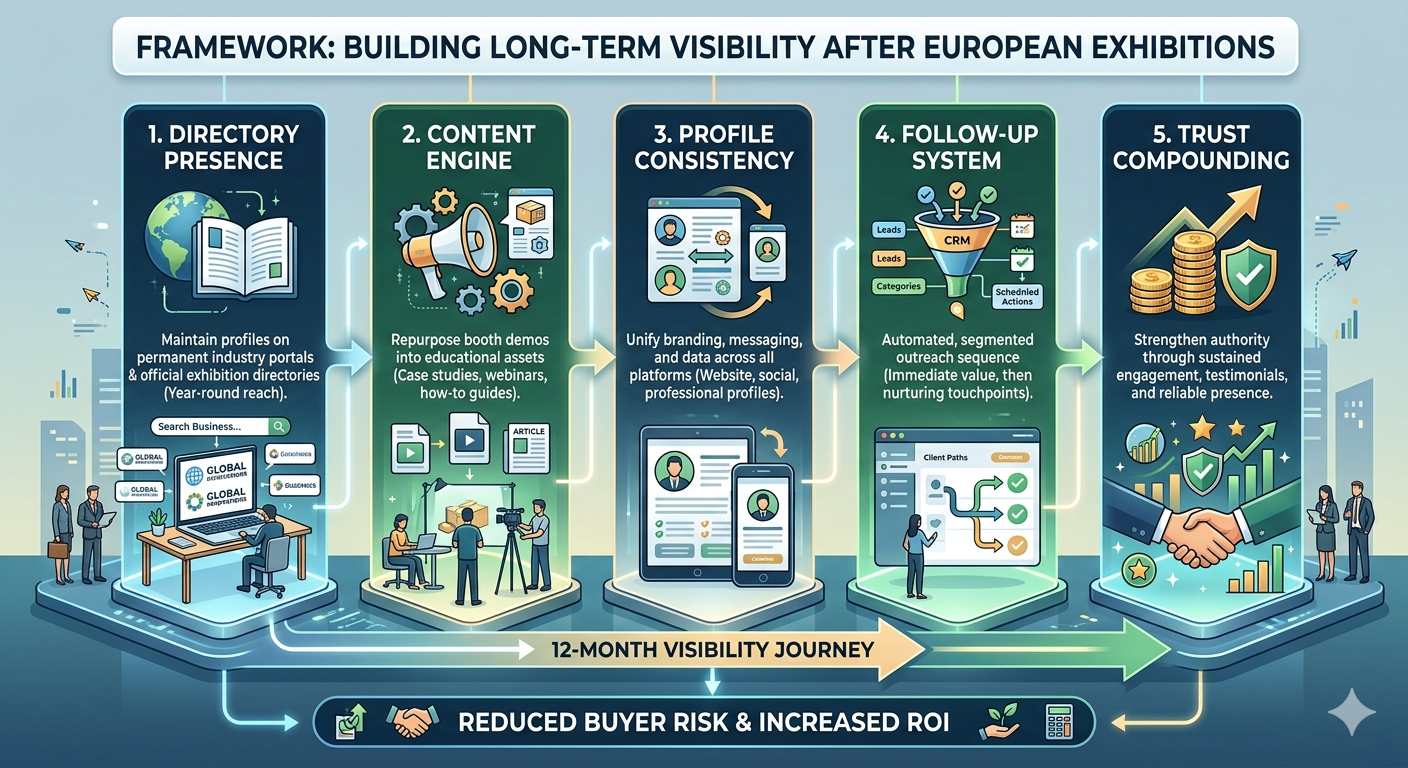
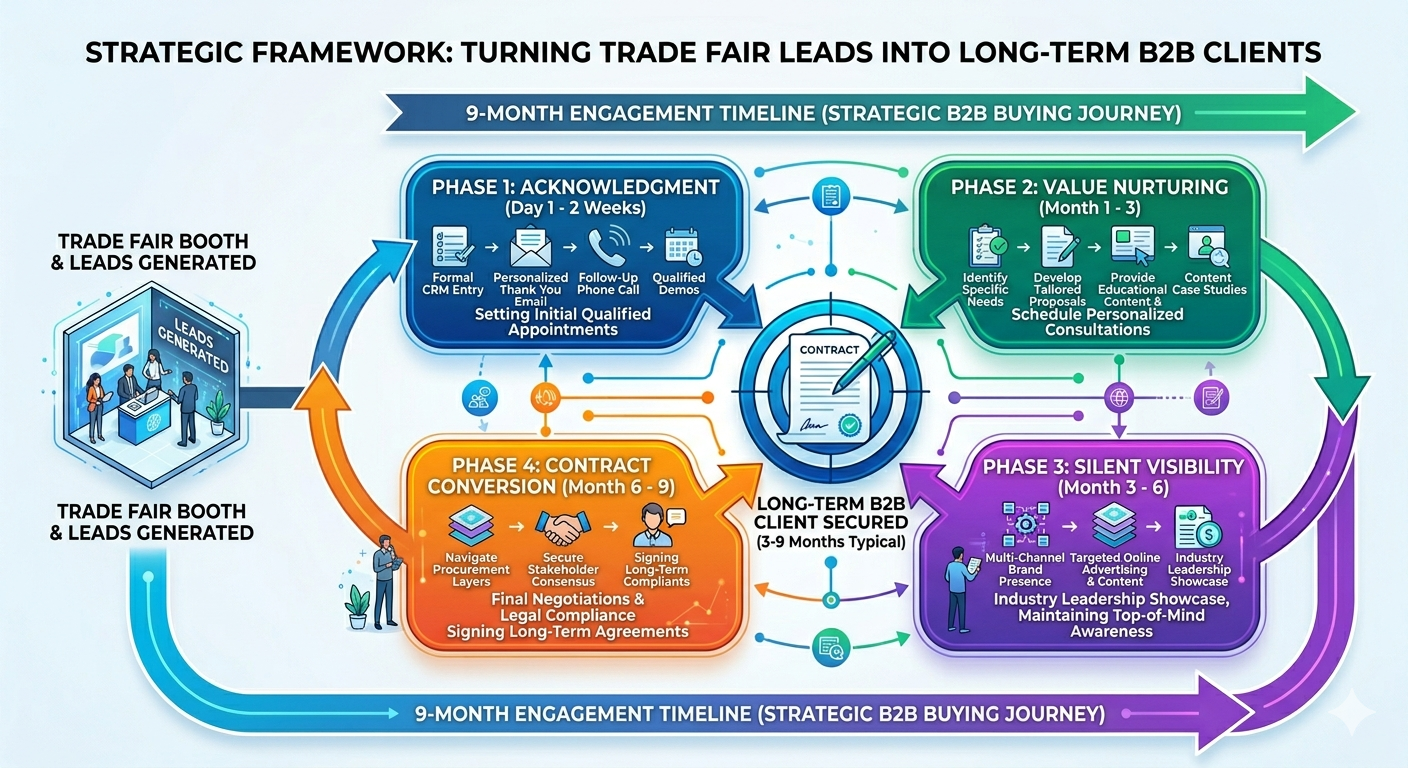
The post-exhibition strategy framework consists of four reinforcement phases, each designed to reset the forgetting curve and maintain brand recall across the procurement cycle.
Phase 1: Immediate Reinforcement (Days After the Fair)
Within days of the fair ending, buyers need to hear from you. Not generic “nice to meet you” emails. Personalised reinforcement that references specific conversation points, answers questions raised at the booth, and provides value that extends beyond the fair interaction.
Strategic objective: Reset the forgetting curve before significant decay occurs. Capture the buyer’s attention while the fair is still recent memory. Demonstrate that you were paying attention and that you care about their specific situation.
Phase 2: Value Reinforcement (Weeks After the Fair)
In the weeks following initial contact, provide ongoing value that does not ask for anything in return. Relevant case studies. Industry insights. Documentation that supports internal validation. Each touchpoint resets the forgetting curve and builds trust through demonstrated expertise.
Strategic objective: Keep your brand present during the early stages of internal evaluation. Provide evidence that buyers can use to champion your solution inside their organisations.
Phase 3: Authority Reinforcement (Months After the Fair)
As the buyer’s internal validation process intensifies, your brand needs to be discoverable through multiple channels. Search visibility. B2B directory presence. Published case studies. Active social profiles. Each channel provides another opportunity for buyers to find and verify your credibility.
Strategic objective: Be findable when buyers actively research options during their decision window. Do not rely on them remembering to reach out to you. Ensure they can find you when they are ready.
Phase 4: Continuity Reinforcement (Extended Period)
The procurement cycle extends over many months. Your reinforcement cannot stop early. Permanent 365-day visibility infrastructure ensures your brand remains discoverable, credible, and trusted when buyers finally make decisions.
Strategic objective: Outlast the competition. Most exhibitors disappear early. Be the brand that is still visible when buyers are ready to decide.
The BHOWCO 365-Day Profile provides Phase 4 infrastructure. It ensures your brand remains discoverable across the full procurement cycle, not just during the immediate post-fair window.
Exhibitors who implement all four phases maintain brand recall at dramatically higher levels than those who stop after Phase 1. The forgetting curve is not destiny. It is a pattern you can strategically interrupt.
Brand Recall vs. Brand Recognition: Why Buyers Must Remember You Without Cues
To understand the importance of post-exhibition strategy, you must distinguish between two different types of memory: recognition and recall.
Recognition is passive. A buyer sees your logo or your booth and remembers meeting you. Recognition is relatively easy to trigger. It requires a cue — your brand appearing in the buyer’s environment.
Recall is active. A buyer thinks of your brand without any external cue. They are sitting in an internal procurement meeting, discussing potential suppliers, and your name comes to mind unprompted. Recall is much harder to achieve — and much more valuable.
Why Recall Matters More for Global B2B
Procurement decisions are rarely made alone. They involve committees, cross-departmental stakeholders, and multiple rounds of evaluation. If buyers can only recognise your brand with a cue, you will not be discussed when you are not in the room.
Recall ensures that your brand is part of the conversation even when you are not present. Your name comes up in internal meetings. Your capabilities are compared to other options. Your credibility is debated — favourably, because recall is associated with trust.
How 4 Days Fail to Create Recall
Four days of exhibition presence are sufficient for recognition. Buyers who saw your booth will recognise your logo for a period of time. But recognition decays faster than recall and requires constant cues to maintain.
Recall requires repetition, reinforcement, and meaningful association across time. It cannot be built in four days. It requires a post-exhibition strategy that maintains presence across the full procurement cycle.
The Recall Advantage of 365-Day Visibility
Exhibitors with 365-day visibility infrastructure create multiple opportunities for recall. Buyers see their brand in search results. They encounter their content while researching. They find their profiles on credible B2B directories. Each encounter builds recall without requiring active outreach.
As the German Buyer Behavior guide notes, “German trade fairs are global networking hubs where you can connect with decision-makers from around the world.” But connection is not enough. Recall is what converts connection into contract.
The question is not whether buyers recognised you at the fair. The question is whether they will recall you months later when procurement decisions are being made. Four days cannot answer that question positively. Only strategic continuity can.
Visibility Psychology: Why Presence Signals Stability and Absence Signals Risk
Memory decay is not the only reason four days are insufficient. There is also the psychology of how buyers interpret visibility itself.
Visibility as a Heuristic for Stability
In global B2B procurement, buyers use visibility as a mental shortcut. Brands that are consistently visible are assumed to be stable, successful, and reliable. Brands that are invisible are assumed to be struggling, unstable, or lacking global infrastructure.
This heuristic is not always accurate. Some excellent companies have poor visibility. Some mediocre companies have excellent visibility. But in procurement psychology, perception often matters more than reality.
The Negative Signal of Disappearance
When you exhibit at a German trade fair and then disappear, you send a powerful negative signal. Buyers who noticed your presence and then noticed your absence draw inferences. They assume your silence signals instability. They assume your disappearance indicates lack of commitment. They assume your absence means you could not convert fair interest into ongoing operation.
This negative inference is often unconscious, but it shapes decisions. Buyers prefer partners who demonstrate consistency. Disappearance is the opposite of consistency.
The Compounding Value of Continuous Presence
Each month your brand remains visible, the trust signal strengthens. Buyers who see you consistently across time assume you have survived, grown, and proven your capability. Continuous presence signals that you are not a temporary player. You are a permanent participant in the global B2B ecosystem.
This is why returning exhibitors enjoy such dramatic advantages over first-timers. Their presence has already signalled stability. They do not need to prove it again.
The Cost of Starting from Zero
Exhibitors without 365-day visibility start from zero at every fair. Each fair, they must rebuild credibility that should have been maintained continuously. This is expensive, inefficient, and unnecessary. The cumulative cost of starting from zero far exceeds the investment required for permanent visibility infrastructure.
The BHOWCO 365-Day Profile prevents the negative signal of disappearance. It maintains your visibility across the full year, signalling stability and commitment to buyers throughout their decision cycle.
Strategic Continuity: The 365-Day Touchpoint Architecture
If four days are insufficient, what is sufficient? The answer is strategic continuity — a deliberate architecture of touchpoints designed to maintain brand recall across the full procurement cycle.
What Strategic Continuity Is Not
Strategic continuity is not spamming buyers with irrelevant emails. It is not aggressive follow-up that annoys rather than serves. It is not expensive advertising campaigns that buyers ignore.
Strategic continuity is a systematic, value-adding presence that makes your brand findable, credible, and relevant when buyers are ready to engage.
The Touchpoint Architecture
Effective post-exhibition strategy includes multiple touchpoint types across multiple channels:
Direct Touchpoints: Personalised follow-up emails, phone calls for qualified opportunities, invitation to webinars or events.
Indirect Touchpoints: Search visibility for relevant keywords, content that answers buyer questions, presence on credible B2B directories.
Passive Touchpoints: Updated case studies, recent publications, active social profiles that buyers can discover without direct outreach.
Touchpoint Frequency and Timing
The forgetting curve dictates that reinforcement must occur before significant decay sets in. Initial reinforcement within days. Secondary reinforcement within weeks. Tertiary reinforcement within a month. Ongoing passive visibility across the remaining months.
This is not aggressive follow-up. This is strategic memory maintenance. Each touchpoint is timed to reset the forgetting curve before the buyer forgets you.
The 365-Day Visibility Ecosystem
Permanent visibility infrastructure — the BHOWCO profile, search presence, content continuity — provides passive reinforcement without active outreach. Buyers who are researching options months after the fair can discover your brand, verify your credibility, and engage on their own timeline.
This passive infrastructure is what most exhibitors lack. Without it, your brand disappears from buyer awareness between active follow-up touchpoints. With it, your brand remains present across the entire decision cycle.
The 365-Day Visibility System provides the framework for building this touchpoint architecture. Not as a one-time implementation, but as an ongoing strategic process that compounds with each exhibition.
The Cost of Insufficient Post-Exhibition Strategy
Let us calculate what four days without continuity actually costs.
Direct Costs of Exhibition Participation
Booth space: Significant depending on size and location. Materials and displays: Substantial. Travel and accommodation for staff: Considerable. Staff time and preparation: Significant internal costs. Total direct investment: Substantial per fair.
The ROI Gap Without Continuity
Research across B2B exhibition sectors suggests that without strategic continuity, a significant portion of exhibition-generated leads never convert. Not because they were bad leads. Because follow-up was insufficient, memory decay accelerated, and competitors who maintained visibility won the deals.
If your fair investment is substantial and you lose a large portion of potential ROI to insufficient continuity, you are effectively wasting a significant amount per fair. Over multiple fairs, that is a substantial amount of wasted investment.
The Cumulative Cost of Starting from Zero
Exhibitors without 365-day visibility start from zero at every fair. Each fair, they must rebuild brand awareness, trust, and relationship momentum. This cumulative inefficiency costs far more than the investment required for continuity infrastructure.
A BHOWCO 365-Day Profile is available at various price points. Compare these numbers to the significant waste per fair without continuity. The ROI calculation is not complex.
The Opportunity Cost of Invisible Competitors
While you disappear after the fair, your competitors who maintain 365-day visibility are winning the deals you should have won. Each deal lost to a more visible competitor represents not just lost revenue, but lost market position, lost reference customers, and lost compounding advantage.
These opportunity costs accumulate across years. The company that maintains visibility for an extended period builds a trust advantage that new entrants cannot easily overcome. The company that disappears each year never builds this advantage.
The question is not whether you can afford 365-day visibility infrastructure. The question is whether you can afford to continue without it.
Building Your Post-Exhibition Strategy: A Practical Roadmap
You understand the psychology, the framework, and the costs. Now you need a practical roadmap for building your post-exhibition strategy.
Step 1: Audit Your Current Continuity Gap
Honestly assess what actually happens after your last exhibition. How quickly is follow-up sent? Is it personalised or generic? How long does visibility continue? Where can buyers find you between fairs? Most exhibitors discover significant gaps in this audit. Those gaps represent lost opportunities and wasted investment.
Step 2: Build Your Immediate Reinforcement System
Before your next fair, document your post-fair process. Who sends follow-up? Within what timeframe? What personalisation is required? What case studies are ready to send? What segmentation criteria will you use? A documented system beats ad hoc effort every time. Prepare follow-up templates that allow personalisation without starting from scratch.
Step 3: Establish Value Reinforcement Cadence
Plan your nurturing sequence before the fair begins. What content will you send? When will you send it? What buyer behaviours will trigger different follow-up paths? A planned sequence ensures consistent reinforcement even when your team is busy with other priorities.
Step 4: Activate 365-Day Visibility Infrastructure
Establish permanent presence inside credible B2B ecosystems. The BHOWCO 365-Day Profile provides this infrastructure. It ensures your brand remains discoverable, credible, and visible across the full procurement cycle. It prevents the signal decay that destroys ROI for most exhibitors.
Step 5: Create Passive Reinforcement Assets
Develop case studies, white papers, and content that buyers can discover independently. These assets provide passive reinforcement without active outreach. When buyers research options, your assets should be what they find. When they compare suppliers, your case studies should be what they reference.
Step 6: Measure What Actually Predicts ROI
Track: brand recall at intervals (through surveys or engagement metrics), post-fair engagement retention, sales cycle acceleration compared to non-exhibition channels, and inbound inquiry volume from target markets. These metrics tell you whether your post-exhibition strategy is working. Booth traffic and business card counts tell you almost nothing.
The post-exhibition strategy roadmap is not complicated. But it requires discipline, consistency, and a willingness to invest in infrastructure that most exhibitors ignore. Those who follow it will achieve results that those who do not cannot imagine.
Frequently Asked Questions
Why do buyers forget trade fair conversations so quickly?
Human memory follows a forgetting curve — without reinforcement, a significant portion of new information is forgotten within hours, and most within days or weeks. Trade fairs are also information-dense environments where cognitive overload accelerates forgetting. Buyers meet dozens or hundreds of exhibitors, making individual interactions particularly vulnerable to memory decay.
What is the difference between brand recognition and brand recall?
Recognition is passive — a buyer sees your logo and remembers meeting you. Recall is active — a buyer thinks of your brand without any external cue. Recall is much more valuable for B2B procurement because decisions are made in internal meetings where your brand may not be visibly present. Four days of exhibition presence can create recognition. Only strategic continuity can create reliable recall.
How does visibility signal stability to international buyers?
Buyers use visibility as a mental shortcut for stability. Brands that are consistently visible are assumed to be stable, successful, and reliable. Brands that disappear after fairs are assumed to be struggling, unstable, or lacking global infrastructure. This heuristic shapes procurement decisions, often unconsciously. A trade fair positioning strategy ensures continuous visibility signals that you are a permanent player, not a temporary participant.
What is the forgetting curve and why does it matter for exhibitors?
The forgetting curve is the exponential decay of human memory without reinforcement. Within weeks of a trade fair, most buyers will have forgotten most of what they learned about your brand. This matters because procurement decisions are made months after fairs — long after the forgetting curve has done its damage. Strategic post-exhibition reinforcement resets the forgetting curve and maintains brand recall across the decision cycle.
How does BHOWCO support post-exhibition continuity?
BHOWCO provides the permanent visibility infrastructure that most exhibitors lack. Your 365-day profile ensures your brand remains discoverable, credible, and present across the full procurement cycle. It provides passive reinforcement that maintains brand recall without requiring active outreach. The platform closes the continuity gap that destroys ROI for exhibitors who disappear after the fair.
What is the cost of insufficient post-exhibition strategy?
Direct costs include a significant portion of exhibition-generated leads never converting — wasting substantial investment per fair. Cumulative costs include starting from zero at every fair, never building compounding credibility. Opportunity costs include losing deals to more visible competitors and never achieving the trust advantage that comes from consistent presence. These costs far exceed the investment required for 365-day visibility infrastructure.
Four days are not enough. They have never been enough. And they will never be enough.
Not because your booth is inadequate. Not because your team is unprepared. Because human memory decays. Because procurement cycles outlast fair calendars. Because absence signals instability. Because visibility without continuity is forgotten.
A true trade fair positioning strategy does not end when the fair ends. It continues across the full procurement cycle through strategic reinforcement, permanent visibility infrastructure, and consistent brand presence.
Your competitors will continue believing the 4-day illusion. They will invest significant amounts in temporary presence and wonder why their ROI never materialises. They will measure booth traffic and celebrate business cards. They will disappear after the fair and start from zero at the next one.
You can choose differently. You can build post-exhibition infrastructure that maintains brand recall across the full procurement cycle. You can be the brand buyers remember when decisions are finally made. You can achieve what four days alone never could.
Stop believing that four days are enough. Start building the continuity that actually works.
→ Select your anchor exhibition hub
→ Master the 365-day visibility framework
→ Build your post-exhibition continuity infrastructure