Latest Insights
Turn Trade Fair Participation into a Year-Round Strategic Asset


How to Turn Trade Fair Participation into a Year-Round Strategic Asset
Most exhibitors treat trade fairs as expenses. They budget for the booth. They staff for the event. They measure success by what happens during four days.
Then the fair ends. The visibility disappears. The investment depreciates to zero. And they start over at the next fair.
This is not strategy. This is an expensive treadmill.
A small minority of exhibitors do something different. They treat trade fairs as assets. Not expenses that disappear, but infrastructure that compounds. Each exhibition builds on previous ones. Visibility accumulates. Credibility grows. ROI improves year after year, not fair after fair.
They have turned trade fair participation into a year-round strategic asset.
This article reveals how to make the shift from expense to asset. You will learn why most exhibitors remain stuck in transaction thinking, how to build continuity infrastructure that compounds value, and the specific framework for transforming four days of visibility into 365 days of strategic positioning.
Expense vs. Asset: The Strategic Shift That Changes Everything
Before we discuss how to build year-round assets, we must understand the fundamental distinction between expense thinking and asset thinking.
Expense Thinking (Most Exhibitors)
- The fair is an isolated event
- Budget is allocated per exhibition
- Success measured by booth traffic and leads collected
- Investment depreciates to zero after the fair
- Each fair starts from zero credibility
- ROI is calculated per exhibition, usually disappointing
Asset Thinking (Strategic Exhibitors)
- The fair is a checkpoint within a 365-day system
- Budget allocated to continuity infrastructure, not just booths
- Success measured by brand recall, engagement retention, and compounding visibility
- Investment builds assets that appreciate over time
- Each fair builds on previous credibility
- ROI compounds across years, improving with each exhibition
The shift from expense to asset is not about spending more money. It is about spending money differently. It is about allocating budget to infrastructure that lasts, not just to presence that vanishes.
As the 365-Day Visibility System explains: “You can buy visibility for 3 days at Messe Frankfurt. Credibility takes 365.” The expense mindset buys visibility. The asset mindset builds credibility. They are not the same thing. They require different investments, different metrics, and different infrastructure.
The question is not whether you can afford asset thinking. The question is whether you can afford to continue with expense thinking while your competitors build compounding advantages.
Why Most Exhibitors Never Build Strategic Assets
If asset thinking is so powerful, why do most exhibitors remain stuck in expense thinking? The answer lies in four structural barriers.
Barrier 1: Budget Cycles vs. Buyer Cycles
Corporate budget cycles are annual. Exhibition expenses are approved per event. This creates pressure to demonstrate ROI within the budget cycle. Asset thinking requires investment that pays returns across multiple cycles. Most finance departments are not structured to evaluate asset investments in exhibition participation.
The consequence: Exhibitors optimise for short-term metrics that fit budget cycles. They underinvest in long-term infrastructure that would produce greater returns.
Barrier 2: Organisational Attention Spans
Exhibitions create spikes of organisational attention. In the months before a fair, everyone cares. Marketing prepares. Sales anticipates. Leadership visits the booth. After the fair, attention moves to other priorities. This attention cycle prevents the sustained focus required for asset building.
The consequence: Post-fair continuity is neglected because no one is paying attention. The infrastructure that would turn the fair into an asset never gets built.
Barrier 3: Metric Mismatch
What gets measured gets managed. Most exhibitors measure what is easy: booth traffic, business cards, conversation counts. These metrics reward expense thinking. They do not measure brand recall, engagement retention, or compounding visibility. Without asset metrics, asset behaviour does not follow.
The consequence: Exhibitors celebrate metrics that predict nothing and ignore metrics that predict long-term success.
Barrier 4: The Visibility Illusion
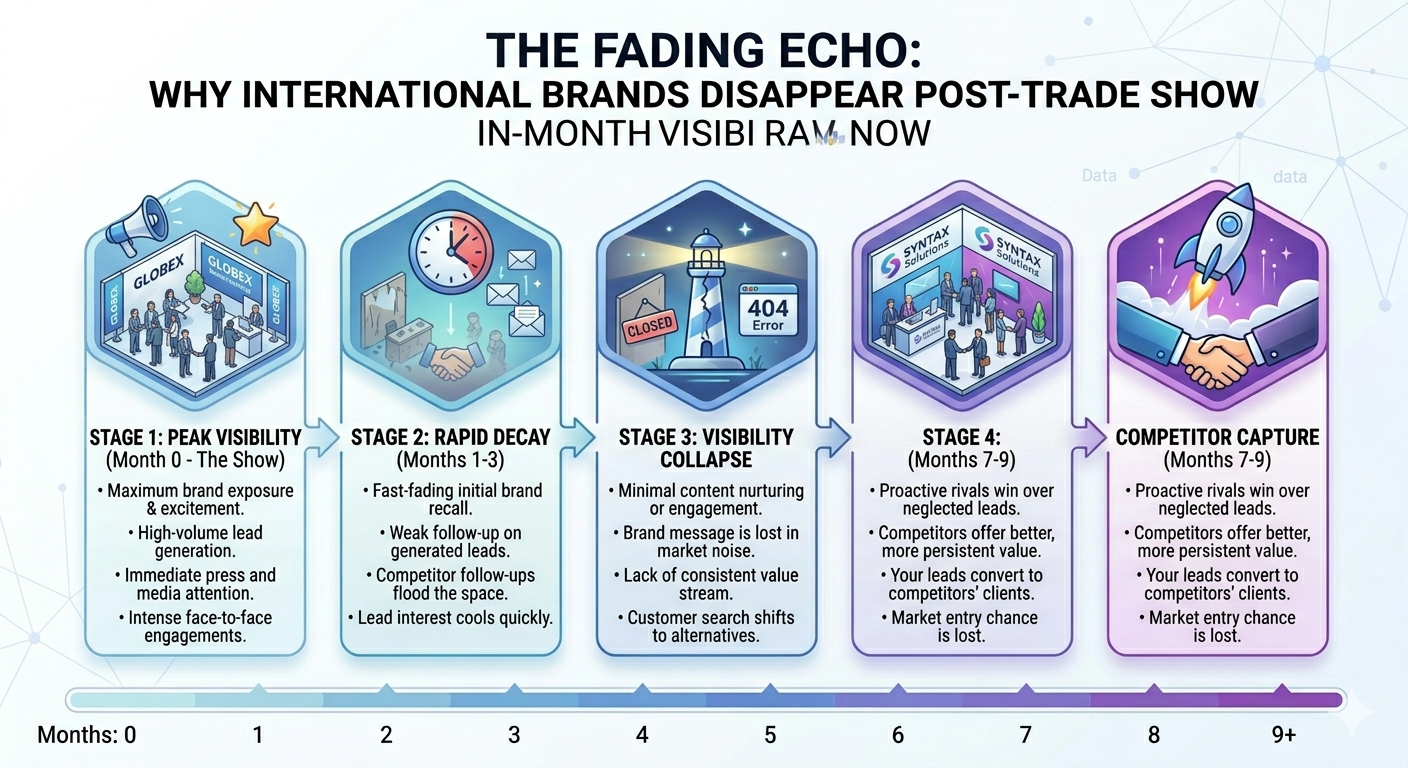
During the fair, visibility feels real and valuable. The booth is crowded. Conversations are engaging. The energy is high. This vividness creates an illusion of impact. Exhibitors believe they have built something lasting. They have not. Without continuity, the visibility illusion fades within weeks.
The consequence: Exhibitors are lulled into complacency by the fair’s energy. They do not realise that most of their investment is about to evaporate.
These barriers are not insurmountable. They are structural patterns that can be overcome with strategic clarity and disciplined investment. The first step is recognising that expense thinking is the default — and that default is destroying your ROI.
From Transaction to Asset: The Continuity Infrastructure Framework
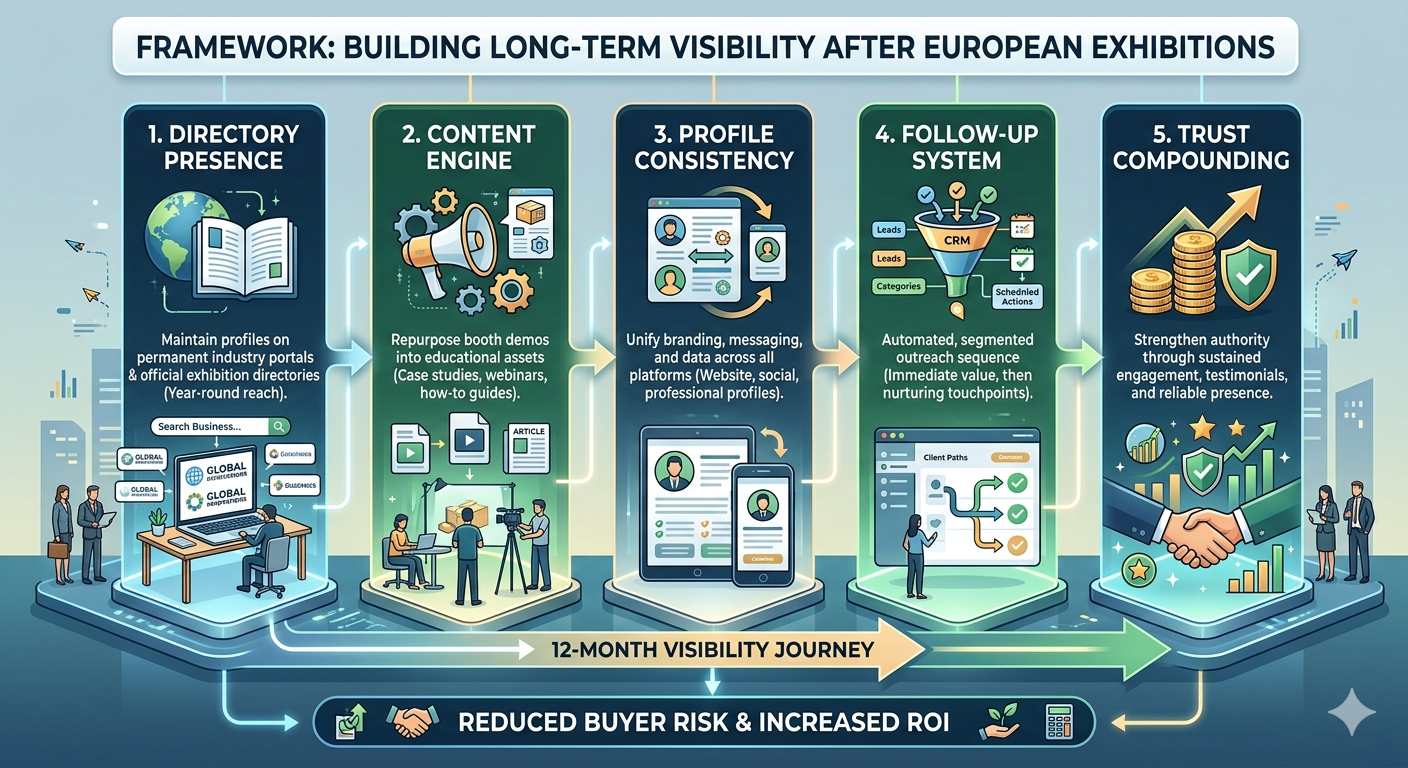
Turning trade fair participation into a strategic asset requires specific infrastructure. This framework consists of four interconnected layers, each transforming a different aspect of exhibition investment from temporary to permanent.
Layer 1: Pre-Fair Asset Building (Months 3-6 Before)
Before the fair, build discoverable assets that will continue working after the fair ends. Case studies optimised for buyer research. Content that demonstrates global capability. Search visibility for partnership keywords. These assets do not disappear when the fair ends. They continue attracting and informing buyers across the full procurement cycle.
Asset transformation: Pre-fair content becomes permanent discovery infrastructure.
Layer 2: During-Fair Asset Capture (The 4 Days)
The fair is not where assets are built. It is where assets are accelerated. Your booth should capture context that feeds your continuity infrastructure — not just contacts. Specific buyer challenges. Decision timelines. Internal validation requirements. This captured context becomes the raw material for personalised post-fair reinforcement.
Asset transformation: Booth conversations become data inputs for continuity systems.
Layer 3: Post-Fair Asset Reinforcement (Days 1-90)
Strategic reinforcement transforms initial interest into durable trust. Personalised follow-up, value-adding content, and structured re-engagement prevent memory decay and build relationship momentum. Each touchpoint reinforces your brand and resets the forgetting curve.
Asset transformation: Follow-up sequences become relationship-building infrastructure.
Layer 4: 365-Day Asset Infrastructure (Year-Round)
Permanent visibility infrastructure ensures your brand remains discoverable, credible, and trusted across the full procurement cycle. A BHOWCO 365-Day Profile provides this infrastructure. It is the foundation that transforms temporary exhibition presence into permanent brand asset.
Asset transformation: Permanent profiles become credibility infrastructure that compounds annually.
The BHOWCO 365-Day Profile is the foundational asset for Layer 4. It ensures your brand remains visible when buyers are finally ready to decide — not just when you are ready to exhibit.
Exhibitors who build all four layers transform their trade fair participation from a depreciating expense into an appreciating asset. Each fair adds to the asset. Each year, the asset is more valuable than the year before.
The Psychology of Asset Building: Why Continuity Creates Trust
To understand why continuity infrastructure creates assets, you must understand how buyers perceive consistent versus intermittent presence.
The Continuity Trust Signal
When your brand remains visible across time, buyers draw positive inferences. They assume that consistent presence signals stability, capability, and long-term commitment. These inferences are unconscious but powerful. They shape procurement decisions in your favour without you ever making a claim.
As the German Buyer Behavior guide explains, “German trade fairs are global networking hubs.” But networking is not enough. Continuity is what transforms networking into trust.
The Intermittence Trust Penalty
When your brand appears and disappears, buyers draw negative inferences. They assume that absence signals instability, lack of commitment, or insufficient global infrastructure. This penalty applies even if your intermittent presence is intentional and strategic. Buyers do not know your intentions. They only see your pattern.
The intermittence penalty means that exhibiting every other year can be worse than not exhibiting at all. The gap between appearances creates negative inference that damages trust.
The Compounding Advantage of Continuous Presence
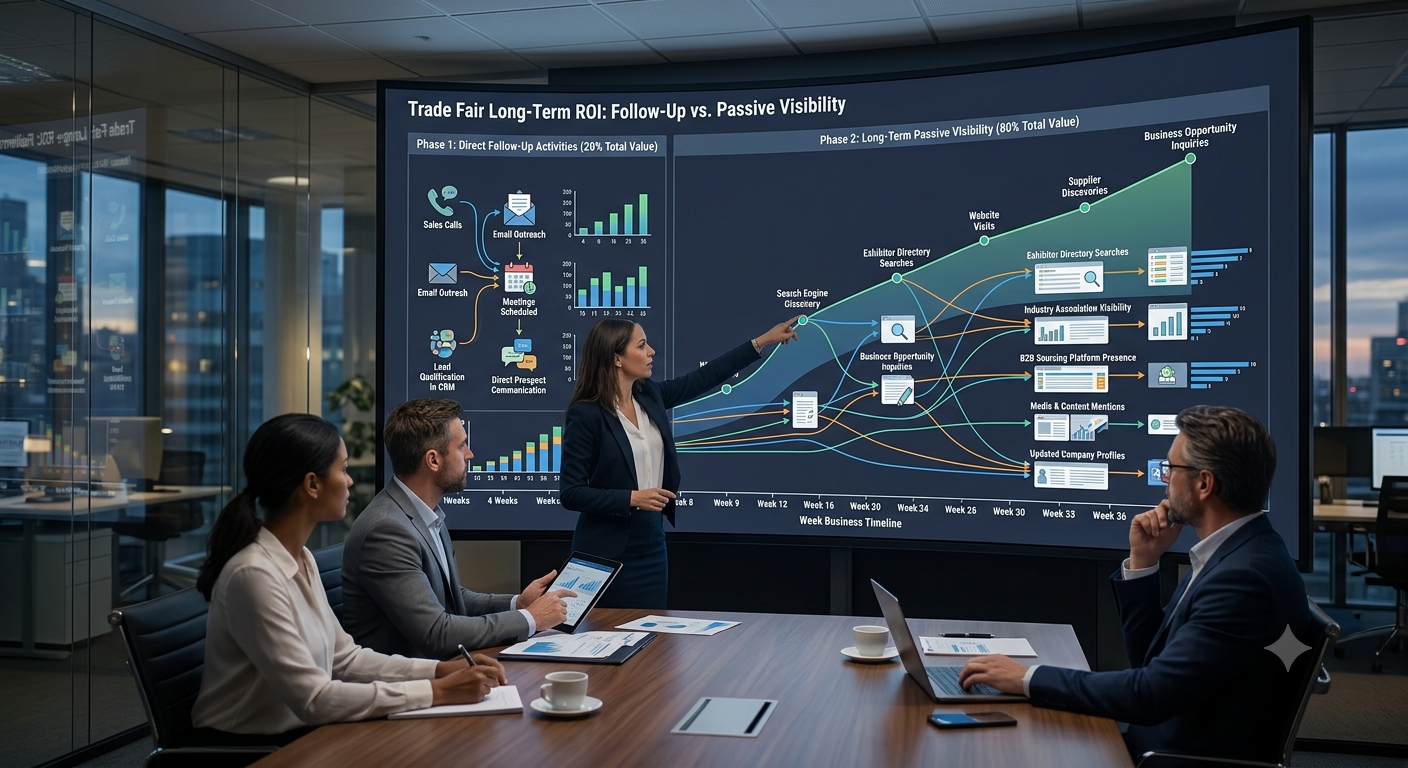
Each month your brand remains visible, the trust signal strengthens. Each year of consistent presence builds on previous years. After an extended period, your credibility is higher than at the beginning. After multiple years, you have built a trust advantage that new entrants cannot easily overcome.
This compounding is what transforms exhibition participation from expense to asset. The asset grows in value the longer you maintain it.
The Forgetting Curve and Asset Maintenance
Psychological research on the forgetting curve demonstrates that without reinforcement, memory decays exponentially. Strategic reinforcement resets the curve. Each reinforcement touchpoint strengthens memory and delays decay. Continuous reinforcement across time creates durable recall that survives the procurement cycle.
Your 365-day visibility infrastructure is the reinforcement system that maintains your brand in buyer memory. Without it, your asset depreciates. With it, your asset appreciates.
The Five Asset Components Every Exhibitor Needs
To turn trade fair participation into a strategic asset, you need five specific components. Each component serves a distinct function in the asset architecture.
Component 1: Permanent Discoverability Infrastructure
Your brand must be findable year-round, not just during fair weeks. This requires credible B2B directory presence, search visibility for relevant keywords, and optimised profiles on platforms that international buyers trust. A BHOWCO 365-Day Profile provides this infrastructure.
Asset function: Ensures buyers can find you during their research window, not just during your activation window.
Component 2: Content Continuity Engine
Your brand needs consistent content publishing across the full 12-month cycle. Case studies from recent client work. Industry insights that demonstrate expertise. Market updates that show continued engagement. Each piece of content is a reinforcement touchpoint that maintains brand recall.
Asset function: Provides passive reinforcement that resets the forgetting curve without active outreach.
Component 3: Reinforcement Cadence System
Your team needs documented processes for post-fair reinforcement. Who sends follow-up? Within what timeframe? What content goes to which buyer segments? What triggers different follow-up paths? A documented system ensures consistency even when team members change.
Asset function: Converts ad hoc follow-up into systematic relationship-building infrastructure.
Component 4: Buyer Journey Tracking
Your CRM needs to track buyer engagement across the full procurement cycle. Email opens, content downloads, profile views, website visits. This tracking tells you who is still engaged, who is fading, and who needs reinforcement. It enables targeted, timely intervention.
Asset function: Transforms blind follow-up into intelligence-driven reinforcement.
Component 5: Credibility Evidence Base
Your brand needs a permanent, verifiable evidence base that buyers can access during internal validation. Case studies, client testimonials, certification documentation, capability demonstrations. This evidence base is what procurement teams use to justify their decisions internally.
Asset function: Provides the proof that converts buyer interest into signed contracts.
The 365-Day Visibility System provides the framework for building these five components. Not as a one-time project, but as an ongoing strategic capability that compounds with each exhibition.
Exhibitors who build all five components turn their trade fair participation into a strategic asset. Those who do not remain stuck in expense thinking, wondering why their ROI never improves.
From Asset Components to Asset Value: Measuring What Matters
You cannot manage what you do not measure. Expense thinking measures activity — booth traffic, business cards, conversation counts. Asset thinking measures outcomes that predict long-term value.
Asset Metric 1: Brand Recall at Intervals
Survey a sample of buyers who engaged with you at the fair. What do they remember about your brand? Recall is the most direct measure of whether your continuity infrastructure is working.
Asset target: Meaningful recall maintained across intervals.
Asset Metric 2: Engagement Retention Curve
Track email open rates, content downloads, and profile views at intervals post-fair. Calculate retention as percentage of initial engagement. The shape of your retention curve tells you whether reinforcement is working.
Asset target: Retention remaining at meaningful levels across intervals.
Asset Metric 3: Passive Discovery Rate
What percentage of inbound inquiries come from buyers who found you through passive visibility — search, directory profiles, content discovery — rather than active outreach? This measures the health of your permanent discoverability infrastructure.
Asset target: A significant portion of qualified leads from passive discovery channels.
Asset Metric 4: Sales Cycle Acceleration
Compare sales cycle length for fair-sourced deals versus other channels. If fair-sourced deals take longer to close, your post-fair reinforcement is insufficient. If they take less time, your asset is working.
Asset target: Fair-sourced deals closing faster than other channels.
Asset Metric 5: Compounding ROI Trend
Calculate ROI per exhibition across multiple years. Expense thinking produces flat or declining ROI. Asset thinking produces improving ROI as previous investments compound. The trend tells you whether you are building an asset or incurring an expense.
Asset target: ROI improving year over year for the same fair.
These metrics are operational. Exhibitors who track them can diagnose asset health, optimise reinforcement, and demonstrate the value of continuity infrastructure to internal stakeholders.
Case Study: Two Exhibitors, Two Trajectories
Let us examine two exhibitors over three years. Both exhibited at the same fair. Both had comparable products and booth quality. Their approaches to asset building could not be more different.
Company A: Expense Thinking
Year 1: Company A invested significantly in a premium booth. They measured success by booth traffic and business cards. Post-fair follow-up was generic and ended early. No permanent visibility infrastructure. ROI: Negative. Conclusion: “The fair was too expensive.”
Year 2: Company A did not return. The contacts from Year 1 had forgotten them. No asset was built. No value compounded.
Year 3: Company A tried a different fair. Same pattern. Same result. Same conclusion.
Trajectory: Flat. Each fair starts from zero. No asset accumulation. No compounding ROI.
Company B: Asset Thinking
Year 1: Company B invested in a modest booth and in asset infrastructure — BHOWCO profile, content continuity, documented reinforcement. Post-fair follow-up was personalised and sustained. ROI: Modestly positive. Asset value: Emerging.
Year 2: Company B exhibited again. Pre-fair discovery rates were higher because buyers remembered them from Year 1. Booth conversations were more productive. ROI: Strongly positive. Asset value: Growing.
Year 3: Company B exhibited again. Buyers sought them out. Competitors were compared to them. ROI: Exceptional. Asset value: Durable and compounding.
Trajectory: Compounding. Each fair adds to the asset. ROI improves year over year. The asset becomes more valuable with each exhibition.
The Difference
Company A treated each fair as an isolated transaction. They invested in temporary presence. They achieved temporary results — which is to say, no results worth measuring.
Company B treated each fair as a checkpoint within a 365-day system. They invested in permanent infrastructure. They achieved compounding results — which is to say, results that grew across years.
The choice is not about budget. It is about mindset. Expense thinking produces expense outcomes. Asset thinking produces asset outcomes.
Building Your Year-Round Asset: A Practical Roadmap
You understand the framework. You understand the metrics. You understand the case study. Now you need a practical roadmap for building your own year-round strategic asset.
Step 1: Audit Your Current Asset Status
Measure your brand recall, engagement retention, passive discovery rate, and compounding ROI trend from your last few fairs. Be honest about the gaps. Most exhibitors discover that they have been operating in expense thinking without realising it.
Deliverable: A clear diagnosis of whether your exhibition participation is an expense or an asset.
Step 2: Build Your Permanent Infrastructure
Establish a BHOWCO 365-Day Profile before your next fair. Ensure your profile is complete, current, and strategically positioned. This is the foundation. Without permanent infrastructure, asset thinking is impossible.
Deliverable: A live, optimised 365-day profile that serves as your permanent brand asset.
Step 3: Document Your Reinforcement Cadence
Before your next fair, document your post-fair reinforcement sequence. What content goes to which buyer segments? At what intervals? Who is responsible? A documented system ensures consistency and enables optimisation.
Deliverable: A written reinforcement cadence document that guides post-fair activity.
Step 4: Establish Content Continuity
Create a content calendar. Case studies, industry insights, market updates. Publish consistently across the full year, not just around fairs. Each piece of content is a reinforcement touchpoint that prevents asset depreciation.
Deliverable: A content calendar with scheduled publications for the coming months.
Step 5: Train Your Team on Asset Thinking
Ensure everyone involved in exhibition strategy understands the shift from expense to asset. The booth team needs to know that their work continues after the fair. The marketing team needs to know that post-fair reinforcement is not optional. The sales team needs to know that the asset supports their pipeline.
Deliverable: A shared understanding across teams of the asset framework and each person’s role in building it.
Step 6: Measure, Learn, and Compound
Track your asset metrics after every fair. What worked? What did not? Which reinforcement touchpoints drove engagement? Use the data to optimise your next fair. Each cycle should improve asset value.
Deliverable: A continuous improvement loop that compounds asset value year over year.
The roadmap is not complicated. But it requires discipline, consistency, and a willingness to invest in infrastructure that most exhibitors ignore. Those who follow it will achieve results that those who do not cannot imagine.
Frequently Asked Questions
What is the difference between expense thinking and asset thinking in exhibition strategy?
Expense thinking treats each fair as an isolated transaction. Budget is allocated per event. Success is measured by booth traffic and leads collected. Investment depreciates to zero after the fair. Asset thinking treats each fair as a checkpoint within a 365-day system. Budget is allocated to continuity infrastructure. Success is measured by brand recall, engagement retention, and compounding visibility. Investment builds assets that appreciate over time.
Why do most exhibitors never build strategic assets from trade fairs?
Most exhibitors remain stuck in expense thinking due to four barriers: budget cycles that conflict with buyer cycles, organisational attention spans that neglect post-fair continuity, metric mismatches that reward activity over outcomes, and the visibility illusion that confuses fair energy with lasting impact. Overcoming these barriers requires strategic clarity and disciplined investment in continuity infrastructure.
What are the five asset components every exhibitor needs?
The five asset components are: permanent discoverability infrastructure (such as a BHOWCO profile), content continuity engine, reinforcement cadence system, buyer journey tracking, and credibility evidence base. Exhibitors who build all five components transform their trade fair participation from a depreciating expense into an appreciating asset.
How does BHOWCO help turn trade fair participation into a strategic asset?
BHOWCO provides the permanent visibility infrastructure that most exhibitors lack — the foundation of asset thinking. Your 365-day profile ensures your brand remains discoverable, credible, and present across the full procurement cycle. It provides passive reinforcement that maintains brand recall without requiring active outreach. The platform transforms temporary exhibition presence into permanent brand asset.
What metrics should I track to measure asset value?
Track five asset metrics: brand recall at intervals, engagement retention curve, passive discovery rate (significant portion of qualified leads from passive channels), sales cycle acceleration (faster than other channels), and compounding ROI trend (improving year over year).
How long does it take to turn trade fair participation into a strategic asset?
Asset building is a multi-year process. Early results are often modest — positive ROI possible but not guaranteed. Results typically show significant improvement as compounded credibility begins to work. Over time, asset thinking dramatically outperforms expense thinking. Exhibitors who maintain 365-day visibility over multiple years build trust advantages that new entrants cannot easily overcome.
Trade fair participation can be an expense that depreciates to zero. Or it can be an asset that compounds year after year.
The difference is not booth size. It is not budget size. It is not product quality. It is mindset and infrastructure. Expense thinking produces expense outcomes. Asset thinking produces asset outcomes.
Your competitors will continue with expense thinking. They will invest in temporary presence. They will measure booth traffic. They will watch their ROI evaporate after each fair. They will start from zero at every exhibition.
You can choose differently. You can build the infrastructure that turns each fair into a compounding asset. You can measure what actually predicts long-term success. You can achieve ROI that improves year after year rather than resetting to zero.
Stop treating trade fairs as expenses. Start building them as strategic assets today.
→ Select your anchor exhibition hub
→ Master the 365-day visibility framework
→ Build your permanent brand asset