Latest Insights
The Continuous Visibility Model: Staying Relevant Between Trade Fairs


The Continuous Visibility Model: Staying Relevant Between Trade Fairs
Your booth at Hannover Messe was excellent. Your team delivered flawless presentations. Buyers visited in numbers that exceeded your targets. Conversations felt productive. Business cards filled your collection boxes.
Then the fair ended. The booth came down. The team flew home. And within weeks, most of those promising buyers had forgotten your brand entirely.
This is not a failure of your fair performance. This is a failure of your between-fair strategy. You had a visibility spike. You did not have visibility continuity. And without continuity, even the best fair performance evaporates.
Continuous visibility is the model that solves this problem.
Not visibility that spikes during fairs and collapses between them. Not visibility that depends on your active outreach. Not visibility that resets to zero at every exhibition.
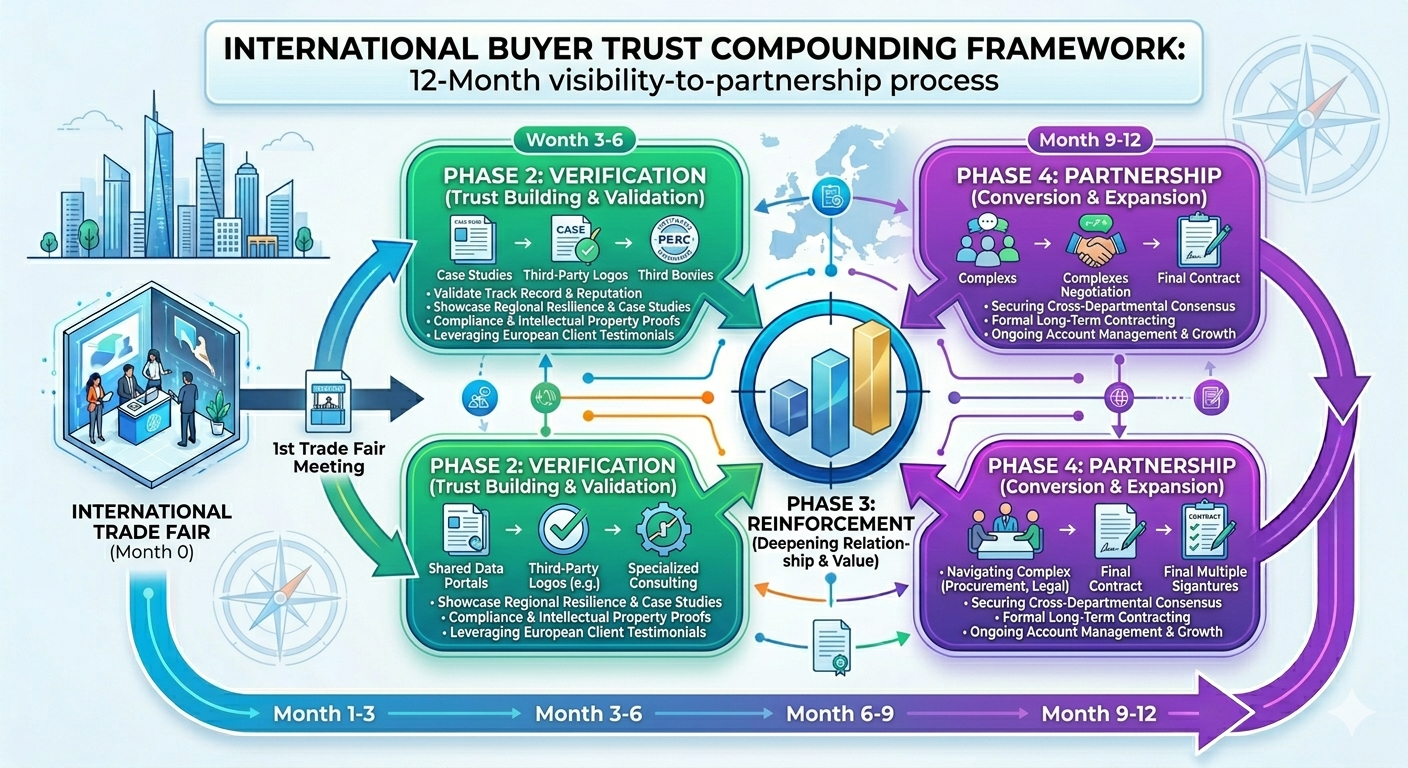
Continuous visibility is systematic, permanent, discoverable presence that maintains your brand in buyer consciousness across the full procurement cycle. It is the strategic infrastructure that turns trade fair participation from an event into an asset.
This article reveals the continuous visibility model — why most exhibitors remain trapped in spike-and-collapse cycles, how buyer psychology rewards consistent presence, and the specific infrastructure required to stay relevant between trade fairs.
The Spike-and-Collapse Trap: Why Most Exhibitors Stay Irrelevant Between Fairs
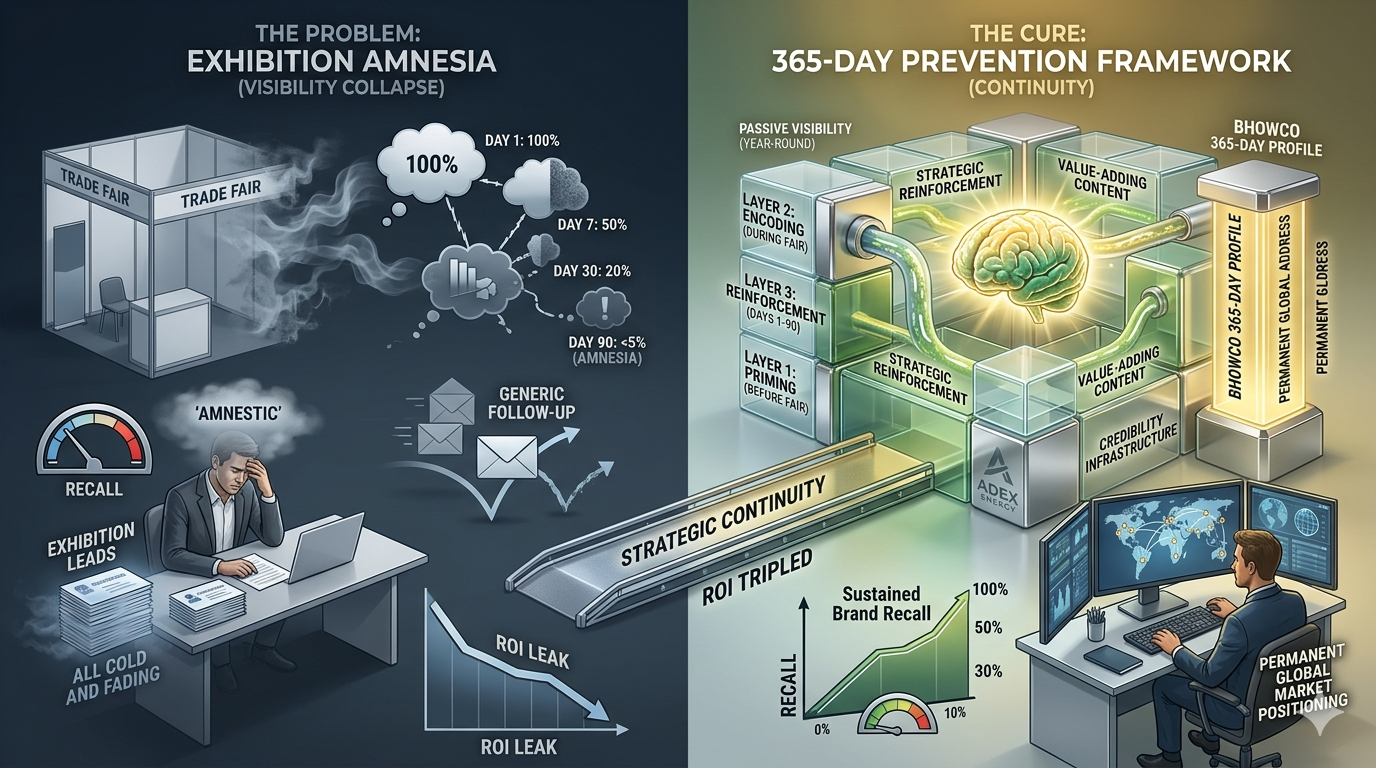
Most exhibitors operate on a visibility model that is fundamentally flawed. They invest heavily in visibility spikes during fair weeks, then allow visibility to collapse between fairs. This spike-and-collapse pattern destroys ROI and prevents the compounding credibility that comes from continuous presence.
The Spike-and-Collapse Pattern
The pattern is predictable and almost universal among exhibitors without continuity infrastructure:
During fair week: Peak visibility. Your brand is discoverable, your team is present, your messaging is active. Buyers see you. Conversations happen. Energy is high.
Weeks 1-4 post-fair: Visibility begins to decline. Generic follow-up goes out. Some buyers respond. Most do not. The fair energy fades.
Weeks 5-12 post-fair: Visibility collapses significantly. Active outreach stops. Content publishing ceases. Your brand becomes difficult to find. Buyers who are researching during this window find limited evidence of your continued existence.
Weeks 13-52 post-fair: Visibility approaches zero. Your brand is effectively invisible to buyers in the middle of their procurement cycle. When decisions are finally made months after the fair, you are not part of the conversation.
Why the Spike-and-Collapse Model Fails
The spike-and-collapse model fails because it is designed around the exhibitor’s calendar, not the buyer’s decision cycle. Exhibitors are active during fairs and passive between fairs. Buyers, however, are active across the entire year. Their procurement cycles do not pause between exhibitions. Their research continues. Their internal validation continues. Their comparison of alternatives continues.
When your visibility collapses, you disappear from the buyer’s consideration set. Not because you are uncompetitive. Because you are invisible. And in global B2B procurement, invisible suppliers are not trusted suppliers.
The Spike-and-Collapse Cost
The cost of the spike-and-collapse model is substantial. Exhibitors invest significant amounts in fair participation. Then they allow most of that investment to evaporate through visibility collapse between fairs. They are paying for visibility spikes that have no continuity. They are funding awareness that fades before it can convert into trust.
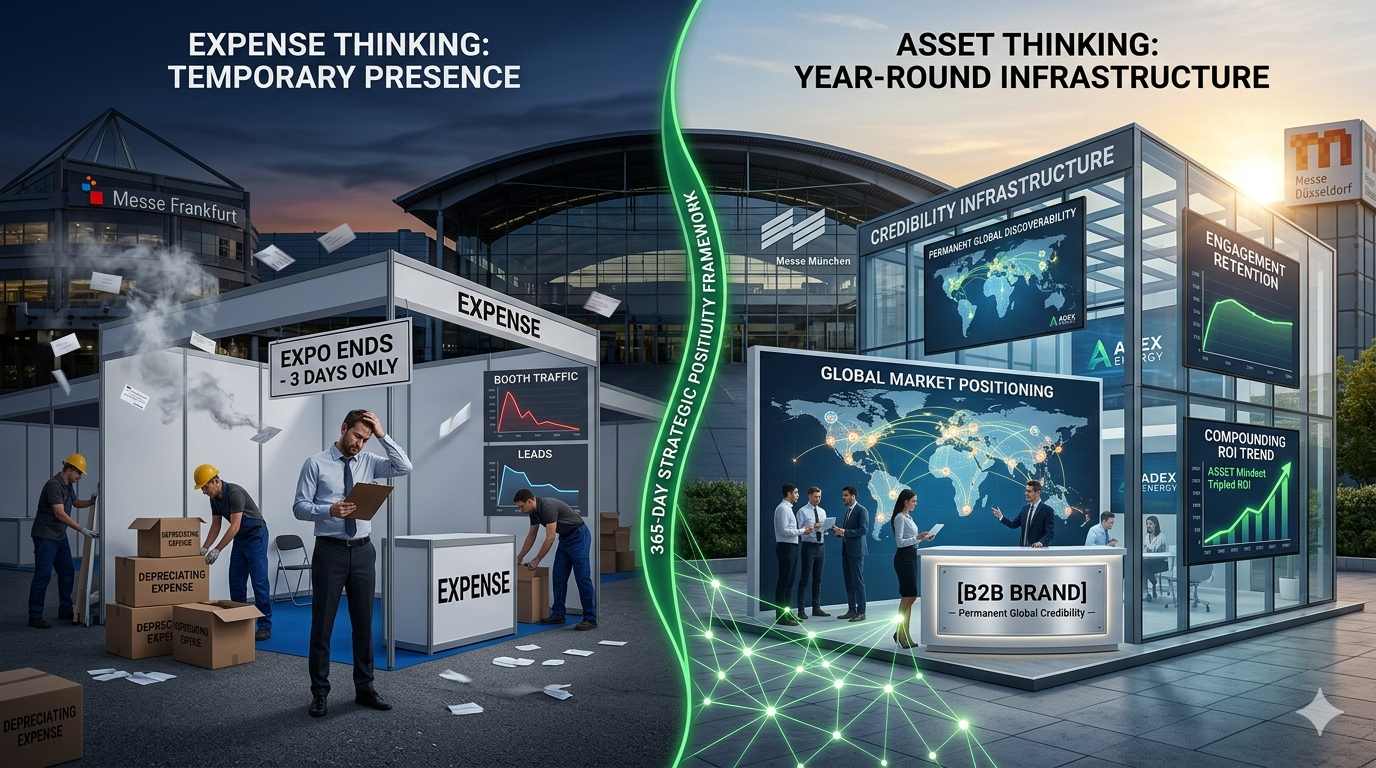
As the 365-Day Visibility System explains: “You can buy visibility for 3 days at Messe Frankfurt. Credibility takes 365.” The spike-and-collapse model buys visibility that disappears. The continuous visibility model builds credibility that endures.
The Continuous Visibility Model: From Spikes to Sustained Presence
The continuous visibility model replaces spikes with sustained presence. Instead of intense visibility during fairs and collapse between them, this model maintains consistent, discoverable presence across the full year.
What Continuous Visibility Looks Like
In the continuous visibility model, your brand remains discoverable, credible, and relevant across all phases of the buyer’s decision cycle:
During fair week: Peak activation. Your booth accelerates relationships, confirms digital credibility, and creates face-to-face trust. The fair is a checkpoint, not the entire journey.
Weeks 1-4 post-fair: Active reinforcement. Personalised follow-up, value-adding content, and structured re-engagement reset the forgetting curve and maintain momentum.
Weeks 5-12 post-fair: Passive visibility. Your BHOWCO profile, search presence, and content continuity ensure buyers can find you during active research. Visibility does not collapse because infrastructure maintains it.
Weeks 13-52 post-fair: Continuous discoverability. Your brand remains findable through permanent directory presence, consistent content publishing, and ongoing search visibility. When buyers make decisions months after the fair, you are part of the conversation.
The Strategic Shift Required
Moving from spike-and-collapse to continuous visibility requires three strategic shifts:
Shift 1: From Event Thinking to System Thinking. Stop treating each fair as an isolated event. Start treating fairs as checkpoints within a 365-day visibility system. The system is the asset. Fairs are accelerators of that asset.
Shift 2: From Active-Only to Active+Passive. Most exhibitors rely entirely on active outreach — emails, calls, meetings. Continuous visibility adds passive discoverability — search presence, directory profiles, content that buyers find on their own.
Shift 3: From Post-Fair to Pre-Fair+Post-Fair. Most exhibitors think about post-fair follow-up. Continuous visibility adds pre-fair positioning that primes memory before the fair, making encoding stronger and forgetting slower.
The Infrastructure Required
Continuous visibility is not a mindset alone. It requires specific infrastructure. A BHOWCO 365-Day Profile provides the permanent discoverability that passive visibility requires. Content continuity systems provide the reinforcement that prevents memory decay. Documented cadences provide the consistency that active outreach requires.
Exhibitors who build this infrastructure escape the spike-and-collapse trap. Their visibility does not collapse between fairs because they have built systems that maintain it.
The Psychology of Continuous Visibility: Why Presence Signals Partnership
Continuous visibility works because of fundamental principles of buyer psychology. Understanding these principles helps you design more effective continuity infrastructure.
Principle 1: The Mere Exposure Effect
Psychological research has consistently demonstrated the mere exposure effect: repeated exposure to a stimulus increases liking and trust, even without conscious awareness of the exposure. Each time a buyer encounters your brand — in search results, on a directory profile, through published content — their unconscious trust in your brand increases.
Continuous visibility generates repeated exposures. Spike-and-collapse visibility generates a single exposure that fades. The mere exposure effect means that continuous visibility builds trust that spike visibility cannot.
Principle 2: The Availability Heuristic
Buyers use mental shortcuts to make decisions. One of the most powerful shortcuts is the availability heuristic: things that come to mind easily are judged as more likely, important, or trustworthy. When your brand is continuously visible, it comes to mind easily during procurement decisions. When your brand disappears between fairs, it does not.
As the German Buyer Behavior guide explains, “German trade fairs are global networking hubs.” But networking hubs are not enough. Continuous visibility ensures your brand is available to memory when decisions are made.
Principle 3: The Consistency Signal
Buyers interpret consistent presence as a signal of stability, capability, and long-term commitment. A brand that is visible in January, visible in April, and visible in September signals something different from a brand that is visible only during fair weeks. Consistency signals that you are a permanent player, not a temporary participant.
The consistency signal is particularly powerful in international B2B, where buyers face significant risk when choosing new suppliers. Continuous visibility reduces perceived risk. Spike-and-collapse visibility increases it.
Principle 4: The Forgetting Curve Reset
The forgetting curve is exponential — without reinforcement, memory decays rapidly. Strategic reinforcement resets the curve. Each encounter with your brand — whether active outreach or passive discovery — strengthens memory and delays decay.
Continuous visibility provides repeated reinforcement across the full procurement cycle. Spike-and-collapse visibility provides one reinforcement event (the fair) followed by rapid decay. The difference in memory retention is substantial.
Principle 5: The Trust Gradient
Trust is not binary. It exists on a gradient. Initial trust is fragile and easily broken. Repeated positive encounters build stronger trust that withstands challenges. Continuous visibility enables the repeated encounters required for trust to deepen.
Spike-and-collapse visibility builds fragile trust that collapses when visibility collapses. Continuous visibility builds durable trust that persists even without active outreach.
The psychology is clear: continuous visibility is not a nice-to-have. It is required for the trust, recall, and consideration that drive procurement decisions.
The Forgetting Curve and Your Exhibition Investment
The forgetting curve is the most important concept for exhibitors to understand — and the most consistently ignored.
What the Forgetting Curve Actually Shows
Research demonstrates that without reinforcement, memory decays rapidly. Within a short period, a significant portion of new information is forgotten. Within days or weeks, most specific details are lost without strategic reinforcement.
This is not speculation. This is replicated cognitive psychology. Your booth presentation, your value proposition, your memorable interaction — all of it follows this curve unless you strategically intervene.
What This Means for Your Exhibition Investment
If you invest significantly in a trade fair and do not provide strategic reinforcement, you are effectively paying for buyers to forget most of what you communicated within weeks. You are funding a forgetting curve that destroys most of your investment.
This is not a failure of your fair performance. It is a failure of your post-fair strategy. The forgetting curve is not optional. It is biological. You can work with it through strategic reinforcement, or you can ignore it and watch your investment evaporate.
How Continuous Visibility Resets the Curve
Each strategic reinforcement touchpoint resets the forgetting curve. A personalised follow-up email within days resets the curve. A value-adding case study at day 14 resets it again. A passive discovery through search at day 60 resets it again.
Continuous visibility provides repeated resets across the full procurement cycle. The forgetting curve never reaches the point of significant decay because reinforcement arrives before substantial forgetting occurs.
The Reinforcement Timing Window
Reinforcement must occur before significant decay sets in. Research suggests that the optimal reinforcement windows are:
First reinforcement: Within days of the fair. Before significant forgetting has occurred.
Second reinforcement: Within 7-14 days. Before most specific details have been lost.
Third reinforcement: Within 30 days. Before gist memory becomes unreliable.
Ongoing reinforcement: Passive visibility across months. Maintaining recall until procurement decisions are finalised.
Exhibitors who follow this reinforcement schedule maintain substantially higher brand recall than those who provide a single generic follow-up email or none at all.
The Long-Term Touchpoint Architecture for Continuous Visibility
Continuous visibility requires a deliberate architecture of touchpoints across time and channels. This architecture ensures reinforcement occurs before significant decay and that passive visibility supports recall between active touchpoints.
Touchpoint Type 1: Active Direct Outreach
Emails, phone calls, and direct messages initiated by your team. These touchpoints are essential for immediate reinforcement and relationship building. They require personalisation, timing, and relevance to be effective.
Optimal frequency: Multiple active touchpoints in the first weeks post-fair, decreasing as passive visibility takes over.
Touchpoint Type 2: Passive Discovery Channels
Search results, directory profiles, published content, and social presence that buyers find on their own. These touchpoints are essential for ongoing reinforcement without active outreach. They require permanent infrastructure and consistent updating.
Optimal frequency: Continuous. Passive channels work without incremental effort.
Touchpoint Type 3: Value-Adding Content
Case studies, white papers, industry insights, and market updates that demonstrate expertise and provide utility. Each piece of content serves as both an active touchpoint (when sent directly) and a passive touchpoint (when discovered).
Optimal frequency: Regular content publication, sustained across the full year.
Touchpoint Type 4: Third-Party Validation
Directory listings, industry association profiles, and partner network presences that provide independent credibility. These touchpoints are discovered passively and signal that your brand is recognised by credible third parties.
Optimal frequency: Permanent presence on credible platforms, maintained continuously.
Touchpoint Type 5: Retargeting and Display
Programmatic visibility that follows buyers who have engaged with your brand. These touchpoints maintain presence without requiring active decision-making from your team.
Optimal frequency: Sustained campaigns across the procurement cycle, not just post-fair.
The BHOWCO 365-Day Profile provides Touchpoint Type 2 and Type 4 infrastructure. It ensures your brand remains discoverable through passive channels, providing continuous reinforcement without active outreach.
Exhibitors who build this touchpoint architecture maintain substantially higher brand recall than those who rely on spike-and-collapse visibility alone.
Visibility Psychology: Why Absence Is Not Neutral
One of the most misunderstood aspects of buyer psychology is the impact of absence. Most exhibitors assume that disappearing between fairs is neutral — that buyers simply forget them without negative consequence.
This assumption is dangerously wrong.
The Negative Inference of Absence
When a brand that was visible during a fair becomes invisible after the fair, buyers draw inferences. Not consciously, perhaps. But the pattern registers. The contrast between presence and absence creates a negative unconscious judgment.
Buyers infer that absence signals instability. They infer that absence signals lack of global infrastructure. They infer that absence signals a company that could not sustain the momentum from the fair. These inferences damage trust, often permanently.
The Trust Penalty of Disappearance
Research on expectation violations suggests that when a positive experience (the fair interaction) is followed by a negative experience (post-fair disappearance), the overall evaluation is lower than if the positive experience had never occurred. The disappointment of disappearance colours memory of the entire relationship.
This trust penalty means that disappearing after the fair can be worse than not exhibiting at all. Buyers who met you and then saw you disappear trust you less than buyers who never met you. The negative inference from absence outweighs the positive impression from presence.
The Positive Signal of Continuous Presence
Conversely, continuous presence sends powerful positive signals. When buyers see your brand consistently across time — in search results, on directory profiles, through published content — they draw positive inferences. They infer stability. They infer global capability. They infer long-term commitment.
These positive signals accumulate. Each month your brand remains visible, the trust signal strengthens. Over an extended period of continuous visibility, your brand enjoys a trust advantage that spike-and-collapse exhibitors cannot match.
The Competitive Moat of Continuous Visibility
Continuous visibility creates a competitive moat. Most exhibitors will not build the required infrastructure. They will remain trapped in spike-and-collapse. They will continue to suffer the trust penalty of disappearance.
Exhibitors who build continuous visibility escape this penalty. They enjoy the trust advantage of consistent presence. And because most competitors will not make the investment, this advantage is durable and compounding.
As the 365-Day Visibility System explains: “Silence after the fair is not neutral. It signals lack of commitment to the relationship.” Continuous visibility is the antidote to this negative signal.
From Theory to Practice: Building Your Continuous Visibility System
You understand the psychology. You understand the forgetting curve. You understand the touchpoint architecture. Now you need a practical system for building continuous visibility.
System Component 1: Permanent Discoverability Infrastructure
Establish a BHOWCO 365-Day Profile. Ensure your profile is complete, current, and strategically positioned. This is your permanent home in Germany’s exhibition ecosystem. It ensures buyers can find you year-round, not just during fair weeks.
Implementation timeline: Establish before your next fair. Update continuously.
System Component 2: Documented Reinforcement Cadence
Create a written schedule of post-fair reinforcement. What touchpoints? At what intervals? Using what content? Who is responsible? A documented cadence ensures consistency and enables optimisation.
Implementation timeline: Document before your next fair. Refine after each fair.
System Component 3: Content Continuity Engine
Establish a year-round content calendar. Case studies, industry insights, market updates. Publish consistently across the full year, not just around fairs. Each piece of content is a reinforcement touchpoint and a passive discovery asset.
Implementation timeline: Create calendar quarterly. Execute regularly.
System Component 4: Buyer Journey Tracking
Configure your CRM to track buyer engagement across the full procurement cycle. Email opens, content downloads, profile views, website visits. Use this data to time reinforcement and identify fading relationships.
Implementation timeline: Configure before next fair. Monitor continuously.
System Component 5: Cross-Channel Presence
Ensure your brand is discoverable across multiple channels. Search, directories, social platforms, industry publications. Different buyers prefer different channels. Multi-channel presence ensures you reach each buyer through their preferred touchpoint.
Implementation timeline: Audit and expand regularly.
System Component 6: Continuous Optimisation Process
Measure your continuous visibility metrics after each fair. Brand recall at intervals. Engagement retention curves. Passive discovery rates. Use the data to identify what is working and what needs improvement.
Implementation timeline: Measure after each fair. Optimise before next fair.
This system is operational. Exhibitors who implement all six components escape the spike-and-collapse trap. Their visibility does not collapse between fairs because they have built systems that maintain it.
The BHOWCO platform provides the foundational infrastructure for this system. Your 365-Day Profile ensures permanent discoverability. The strategic framework guides reinforcement cadence and content continuity. What remains is your commitment to building what most exhibitors ignore.
Measuring Continuous Visibility: Metrics That Matter
You cannot improve what you do not measure. Spike-and-collapse metrics measure fair activity. Continuous visibility metrics measure sustained presence.
Metric 1: Brand Recall at Intervals
Survey buyers who engaged at the fair. What do they remember about your brand at 30 days? At 60 days? At 90 days? This is the most direct measure of whether your continuous visibility system is working.
Target: Meaningful recall maintained across intervals.
Metric 2: Engagement Retention Curve
Track email opens, content downloads, and profile views across time. Calculate retention as percentage of initial engagement. The shape of the curve tells you whether reinforcement is preventing decay.
Target: Retention remaining at meaningful levels across intervals.
Metric 3: Passive Discovery Rate
What percentage of inbound inquiries come from buyers who found you through passive channels — search, directory profiles, content discovery? This measures the health of your permanent discoverability infrastructure.
Target: A significant portion of qualified leads from passive discovery.
Metric 4: Visibility Consistency Score
Track your search visibility, profile completeness, and content freshness across the full year. A consistent score indicates continuous visibility. Wide variations indicate spike-and-collapse.
Target: Consistent scores across all months. No post-fair collapse.
Metric 5: Between-Fair Engagement
Track engagement from fair contacts between the current fair and the next fair. Buyers who remain engaged across the full year are those most likely to convert. This metric tells you whether your continuity system is sustaining relationships.
Target: A meaningful portion of fair contacts engaged at months post-fair.
These metrics are the dashboard for your continuous visibility system. Exhibitors who track them can diagnose problems, optimise reinforcement, and demonstrate the value of continuity infrastructure.
Case Study: Spike-and-Collapse vs. Continuous Visibility
Let us compare two exhibitors at the same fair. Same industry. Same buyer audience. Comparable booth quality. Their visibility models could not be more different.
Company A: Spike-and-Collapse Model
Company A invested significantly in a premium booth. Their fair performance was strong. Booth traffic exceeded targets. Conversations felt productive. Then the fair ended.
Follow-up was generic and sent weeks post-fair. No second touchpoint. No passive visibility infrastructure. No content continuity. By day 60, brand recall had dropped substantially. By day 90, recall was very low. Inbound inquiries stopped completely.
When procurement decisions were finalised months later, Company A was invisible. Their significant investment generated minimal ROI. The team concluded the fair was not worth repeating.
Visibility pattern: Intense spike during fair. Rapid collapse to near-zero within weeks.
Company B: Continuous Visibility Model
Company B invested in a modest booth and in continuity infrastructure — BHOWCO profile, content calendar, documented reinforcement cadence. Follow-up was personalised and sent within days. Reinforcement continued at regular intervals. Their BHOWCO profile remained active and discoverable. Content publishing continued across the full year.
By day 60, brand recall remained substantial. By day 90, recall was still meaningful. Inbound inquiries continued across the full procurement cycle. When decisions were finalised months later, Company B was visible and top-of-mind.
Company B won significantly more deals than Company A from the same fair. ROI was strongly positive and improved in subsequent years as visibility compounded.
Visibility pattern: Moderate spike during fair. Sustained presence across full year. No collapse.
The Difference
Company A had a visibility spike followed by collapse. Company B had continuous visibility across the full procurement cycle. The difference in outcomes was not fair performance. It was the visibility model.
Company A’s investment largely evaporated. Company B’s investment compounded. The same fair. The same industry. The same buyer audience. Different models, different results.
Frequently Asked Questions
What is the continuous visibility model for trade fair exhibitors?
The continuous visibility model replaces spike-and-collapse visibility with sustained presence across the full procurement cycle. Instead of intense visibility during fairs and collapse between them, continuous visibility maintains consistent, discoverable presence through permanent infrastructure, strategic reinforcement, and passive discovery channels. This model builds durable trust and compounding ROI that spike visibility cannot achieve.
Why does spike-and-collapse visibility destroy exhibition ROI?
Spike-and-collapse visibility follows the forgetting curve — without reinforcement, memory decays rapidly. Buyers whose procurement cycles extend over months forget spike-only exhibitors entirely. The contrast between fair presence and post-fair absence also creates negative trust inferences. Spike-and-collapse means paying for visibility that evaporates before buyers are ready to decide.
How does continuous visibility maintain brand recall between fairs?
Continuous visibility provides repeated reinforcement that resets the forgetting curve before significant decay occurs. Active touchpoints (personalised follow-up, value-adding content) and passive touchpoints (search visibility, directory profiles, published content) work together to maintain brand recall across the full procurement cycle. This reinforcement ensures your brand remains discoverable and memorable when buyers finally make decisions.
What infrastructure does continuous visibility require?
Continuous visibility requires six infrastructure components: permanent discoverability infrastructure (such as a BHOWCO profile), documented reinforcement cadence, content continuity engine, buyer journey tracking, cross-channel presence, and continuous optimisation process. Without this infrastructure, continuous visibility is impossible. With it, spike-and-collapse can be eliminated.
How does BHOWCO support continuous visibility between fairs?
BHOWCO provides the permanent discoverability infrastructure that most exhibitors lack — the foundation of continuous visibility. Your 365-day profile ensures your brand remains findable, credible, and present across the full procurement cycle. It provides passive reinforcement that maintains brand recall without requiring active outreach. The platform transforms spike-and-collapse visibility into continuous visibility.
What metrics should I track for continuous visibility?
Track five metrics: brand recall at intervals, engagement retention curve, passive discovery rate (significant portion of leads from passive channels), visibility consistency score (no post-fair collapse), and between-fair engagement (meaningful portion of contacts engaged at months post-fair).
Your trade fair visibility can spike and collapse. Or it can be continuous across the full procurement cycle.
The choice determines whether your exhibition investment evaporates or compounds. Whether your brand is forgotten or trusted. Whether you start from zero at every fair or build credibility that grows year after year.
Your competitors will remain trapped in spike-and-collapse. They will pay for visibility that disappears. They will wonder why their ROI never improves. They will blame the fair, the industry, the economy — anything except their own visibility model.
You can choose differently. You can build the continuous visibility system that maintains your brand across the full year. You can be present when competitors are invisible. You can be remembered when they are forgotten.
Stop spiking and collapsing. Start building continuous visibility today.
→ Select your anchor exhibition hub
→ Master the continuous visibility framework
→ Build your permanent visibility infrastructure