Latest Insights
The 3-30-365 Formula: Turn Trade Fairs into Global Growth


The 3-30-365 Trade Fair Formula: How Smart Exhibitors Turn Short-Term Visibility into Long-Term Global Growth
Most exhibitors do not fail because of weak products, small booths, or limited budgets.
They fail because buyers forget them shortly after the exhibition ends.
You invested significant budget in a booth at Hannover Messe. Your team delivered flawless presentations. You collected many business cards from promising international buyers. The conversations felt productive. The energy was high.
Then you went home. You sent a few generic follow-up emails. You got busy with other priorities. The leads went cold. The momentum died. And by the time procurement cycles completed months later, your brand had faded completely from buyer memory.
Trade fairs do not reward presence. They reward continuity.
This article reveals the 3-30-365 formula — a strategic operating system that transforms short-term exhibition visibility into long-term international growth. You will learn why buyer memory decays without structured follow-up, how to build authority during the critical conversion window, and exactly how to construct year-round visibility infrastructure that compounds with every exhibition.
The Brutal Truth: Why Most Exhibitors Lose ROI Within Weeks
Let us be honest about what actually happens after most trade fairs.
Days After the Fair: False Optimism
Your team feels good. The booth performed well. You have a stack of business cards. Conversations seemed productive. You believe deals are coming. This is the danger zone. Optimism without systems leads to delayed action.
Weeks After: The Drift Begins
Other priorities compete for attention. The exhibition feels increasingly distant. Generic follow-up emails go out late. Some contacts respond. Most do not. The urgency that existed during the fair has evaporated.
Weeks to Months: Memory Decay Accelerates
Buyers who met you at the fair are now back to their normal routines. Your brand is fading from memory. Procurement cycles continue, but you are not part of their active consideration. You have become invisible during the most critical evaluation window.
Months After: The Silence Gap
Your follow-up has stopped. The buyer’s internal validation process is in full swing. Competitors who maintained visibility are being discussed. You are not. The gap between your strong fair presence and your post-fair silence creates negative inference. Buyers assume your silence signals instability.
Months Later: Lost Deals
Procurement decisions are finalised. Contracts are signed. You are not on the winning side. The ROI you expected from your significant investment never materialised. You tell yourself the fair was disappointing. But the problem was not the fair. The problem was everything that happened — or did not happen — after the fair.
As the 365-Day Visibility System explains: “Silence after the fair is not neutral. It signals lack of commitment to the relationship.” Most exhibitors do not realise that their post-fair silence actively destroys the trust they built during the event.
The 3-30-365 formula exists to solve this exact problem.
Understanding the 3-30-365 Strategic Operating System
The 3-30-365 formula is not a checklist. It is a strategic operating system for international trade fair success. Each number represents a distinct phase with specific objectives, traps to avoid, and strategic actions required.
Here is the framework at a glance:
The “3” – Trade Fair Performance (The Activation Phase)
Days of physical exhibition presence. This is where you create visibility, first impressions, initial trust signals, and buyer awareness. The trap is treating this phase as the main event. The strategy is using your booth as a strategic positioning environment where every conversation builds toward long-term buyer trust.
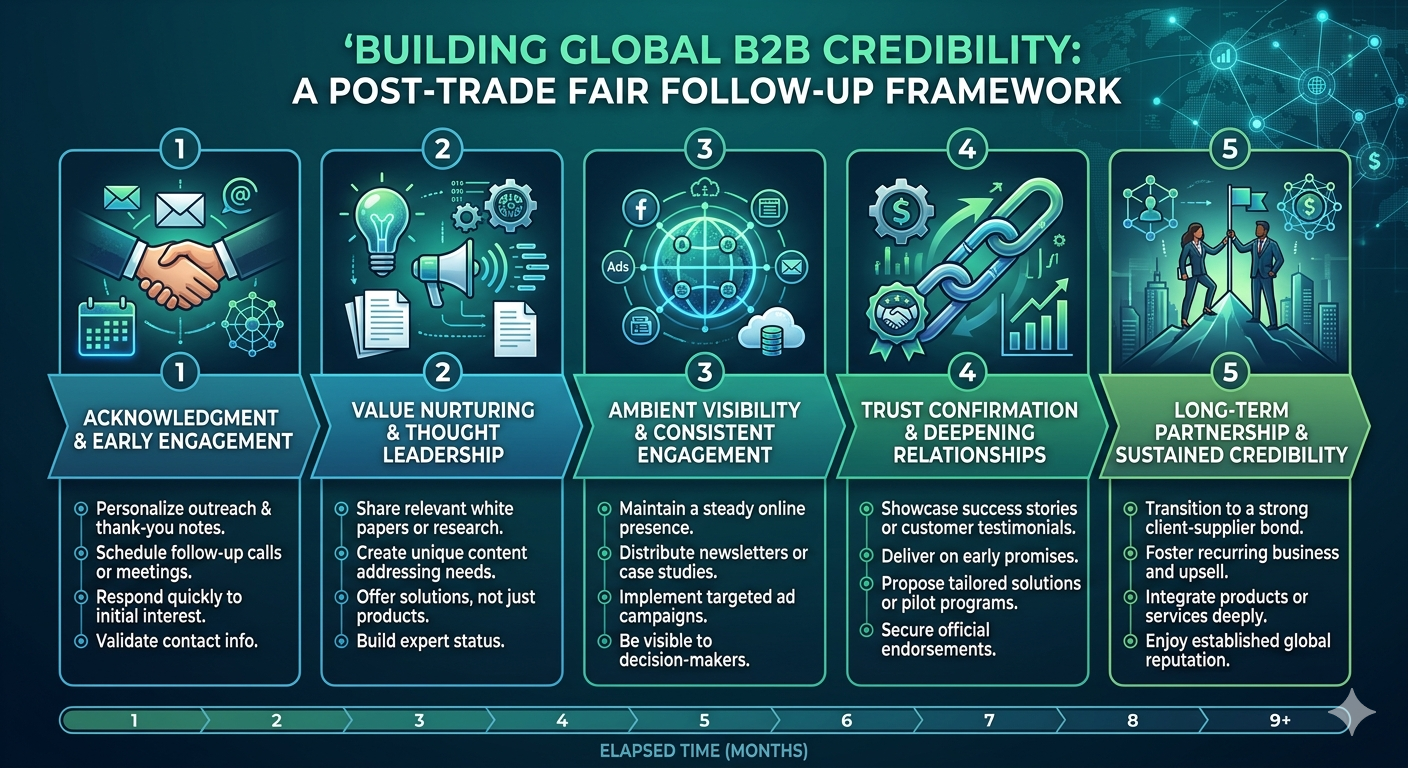
The “30” – Post-Fair Conversion Window (The Nurturing Phase)
The period immediately following the fair. This is where many leads lose momentum entirely. The trap is generic follow-up, delayed outreach, and inconsistent communication. The strategy is maintaining strategic relevance through personalised outreach, structured re-engagement, multi-touchpoint visibility, and continued authority-building.
The “365” – Year-Round Visibility (The Infrastructure Phase)
Permanent, continuous presence across the entire buyer decision cycle. This is where true competitive advantage is built. The trap is disappearing after the fair and losing trust continuity. The strategy is maintaining structured visibility inside credible international B2B ecosystems year-round so your brand remains discoverable, credible, relevant, and trusted when buyers finally make decisions months later.
The BHOWCO 365-Day B2B Visibility Packages are specifically designed to support Phase 3 — the infrastructure that most exhibitors never build and therefore never benefit from.
Phase 1: The “3” – Trade Fair Performance as Trust Activation
Most exhibitors misunderstand what the fair is for. They think it is for selling. They think it is for generating leads. They think booth traffic is the goal.
All of these assumptions are wrong.
The fair is for trust activation. It is the moment when pre-existing digital credibility becomes face-to-face confirmation. It is not where relationships start. It is where relationships accelerate.
Strategic Objectives During the 3-Day Phase
Booth Positioning as Authority Signal: Your booth must communicate instantly that you belong in this ecosystem. Professional design, consistent branding, and clear messaging signal that you are a serious global player. Amateur presentation signals the opposite.
Buyer Qualification, Not Collection: Do not try to talk to everyone. Identify buyers with genuine potential for your export markets. Ask qualification questions that reveal decision authority, budget availability, and timeline expectations. A smaller number of qualified conversations beats a larger number of surface interactions.
Emotional Memory Triggers: Buyers forget features. They remember how you made them feel. Create memorable interactions that stick in memory. Not gimmicks. Genuine insights, unexpected value, or memorable expertise. These emotional anchors survive the memory decay that follows the fair.
Live Trust Creation: Every interaction should build trust through competence, responsiveness, and consistency. Answer questions directly. Admit when you do not know something and commit to follow-up. Demonstrate that you are reliable before the contract is signed.
Trap to Avoid: Transactional Selling
If your booth staff leads with pricing, delivery terms, or closing questions, you are signalling transactional thinking. Buyers interpret this as desperation or inexperience. Neither builds trust. Focus on partnership exploration, not product pushing.
As the German Buyer Behavior guide explains: “In many markets, interest signals intent. In Germany, interest signals need for verification.” Adapt your booth behaviour to this reality or lose trust before you leave the fair.
Phase 2: The “30” – The Post-Fair Conversion Window
The real competitive battle begins after the fair ends.
During the period following the exhibition, buyer memory decays rapidly. Generic follow-up accelerates this decay. Strategic follow-up slows it and converts interest into momentum.
Why the 30-Day Window Matters
Procurement psychology research shows that buyer memory of trade fair interactions decays most rapidly in the immediate weeks after the fair. Without structured re-engagement, your brand becomes indistinguishable from the hundreds of other exhibitors the buyer met.
The companies that win are those who use this window strategically — not to sell, but to reinforce trust, provide value, and stay present while buyers begin their internal validation process.
Strategic Actions During the 30-Day Phase
Personalised Outreach Within Days: Generic “nice to meet you” emails are worse than nothing. Reference specific conversation points. Mention the buyer’s challenges. Provide the specific information they requested. Show that you were paying attention and that you care about their specific situation.
CRM Segmentation by Buyer Origin: Different buyers have different evaluation criteria. German buyers need documentation. Asian buyers need relationship continuity. American buyers need ROI evidence. Segment your follow-up accordingly. One approach does not fit all.
Post-Fair Retargeting Campaigns: Buyers who visited your booth or scanned your QR code should see your brand in their digital environment post-fair. Retargeting keeps you present without being intrusive. It maintains top-of-mind awareness during the internal validation phase.
Proof Reinforcement Through Case Studies: Send relevant case studies from similar markets or similar client profiles. Buyers need evidence to justify their decisions internally. Provide that evidence proactively. Make it easy for them to champion your solution inside their organisation.
Trap to Avoid: Generic Follow-Up
The classic “nice to meet you, here is our brochure” email destroys trust. It signals that you did not pay attention, that you have no understanding of the buyer’s specific situation, and that you treat every conversation as identical. Generic follow-up is worse than no follow-up because it actively disappoints expectations.
The 30-Day phase is where most exhibitors lose the ROI battle. They had good conversations. They collected business cards. And then they sent forgettable emails that no one responded to. The momentum died. The opportunity evaporated. And they blamed the fair.
Phase 3: The “365” – Year-Round Visibility Infrastructure
This is where true competitive advantage is built — and where most exhibitors never compete.
International buyers do not make supplier decisions on the exhibition floor. They make decisions months later, after internal validation, cross-departmental alignment, and competitive comparison.
If your brand disappears after the fair, you lose those decisions.
Why 365-Day Visibility Matters
Consider the buyer’s actual timeline. They meet you at Hannover Messe. They return to their office impressed but not yet committed. Over the following months, they evaluate alternatives, build internal consensus, secure budget, and prepare a recommendation.
During those months, they will search for you online. They will check if you are still active. They will look for evidence that you remain a credible, stable, committed partner.
If they find nothing — if your website is static, your social channels are silent, your profiles are outdated — they draw a devastating conclusion. They assume your silence signals instability. They assume you lack global infrastructure. They assume you are not a serious long-term partner.
What 365-Day Visibility Actually Requires
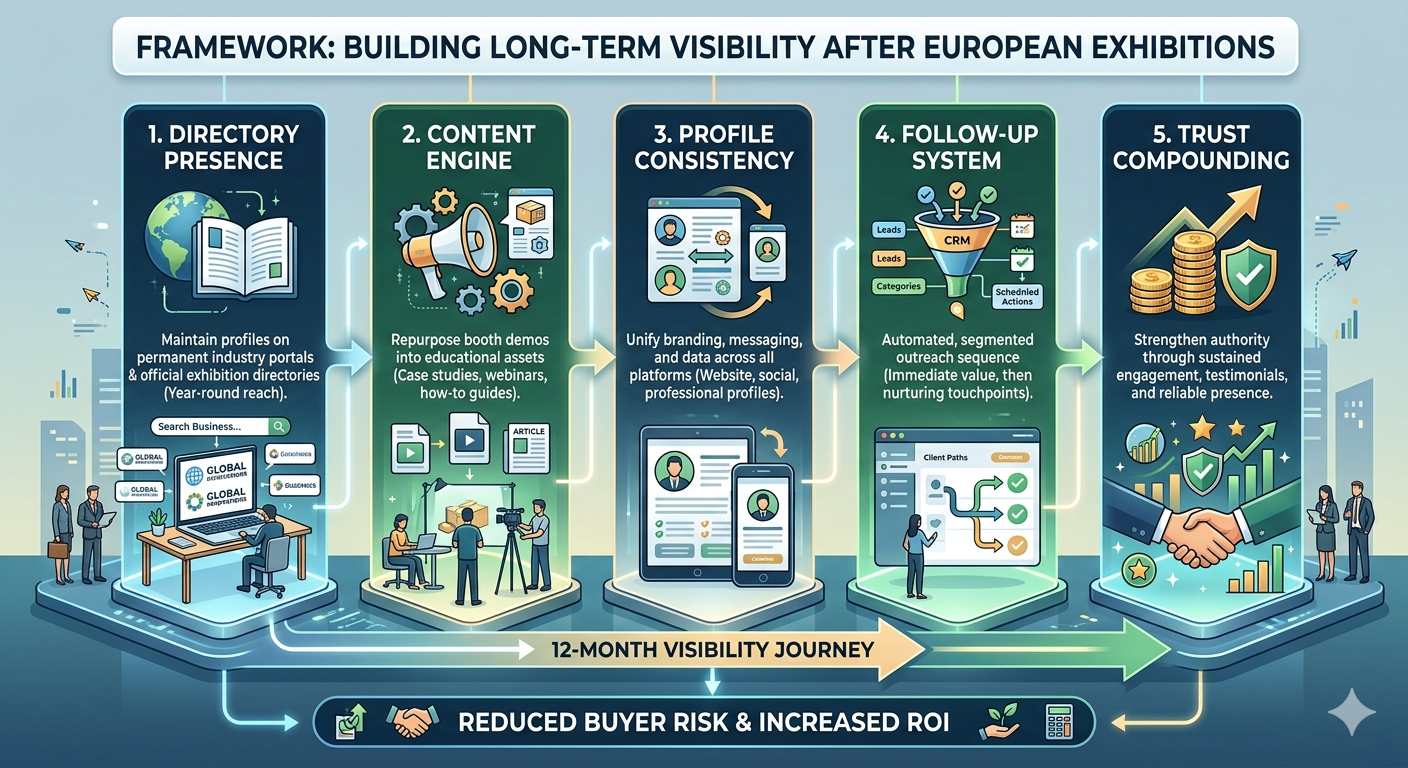
Permanent Discoverability: Your brand must appear in search results when buyers research suppliers during their decision window. Not just during fair season. Every month of the year. This requires ongoing SEO, content publishing, and directory presence.
Credible B2B Directory Positioning: A presence inside respected B2B ecosystems that international buyers trust. Not advertising platforms. Credibility environments where your profile serves as verifiable evidence of your capabilities.
Content Continuity: Regular publication of insights, case studies, and market updates that demonstrate ongoing expertise and activity. Buyers who find your recent content trust you more than buyers who find nothing.
Trust Persistence Through Signal Maintenance: The trust multiplier from your exhibition presence decays without continuity. 365-day visibility maintains that trust signal across the entire buyer decision cycle. It prevents the memory decay that destroys ROI for most exhibitors.
The BHOWCO 365-Day Profile is specifically designed to provide this infrastructure. It gives you permanent, credible, verifiable presence inside Germany’s exhibition ecosystem — discoverable when buyers finally make decisions months after the fair ends.
Signal Decay: Why Trade Fair Visibility Fades Without Strategic Continuity
This section contains the most important concept in the entire article.
Trade fair visibility decays rapidly without continuity.
It is not enough to exhibit well. It is not enough to follow up for a period. If your visibility is not sustained across the entire buyer decision cycle, your credibility will decay faster than you expect.
The Signal Decay Timeline
During Fair: Peak attention. Buyers are engaged, collecting information, forming first impressions. Your visibility is at maximum. Trust is borrowed from the ecosystem but not yet earned.
Days After: Attention begins to fade. Buyers are back to normal routines. Your brand is one of many they met. Without reinforcement, memory starts to decay.
Weeks After: Significant decay has occurred. Most generic follow-up has already been forgotten. Only buyers who received exceptional, personalised engagement still remember you clearly.
Months After: Buyers who have not seen your brand since the fair have largely forgotten you. Your visibility has decayed significantly. Competitors who maintained presence are being considered. You are not.
Extended Period: Your brand has faded completely from buyer memory for most prospects. The trust signals that were so strong during the fair have dissipated. You are starting from zero with the same buyers who were excited to meet you months ago.
What Signal Decay Means for Your ROI
Signal decay is why most exhibitors never see the ROI they expected. They invest heavily in the 3-day phase. They do some work in the 30-day phase. They ignore the 365-day phase entirely. And then they wonder why deals never materialise.
The reality is that significant investment is largely wasted without year-round continuity. The fair opens doors. But those doors close quickly. 365-day visibility keeps them open until buyers are ready to walk through.
How to Prevent Signal Decay
The only solution is strategic continuity. Permanent discoverability. Consistent content. Credible directory presence. A year-round visibility infrastructure that maintains your trust signal across the entire buyer decision cycle.
This is not optional for serious global exhibitors. It is the difference between being remembered and being forgotten. Between winning deals and losing them. Between being a temporary participant and a permanent global brand.
The 5 Reasons Most Exhibitors Fail After German Trade Fairs
Let us name the specific failures that destroy ROI for most international exhibitors. If any of these sound familiar, you have been losing money without understanding why.
1. No Continuity System Between Fairs
Most exhibitors treat each fair as an isolated event. They have no systematic process for maintaining visibility between exhibitions. Every fair starts from zero. Every year, they rebuild credibility that should have been maintained continuously. This is expensive, inefficient, and unnecessary.
2. No Buyer Tracking Across the Decision Cycle
Exhibitors collect business cards but do not track where buyers are in their procurement journey. They have no visibility into who is actively evaluating, who is stalled, and who has moved on. Without tracking, follow-up is blind. Without blind follow-up, most leads are wasted.
3. Weak Positioning That Does Not Survive Memory Decay
Your positioning during the fair might be clear. But does it survive buyer memory decay? Without reinforcement, even strong positioning fades. Exhibitors who do not reinforce their positioning through continuous visibility lose the differentiation they paid so much to create.
4. Generic Follow-Up That Destroys Momentum
Generic follow-up is worse than no follow-up. It signals that you did not pay attention, that the buyer is interchangeable with any other prospect, and that you have no real understanding of their business. Buyers who receive generic follow-up mentally move you to the bottom of their consideration list.
5. Complete Visibility Collapse After a Short Period
Most exhibitors maintain some follow-up for a few weeks after the fair. Then they stop. Completely. Their digital presence stagnates. Their profiles become outdated. Their content publishing ceases. By the time buyers are ready to decide, these exhibitors have become invisible. The deals go to competitors who stayed present.
These five failures are not inevitable. They are choices. Most exhibitors make these choices unconsciously because they have never been shown a better way. The 3-30-365 formula is the better way.
Buyer Psychology: Why Procurement Cycles Outlast Exhibition Attention
To build effective year-round visibility, you must understand how buyers actually think — not how you hope they think.
Why Buyers “Disappear” After Fairs
When a buyer seems interested at your booth and then does not respond to follow-up, it does not mean they were not interested. It means they have returned to a complex job with competing priorities. Your follow-up arrived at a busy moment. They intended to respond later. Later never came.
This is not rejection. This is normal buyer behaviour. The solution is not more aggressive follow-up. The solution is persistent, value-adding visibility that stays present without being intrusive.
Why Procurement Cycles Take Time
International B2B purchasing decisions involve multiple stakeholders, cross-departmental alignment, legal review, compliance verification, and budget approval. These processes take time — usually months from initial contact to signed contract.
Your exhibition presence represents only a small fraction of the buyer’s decision timeline. If you are invisible during the other portion, your chances of winning are dramatically reduced.
Why Memory Decay Is Inevitable Without Reinforcement
Human memory is not reliable. Without reinforcement, most details of your booth conversation will be forgotten within weeks. The buyer will remember that they met someone. They will not remember why you were different.
Strategic visibility reinforces memory. Each touchpoint resets the decay clock. Multiple touchpoints across the decision cycle ensure that when the buyer is ready to decide, your brand is the one they remember clearly.
Why Visibility = Perceived Stability
In global B2B, buyers use visibility as a heuristic for stability. Companies that are visible are assumed to be stable, successful, and reliable. Companies that are invisible are assumed to be struggling, unstable, or lacking global infrastructure.
This perception is not always accurate. But it is powerful. And it shapes procurement decisions every day. Your year-round visibility directly influences whether buyers perceive you as a stable global partner or a risky temporary player.
Case Scenario: Two Exhibitors at Hannover Messe — Same Fair, Different Results
Let us compare two companies. Both exhibited at Hannover Messe. Both had comparable booth quality. Both collected similar numbers of business cards.
Their strategies after the fair could not have been more different.
Company A: The Traditional Exhibitor
After the fair, Company A sent generic follow-up emails to all contacts within weeks. The emails were polite but offered no specific value. When responses were slow, they sent a second generic email. Then they stopped. Their website remained unchanged. Their social channels went quiet. Their B2B profiles were outdated.
By month 3, most buyers had forgotten Company A entirely. By month 6, when procurement decisions were being finalised, Company A was completely invisible. The significant investment generated minimal ROI. The team concluded that Hannover Messe “was not worth it.”
Company B: The 365-Day Strategic Exhibitor
After the fair, Company B sent personalised follow-up within days, referencing specific conversation points. They segmented contacts by buyer origin and sent relevant case studies. They maintained active content publishing. They ensured their BHOWCO profile was current and discoverable.
By month 3, buyers still remembered Company B clearly. By month 6, when procurement decisions were being finalised, Company B was the brand that never left. They won significantly more deals than Company A from the same fair. Their ROI compounded across subsequent exhibitions.
The Difference
Company A and Company B had identical fair performance. The difference was everything that happened after the fair. Company B understood that trade fairs do not reward presence. They reward continuity. They invested in year-round visibility infrastructure. Company A did not. The results speak for themselves.
This is how global B2B procurement actually works. The companies that win are those that stay visible across the entire buyer decision cycle — not just during the days of the fair.
Building Your 365-Day Visibility Infrastructure: A Strategic Roadmap
You understand the psychology. You understand the timeline. You understand the failures that destroy ROI for most exhibitors.
Now you need a practical roadmap for building your own year-round visibility infrastructure.
Step 1: Audit Your Current Post-Fair Continuity
Honestly assess what actually happens after your last exhibition. How quickly is follow-up sent? Is it personalised or generic? How long does visibility continue? Where do buyers find you between fairs? Most exhibitors will discover significant gaps in this audit. Those gaps represent lost opportunities.
Step 2: Select Your Credibility Anchor Fair
Choose one major German trade fair that attracts your target buyers. Do not spread yourself across multiple fairs prematurely. Depth of presence at one fair builds more credibility than surface presence at many. Commit to this fair for multiple consecutive years.
Step 3: Build Your 30-Day Conversion System
Document your post-fair process before the fair begins. Who sends follow-up? Within what timeframe? What personalisation is required? What case studies are ready to send? What segmentation criteria will you use? A documented system beats ad hoc effort every time.
Step 4: Activate Your 365-Day Visibility Infrastructure
Establish permanent presence inside credible B2B ecosystems. The BHOWCO 365-Day Profile provides this infrastructure. It ensures your brand remains discoverable, credible, and visible across the entire buyer decision cycle. It prevents the signal decay that destroys ROI for most exhibitors.
Step 5: Create Content Continuity
Plan your content publishing for the full period between fairs. Case studies from exhibition conversations. Insights about your industry. Evidence of global capability. Content that serves buyers during their internal validation phase. Consistency matters more than volume.
Step 6: Measure What Actually Predicts ROI
Track: post-fair engagement retention at intervals, qualified lead conversion rates by region, sales cycle acceleration compared to non-exhibition channels, and international search visibility trends. These metrics tell you whether your year-round infrastructure is working.
The 3-30-365 formula is not complicated. But it requires discipline, consistency, and a willingness to invest in visibility infrastructure. Most exhibitors will not do this work. That is precisely why those who do will dominate their categories.
Frequently Asked Questions
What is the 3-30-365 trade fair formula?
The 3-30-365 formula is a strategic operating system for international trade fair success. The “3” represents the days of physical exhibition presence where trust is activated. The “30” represents the critical post-fair conversion window where momentum is built or lost. The “365” represents permanent year-round visibility infrastructure that maintains credibility across the buyer’s entire decision cycle.
Why do most exhibitors lose ROI shortly after a trade fair?
Most exhibitors lose ROI because their post-fair follow-up is generic, delayed, or non-existent. Buyer memory decays rapidly without strategic reinforcement. Generic outreach signals that the exhibitor did not pay attention. Without structured engagement, the momentum from the fair evaporates, and buyers forget the exhibitor before procurement decisions are made.
What is signal decay and why does it matter for exhibitors?
Signal decay is the rapid fading of trust signals after a trade fair ends. Peak attention occurs during the fair. Over time, significant decay occurs. Without year-round visibility infrastructure, exhibition investment largely wastes as credibility fades and competitors who maintained visibility win the deals.
How does BHOWCO support 365-day visibility between exhibitions?
BHOWCO provides permanent, credible, verifiable presence inside Germany’s exhibition ecosystem. Your 365-day profile ensures international buyers can find you, verify your capabilities, and see your continued commitment during the long procurement cycle between fairs. It prevents signal decay that destroys ROI for most exhibitors and compounds your credibility year after year.
What is the biggest mistake exhibitors make after trade fairs?
The biggest mistake is generic follow-up that adds no value. Generic “nice to meet you, here is our brochure” emails signal that the exhibitor did not pay attention and treats the buyer as interchangeable. Worse is complete silence shortly after. Both destroy trust built during the fair and ensure most leads never convert.
How long does it take to see results from 365-day visibility infrastructure?
Visibility signals often begin within months — improved search presence, profile engagement, and inquiry volume. Full ROI impact typically appears in subsequent exhibition cycles as compounded credibility accumulates. Exhibitors with year-round visibility see significantly higher engagement from global buyers, with a substantial portion of qualified leads originating outside the initial fair region.
Trade fairs create opportunity. But long-term visibility determines whether that opportunity converts into sustained international growth.
Your booth opens the door. Your follow-up keeps it slightly ajar. But only year-round visibility infrastructure keeps it open until buyers are ready to walk through.
Your competitors will choose the easy path. They will focus on the 3 days. They will do minimal 30-day work. They will ignore the 365-day infrastructure entirely. They will start from zero at every fair and wonder why their ROI never materialises.
You can choose differently. You can build the infrastructure that maintains your credibility across the entire buyer decision cycle. You can be the brand that never leaves. You can win the deals that your competitors lose because they disappeared.
Build your 365-day visibility infrastructure before your next trade fair.
→ Find your trade fair hub
→ Master the 365-day visibility system
→ Strengthen your post-fair authority