Latest Insights
How Germany’s Exhibition Infrastructure Builds Global B2B Credibility


Exhibition Infrastructure Germany – The World’s Most Credible B2B Trust Filter
There is a reason global procurement teams fly to Germany instead of Dubai, Singapore, or Las Vegas.
Not because German booths are shinier. Not because German hotels are better. Not because German logistics are smoother — although they are.
The reason is deeper. Structural. Decades in the making.
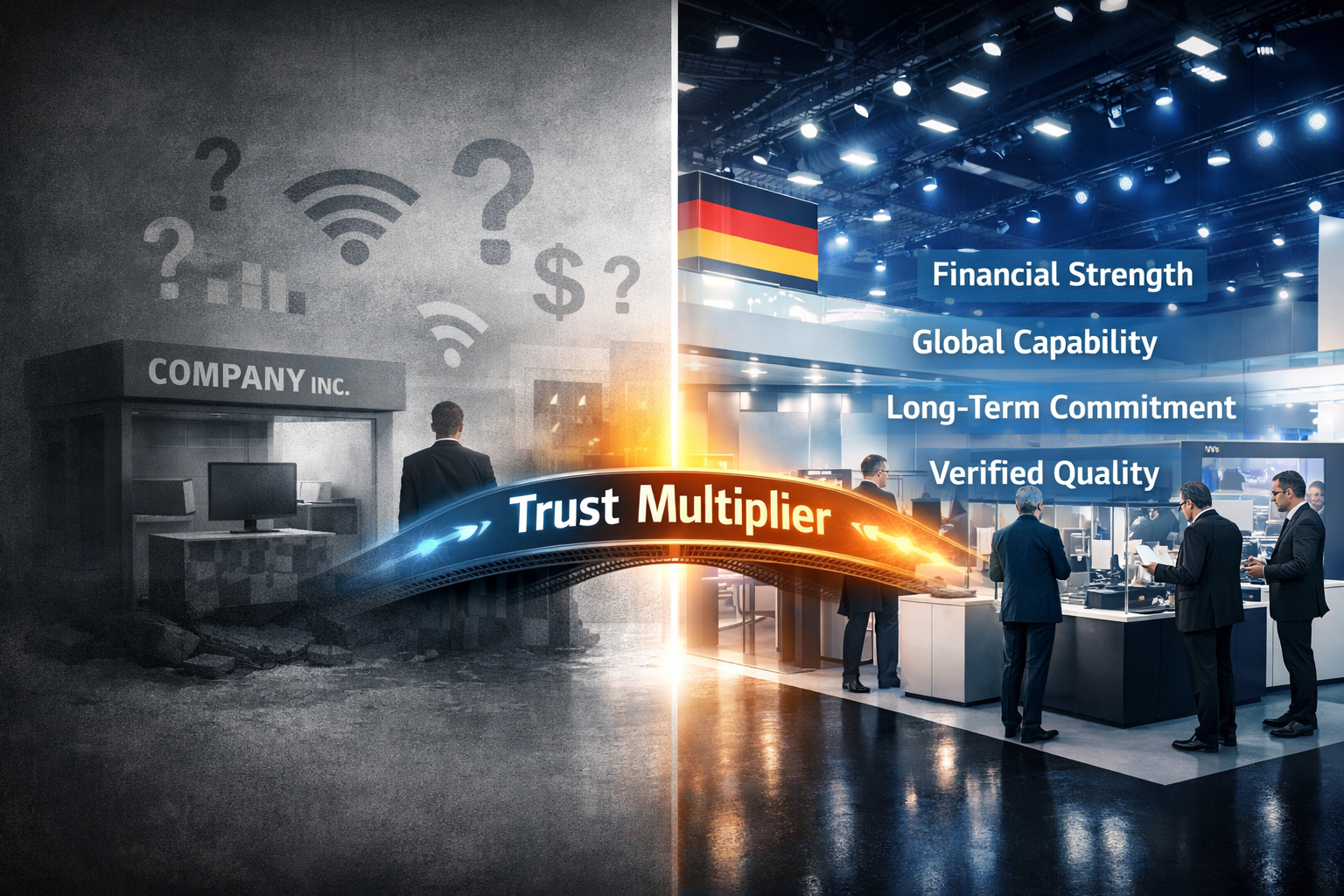
Germany has built the world’s most credible B2B exhibition ecosystem. And that ecosystem functions as a trust filter that international buyers rely on to reduce risk, verify capability, and make multi-million dollar partnership decisions.
This article reveals how Germany’s exhibition infrastructure actually works as a credibility engine. You will learn the four layers of infrastructure that build buyer trust, why Germany’s annual trade fairs create compounding authority, and exactly how to leverage this ecosystem for 365-day B2B credibility — not just 4-day visibility.
1. Beyond Venues: Why German Exhibition Centers Are Trust Filters, Not Just Buildings
Most international exhibitors look at German exhibition centers and see infrastructure. Buildings. Halls. Logistics.
This is like looking at a bank vault and seeing steel. You are missing the point entirely.
German exhibition centers are trust filters. They are physical manifestations of a credibility system that has been refined over decades. When you exhibit at Messe Frankfurt, Hannover Messe, Messe Düsseldorf, or any of Germany’s major venues, you are not just renting space. You are submitting to a filter that international buyers trust.
As detailed in the Exhibition Centers in Germany guide, these venues are the foundation of a strategic global networking system. They are not isolated locations. They are access points to international decision-making networks.
Here is what makes German exhibition centers different from venues anywhere else in the world:
Quality Curation, Not Just Space Rental
German trade fair organisers actively curate their exhibitor base. They maintain standards. They reject companies that do not meet quality thresholds. This curation is invisible to visitors but fundamental to trust. Buyers know that not everyone can exhibit. The barrier to entry is real, and that barrier signals quality.
Industry-Specific Ecosystems, Not Generic Events
Each major German exhibition center has developed deep expertise in specific industries. Messe Frankfurt dominates mobility, textiles, and consumer goods. Hannover Messe is the global capital of industrial technology. MEDICA in Düsseldorf is the world’s largest medical trade fair. This specialization creates dense networks of suppliers, buyers, and partners who return year after year.
International Density, Not Local Focus
A significant portion of visitors at leading German trade fairs come from outside Germany. These are not local events with international attendance. They are international events hosted in Germany. The difference is profound. Buyers attend because other international buyers attend. The ecosystem becomes self-reinforcing.
Historical Authority, Not Marketing Hype
Many of Germany’s major trade fairs have run for decades or even over a century. This longevity cannot be bought or faked. It represents generations of trust built through consistent delivery. When a buyer attends Hannover Messe, they are participating in a tradition of industrial commerce that predates their own career. That weight matters in procurement psychology.
Germany hosts a significant number of international trade fairs annually, attracting a substantial number of exhibitors and visitors from around the world. A large portion of exhibitors and visitors at major German fairs come from outside Germany. The trade fair industry generates significant economic value for the German economy each year. This is not a small industry. This is global B2B infrastructure.
2. The Four Layers of Infrastructure That Build B2B Credibility
Germany’s exhibition credibility rests on four interconnected layers of infrastructure. Each layer filters for different trust signals. Together, they create a system that international buyers trust more than any alternative.
Layer 1: Physical Infrastructure (The Venues)
Messe Frankfurt and Hannover Messe each have hundreds of thousands of square meters of exhibition space. These are not convention centers. They are small cities designed specifically for B2B commerce. The physical scale signals seriousness. Buyers know that companies willing to invest in this environment are not casual participants. They are committed global players.
Layer 2: Organisational Infrastructure (AUMA and Fair Organisers)
The Association of the German Trade Fair Industry (AUMA)
represents and strengthens the interests of exhibiting companies, organisers, service companies, and visitors on national and international markets.
This is not a marketing association. It is a quality assurance system.
AUMA sets standards, collects data, and enforces expectations across the entire ecosystem. Buyers trust AUMA data because it is systematic, not promotional.
Layer 3: Temporal Infrastructure (The Annual Calendar)
German trade fairs run on predictable, regular schedules. Hannover Messe happens every spring. MEDICA happens every autumn. This predictability allows buyers to plan their procurement cycles around the fair calendar. It also creates compounding trust. A company that exhibits year after year signals stability. A company that appears once and disappears signals the opposite.
Layer 4: Digital Infrastructure (365-Day Visibility)
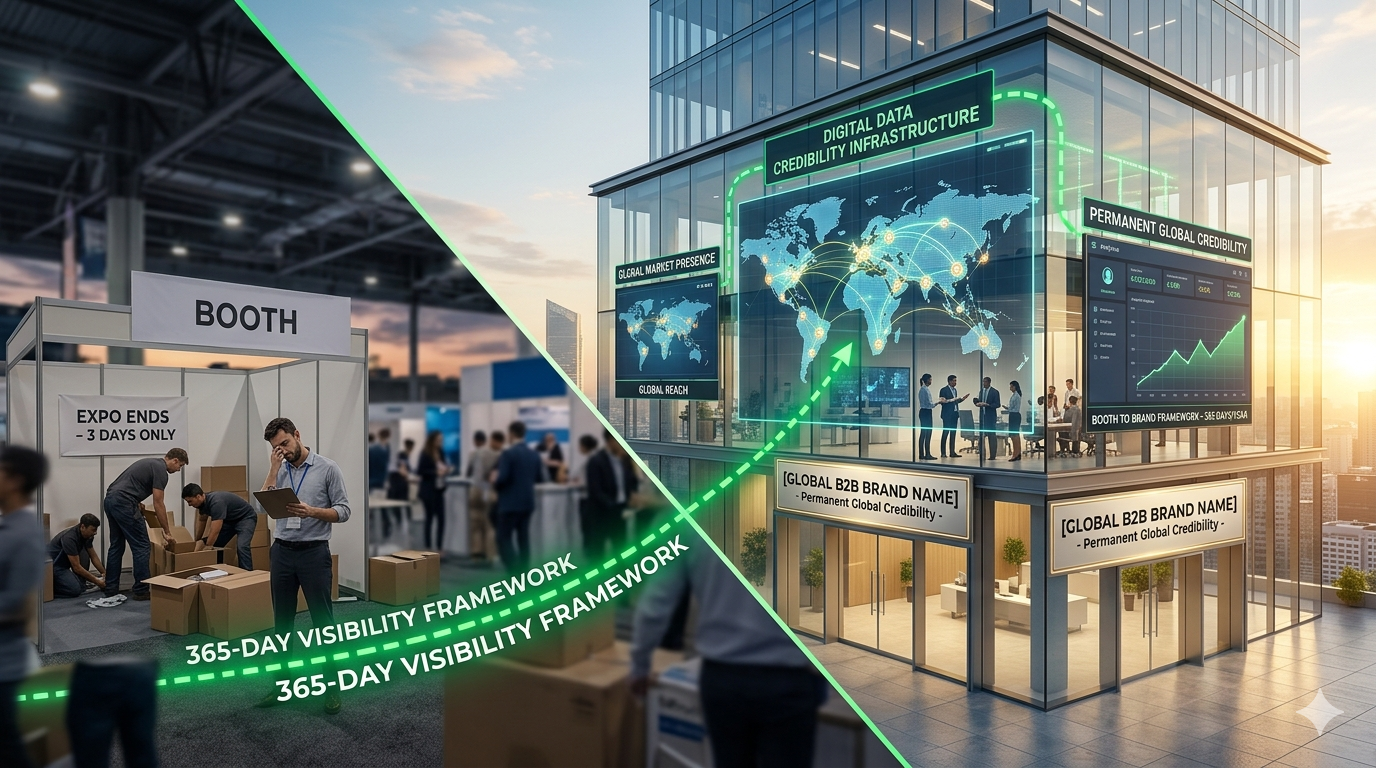
The physical fair lasts a few days. But credibility requires continuity. This is where most exhibitors fail — and where the BHOWCO 365-Day Visibility System was built to bridge the gap. Digital infrastructure extends the trust signals of the physical fair across the other days of the year. It transforms a short event into a year-round credibility asset.
As the 365-Day Visibility guide explains: “You can buy visibility for 3 days at Messe Frankfurt. Credibility takes 365. Understand why the most serious buyers ignore exhibitors who vanish after pack-down.”
The four layers work together as a system. Physical infrastructure attracts international buyers. Organisational infrastructure assures quality standards. Temporal infrastructure enables planning and repetition. Digital infrastructure sustains credibility between events. Miss any layer, and your trust signals become incomplete.
3. The Credibility Flywheel: How Consistency Compounds Across Exhibitions
Most exhibitors approach each trade fair as an isolated event. They spend, exhibit, pack up, and start from zero at the next fair. This approach guarantees that they never build compounding credibility.
The companies that win understand something different. They understand the credibility flywheel.
Here is how the flywheel works across multiple exhibitions:
First Exhibition (Entry)
At your first German trade fair, you benefit from borrowed trust. The ecosystem filters for you. Buyers assume you have met basic standards. But you have not yet demonstrated your own credibility. You are undifferentiated among hundreds or thousands of other exhibitors.
Second Exhibition (Confirmation)
If you exhibit again the following year, something changes. Buyers who attended both years notice your return. They interpret return as a trust signal. Companies that failed or underperformed do not come back. Your presence alone becomes evidence of capability.
Third Exhibition (Differentiation)
By your third year, you are no longer a new exhibitor. You are a fixture. Buyers who have seen you three times begin to assume you are an industry standard. You have moved from participant to reference point. Competitors are compared to you, not the other way around.
Fourth Exhibition and Beyond (Authority)
At this stage, your consistent presence has built durable trust. Buyers seek you out. They reference your past exhibitions in conversations. Your brand becomes synonymous with the category. This is the authority position that most exhibitors will never reach because they cannot sustain the consistency required.
The credibility flywheel explains why returning exhibitors outperform first-timers by such significant margins. It is not because their booths are better. It is because their consistency is a trust signal that cannot be faked.
This is also why the BHOWCO 365-Day B2B Visibility Packages offer tiered positioning from Starter to Growth to Authority. The platform is designed to support exhibitors through multiple years of consistent presence, not just single-event participation.
4. From Exhibition Center to Global Network Hub: The Strategic Shift
Here is the strategic insight that separates global brand builders from temporary exhibitors.
Most companies view exhibition centers as locations. They choose Messe Frankfurt because it is in Frankfurt. They choose Hannover because their industry is there. This is tactical thinking. It misses the structural reality entirely.
German exhibition centers are not locations. They are network hubs. They are physical access points to global B2B ecosystems that exist year-round, not just during fair weeks.
As the Exhibition Centers guide explains, this is a strategic path with four steps:
Step 1: Choose Your Network Hub
Select the exhibition center that dominates your industry ecosystem. Not because of the city. Because of the network density. Messe Frankfurt for mobility and consumer goods. Hannover for industrial technology. Düsseldorf for medical and printing. Nuremberg for toys and electronics. Each hub has developed specialized networks over decades.
Step 2: Select Specific Fairs Within That Hub
Each hub hosts multiple fairs across different sub-sectors. Choose the fairs where your specific buyers actually attend. Research international attendance patterns. Your strategy should align with your target markets.
Step 3: Understand Buyer Behaviour at Your Selected Fairs
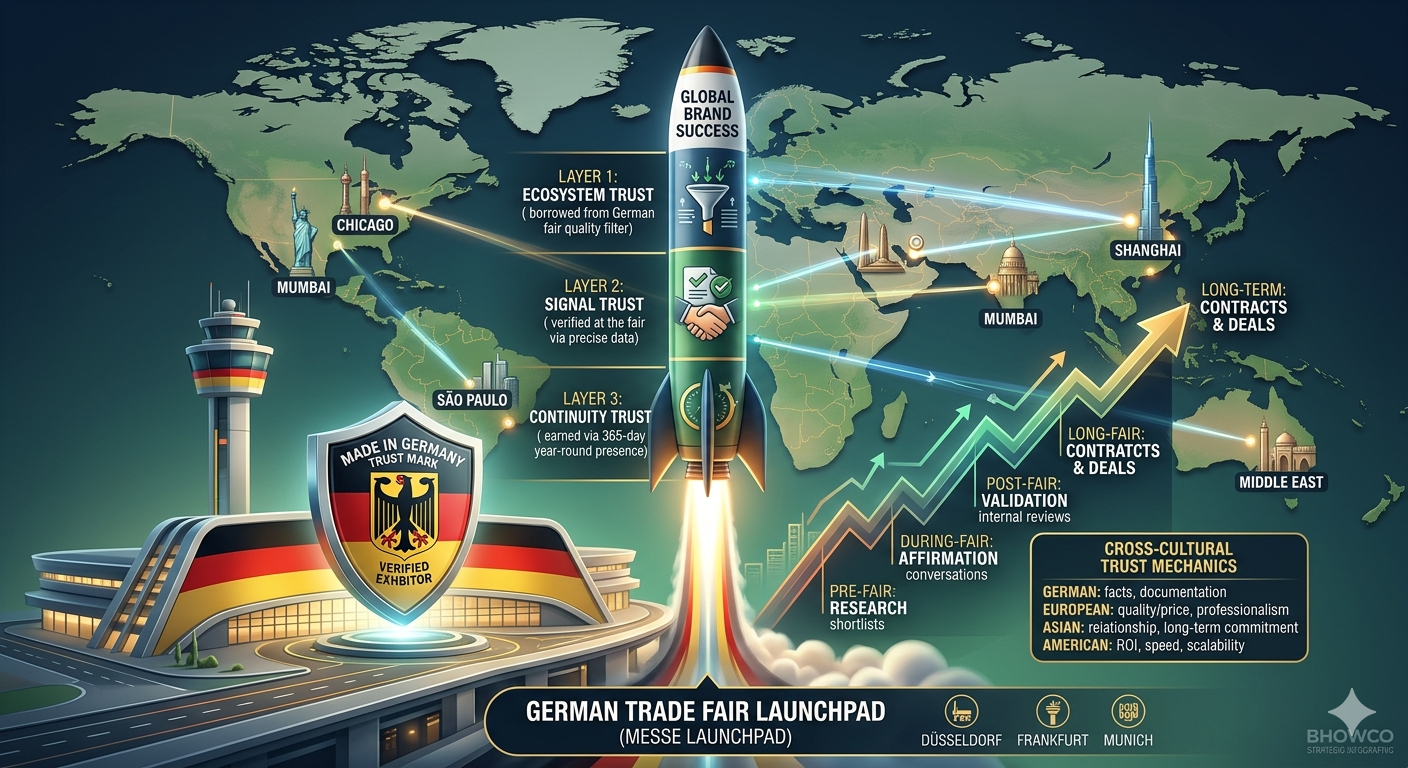
German buyers validate. European buyers balance quality and price. Asian buyers build relationships. American buyers seek ROI. Your booth and follow-up must adapt without confusing your core brand. One approach does not fit all buyer origins.
Step 4: Build 365-Day Presence Around Your Hub
The fair is a checkpoint, not the destination. Your 365-day visibility infrastructure should be centred on your chosen hub. Buyers who attend that fair throughout the year should be able to find you, verify you, and engage with you — not just during the fair days, but during the days when they are internally validating decisions.
This four-step framework transforms exhibition participation from tactical event attendance into strategic network building. You stop thinking about “which fair should we attend” and start thinking about “which network hub should we join for the long term.”
5. The 365-Day Credibility Gap: Why Most Exhibitors Waste Their Ecosystem Access
You now understand how Germany’s exhibition infrastructure builds credibility. You understand the four layers, the flywheel, and the network hub framework.
Here is the painful truth that most exhibitors will never accept.
Despite having access to the world’s most credible B2B exhibition ecosystem, many international exhibitors waste this access. They pay for the filter. They receive the borrowed trust. They stand in the ecosystem.
And then they destroy all of it by vanishing after pack-down.
The 365-Day Visibility guide identifies the specific gaps that destroy international trade fair ROI:
Timing Gaps
No pre-fair positioning before the event. Silence between initial contact and follow-up. Seasonal visibility only around fairs. Each gap signals inconsistency. Each gap erodes trust.
Geographic Gaps
Single-market focus that ignores buyers from Europe, Asia, and the Americas. No multilingual content strategy. Time-zone insensitive communication. Buyers from different regions conclude you are not equipped for global partnership.
Channel Gaps
Over-reliance on single platforms. No integrated digital and physical strategy. Inconsistent messaging across touchpoints. Buyers who verify across channels find contradictions and move on.
Content Gaps
No post-fair case studies. Industry insights only during events. Lack of German-language or region-specific materials. The evidence base buyers need during internal validation does not exist.
The solution is systematic visibility planning that addresses these gaps before they destroy credibility. As the guide states: “Systematic visibility planning creates continuous engagement cycles that align with international buyer behaviours rather than exhibition calendars alone.”
This is not optional for companies serious about global B2B growth. The ecosystem gives you borrowed trust. Your 365-day infrastructure determines whether you keep it, grow it, or lose it.
6. Building Your Permanent Credibility Asset: From Days to Year-Round
Exhibition Infrastructure Germany is not a secret. Any international exhibitor can access it. The barrier is not knowledge. The barrier is strategic patience and systematic execution.
Here is exactly what building permanent credibility through the German ecosystem looks like in practice.
Phase 1: Select Your Hub
Research which German exhibition center hosts the most relevant fairs for your target buyers. Consider international attendance patterns, industry concentration, and the geography of attending buyers. Choose one hub to focus on for an extended period. Do not spread yourself across multiple hubs too early.
Phase 2: Build Your Pre-Fair Presence
Before you ever book a booth, establish digital visibility within your chosen hub’s ecosystem. Publish content relevant to the fair’s audience. Optimise for search terms that buyers use during their research phase. Enter the fair as a known entity, not an unknown.
Phase 3: Execute With Continuity in Mind (During Fair)
Your booth should confirm pre-fair positioning, not introduce new claims. Train staff to capture context for follow-up, not just contacts. Provide documentation buyers can use during internal validation. Every interaction should be designed for the long decision cycle, not the short fair window.
Phase 4: Sustain Visibility During Validation (Post-Fair)
This is where credibility is won or lost. Maintain consistent digital presence. Publish case studies from fair conversations. Ensure your BHOWCO profile remains active and current. Respond to follow-up inquiries with specific, value-adding information. Be the brand that never leaves while competitors go silent.
Phase 5: Compound Through Repeated Participation (Years Beyond)
Exhibit at the same fair in subsequent years. Your return is a trust signal. Build on previous years’ visibility. Expand your profile within the BHOWCO platform from Starter to Growth to Authority levels as your credibility compounds. Each year, your credibility flywheel spins faster.
The BHOWCO 365-Day B2B Visibility Packages are specifically designed to support this five-phase framework. Starter profiles establish initial presence. Growth profiles enhance visibility during buyer comparison. Authority profiles position you as a category reference point that buyers use to validate decisions.
This is not advertising. This is credibility infrastructure. And in global B2B, credibility infrastructure is the only thing that compounds.
Frequently Asked Questions
What makes German exhibition infrastructure different from other countries?
Germany has built an integrated system over decades that includes physical venues, quality standards through AUMA, predictable annual schedules, and dense international attendance. No other country has this combination of scale, quality curation, and global buyer density. A significant portion of the world’s leading trade fairs are held in Germany for a reason: the ecosystem is uniquely credible.
How many international trade fairs does Germany host each year?
Germany hosts a substantial number of international trade fairs annually, attracting hundreds of thousands of exhibitors and millions of visitors from around the world. A significant portion of exhibitors and visitors at major German fairs come from outside Germany. The industry generates substantial economic value for the German economy each year.
Do I need to exhibit at the same fair every year to build credibility?
Not strictly every year, but consistent participation over multiple years is the fastest path to durable trust. Buyers interpret return as a credibility signal. Companies that appear once and vanish are assumed to have underperformed or lacked capability. If you cannot exhibit annually, maintain 365-day digital visibility between less frequent physical participation.
How does BHOWCO extend Germany’s exhibition infrastructure beyond the fair?
BHOWCO provides the digital layer of Germany’s credibility infrastructure. Your 365-day profile serves as permanent evidence for buyer internal validation. It keeps you visible across time zones and decision timelines. It transforms your short-term booth presence into a year-round credibility asset. Traditional directories expire. BHOWCO’s framework is designed for continuity.
What is the ROI of consistent exhibition participation in Germany?
Exhibitors with consistent pre-fair visibility enter as “known entities,” significantly reducing initial validation time. Post-fair continuity maintains engagement momentum, shortening overall sales cycles. Companies with year-round visibility see significantly higher engagement from global buyers, with a substantial portion of qualified leads originating outside the initial fair region.
Can small companies compete with large enterprises in this ecosystem?
Yes, and this is one of the most important features of the German system. Large enterprises have brand awareness but often suffer from fragmented, inconsistent follow-up. Small and mid-sized companies that execute focused, consistent 365-day strategies can absolutely outperform larger competitors who vanish after the fair. Consistency beats budget in post-exhibition credibility.
Germany’s exhibition infrastructure is the world’s most credible B2B trust filter.
But infrastructure alone does nothing. You must activate it. You must sustain it. You must build your permanent credibility asset through consistent participation and 365-day visibility.
Your competitors will attend the same fairs. They will have similar booths. They will collect the same business cards.
And then many of them will vanish. They will waste the ecosystem access. They will start from zero at the next fair.
You can choose differently. You can build credibility that compounds with every exhibition. You can become a fixture in your industry’s German network hub. You can be the brand buyers trust because you never left.
Explore how Germany’s exhibition infrastructure can become your permanent credibility asset.
→ Find your global network hub
→ Master the 365-day visibility system
→ Build your permanent credibility infrastructure