Latest Insights
Exhibition Amnesia: Why Brands Disappear After the Fair


Exhibition Amnesia: Why Brands Disappear After the Fair and How to Prevent It
There is a phenomenon in the exhibition industry that no one talks about publicly, but every exhibitor has experienced privately.
You invest months preparing. You spend significant budget. Your team delivers flawless presentations. Buyers seem genuinely interested. The energy is high. The promise is real.
And then, within weeks of the fair ending, your brand has vanished from buyer consciousness. It is as if you were never there. The conversations that felt so productive have left no trace. The business cards have gone cold. The momentum has evaporated.
This is exhibition amnesia.
Not a failure of your product. Not a failure of your team. Not a failure of your booth design. A failure of continuity — the systematic collapse of brand visibility that occurs when strategic reinforcement does not follow exhibition presence.
Exhibition amnesia destroys a significant portion of trade fair ROI for most international exhibitors. It is the single largest leak in the exhibition investment bucket. And almost no one talks about it because almost no one has diagnosed it accurately.
This article reveals why brands disappear after the fair, the psychology of exhibition amnesia, and the 365-day strategy to prevent visibility collapse. You will learn how to diagnose your own continuity gaps, build reinforcement systems that maintain brand recall, and transform temporary exhibition presence into permanent market visibility.
What Is Exhibition Amnesia? Diagnosing the Visibility Collapse
Exhibition amnesia is the systematic decay of brand visibility and buyer recall that occurs in the weeks and months following a trade fair. It is not accidental. It is structural. It is the predictable outcome of a strategy that ends when the fair ends.
The Symptoms of Exhibition Amnesia
How do you know if your brand suffers from exhibition amnesia? Look for these telltale signs:
- The Post-Fair Silence Gap: After the fair, your brand disappears from channels where buyers might find it. Social media goes quiet. Content publishing stops. Your website becomes static.
- The Generic Follow-Up Pattern: Follow-up emails are templated, impersonal, and indistinguishable from what every other exhibitor sends. Buyers cannot remember which company sent which message.
- The Lost Momentum Syndrome: Promising conversations from the fair lead nowhere. Buyers who seemed interested do not respond to follow-up. Your team cannot understand why.
- The Zero-Repeat Advantage: Each fair requires starting from zero. Previous exhibition participation provides no momentum for the next one. Buyers do not remember you from year to year.
- The Invisible Reference Problem: When buyers make procurement decisions months after the fair, your brand is not part of the conversation. You are not being discussed because you are not being remembered.
The Diagnostic Question
Ask yourself honestly: months after your last trade fair, where can international buyers find your brand? What evidence of continued capability exists? What recent content demonstrates ongoing expertise? What signals of stability and commitment are visible?
If the answer is “not much” or “the same website we have always had,” your brand suffers from exhibition amnesia. The good news is that it is preventable. The bad news is that preventing it requires changes that most exhibitors are unwilling to make.
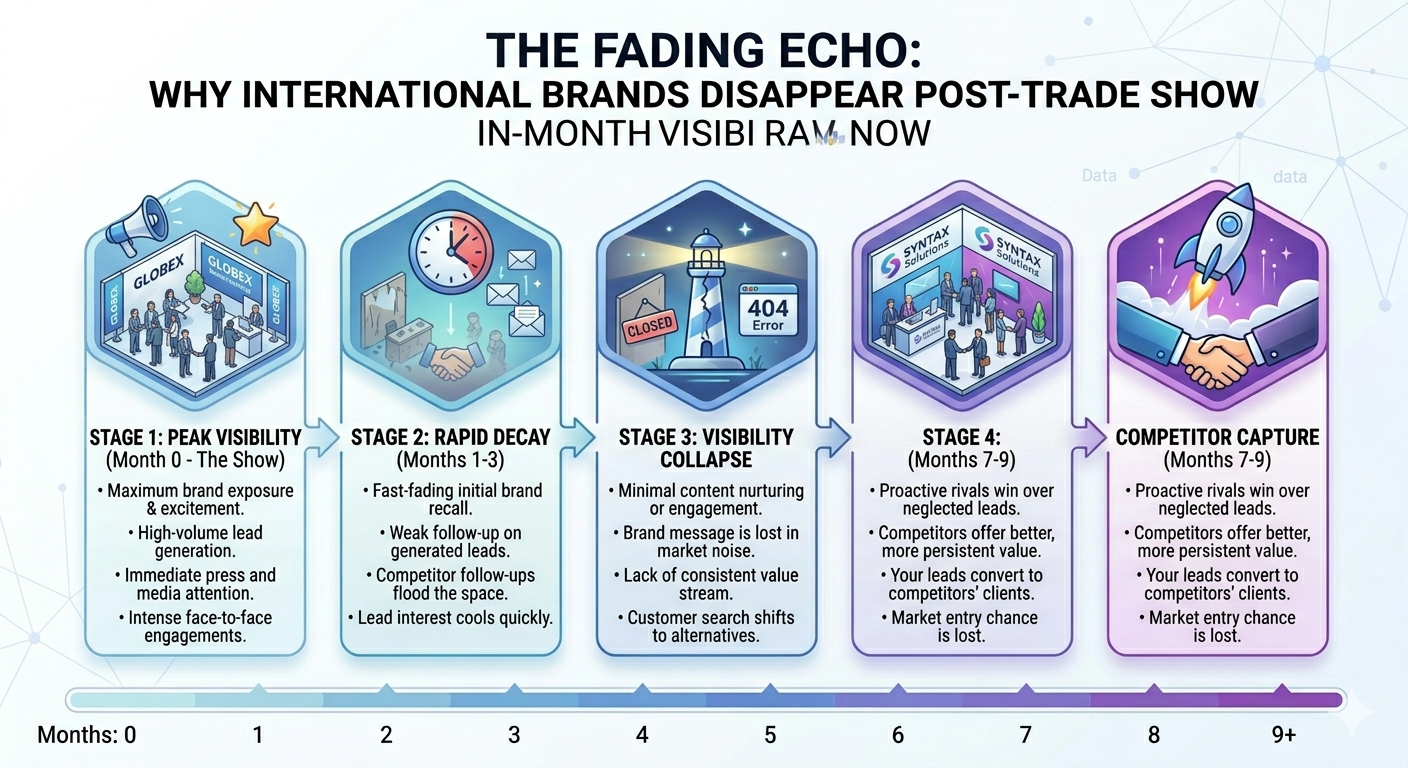
The Visibility Collapse Curve
Exhibition amnesia follows a predictable curve. During the fair: Peak visibility. Days after: Initial decay begins. Generic follow-up fails to reset memory. Weeks after: Significant decay has occurred. Most buyers no longer remember specific details. Months after: Severe decay. Most buyers have forgotten your brand entirely. Extended period: Complete collapse. Your brand is invisible to buyers who are finally making decisions.
This curve is not inevitable. Strategic reinforcement flattens it. 365-day visibility infrastructure prevents the collapse entirely. But without intervention, exhibition amnesia destroys most of your investment.
As the 365-Day Visibility System explains: “Silence after the fair is not neutral. It signals lack of commitment to the relationship.” Exhibition amnesia is not just forgetting. It is active trust destruction. Buyers who forget you also trust you less.
The Psychology of Exhibition Amnesia: Why Forgetting Is Not Failure
To prevent exhibition amnesia, you must first understand why it happens. The causes are not mysterious. They are rooted in predictable psychological and structural factors.
Cause 1: The Cognitive Load Problem
Trade fairs are information-saturated environments. A buyer at Hannover Messe might meet dozens or even hundreds of exhibitors in a single day. Each meeting requires attention, processing, and memory encoding. The human brain cannot prioritise which interactions to retain when everything feels equally urgent and important.
The result is that most interactions are encoded weakly. Without reinforcement, they are lost within days or weeks. This is not a failure of your booth presentation. It is a limitation of human cognition. You cannot overcome it with better brochures or more enthusiastic staff. You can only overcome it with strategic reinforcement.
Cause 2: The Interference Effect
After the fair, buyers return to complex jobs with competing priorities. Each new task, each new email, each new problem interferes with the retention of what they learned at the fair. The interference effect means that your exhibition investment is actively competing with the buyer’s daily work for memory space. And the buyer’s daily work usually wins.
The implication is that passive hope — hoping buyers remember you — is not a strategy. It is a prayer. Strategic reinforcement must actively combat interference by providing repeated, spaced encounters with your brand.
Cause 3: The Absence Signal Problem
When your brand disappears after the fair, buyers notice. Not consciously, perhaps. But the absence registers. The contrast between your strong fair presence and your post-fair silence creates a negative inference. Buyers unconsciously conclude that your absence signals instability, lack of commitment, or insufficient global infrastructure.
This is exhibition amnesia’s cruelest irony. Your disappearance does not just cause forgetting. It actively damages trust. Buyers who forget you also trust you less than if they had never met you at all.
Cause 4: The Expectation Mismatch
Buyers expect follow-up. When follow-up is generic, delayed, or absent, they are disappointed. This disappointment colours their memory of the entire interaction. A booth conversation that felt positive at the time becomes negative in retrospect when followed by inadequate follow-up.
As the German Buyer Behavior guide notes, “In Germany, interest signals need for verification.” Buyers expect verification. When you do not provide it, they conclude you cannot provide it. Trust collapses.
Cause 5: The Reinforcement Gap
The forgetting curve is well-established in cognitive psychology. Without reinforcement, memory decays exponentially. Strategic reinforcement — spaced encounters with your brand — resets the forgetting curve and maintains recall. Most exhibitors provide no reinforcement after the first generic follow-up email. The reinforcement gap is the direct cause of exhibition amnesia.
Preventing exhibition amnesia is not about working harder during the fair. It is about building reinforcement systems that work across the full procurement cycle.
Which Brands Disappear? The Five Profiles of Exhibition Amnesia
Exhibition amnesia does not affect all exhibitors equally. Some brands are more vulnerable than others. Here are the five profiles most at risk.
Profile 1: The Fair-Focused Exhibitor
This exhibitor invests everything in the fair itself. Booth design. Staff training. Giveaways. Pre-fair marketing. But when the fair ends, the investment stops. There is no post-fair strategy because there is no post-fair budget. The assumption is that the fair does the work. The result is rapid visibility collapse.
Prevention failure: Assumes fair presence is sufficient. Does not understand the forgetting curve. No reinforcement infrastructure.
Profile 2: The Generic Follow-Up Exhibitor
This exhibitor sends follow-up emails — but the emails are generic, templated, and indistinguishable from what every other exhibitor sends. “Nice to meet you at the fair. Here is our brochure. Let us know if you have questions.” This follow-up does not reset the forgetting curve. It may even accelerate forgetting by confirming that the exhibitor did not pay attention.
Prevention failure: Confuses activity with effectiveness. Does not understand that generic follow-up is worse than no follow-up.
Profile 3: The One-and-Done Exhibitor
This exhibitor participates in a fair once and does not return. The assumption is that one appearance is enough to establish credibility. The reality is that one appearance, without continuity, creates a negative signal. Buyers wonder why the exhibitor did not return. They assume performance was unsatisfactory.
Prevention failure: Does not understand that credibility compounds through consistency. Treats exhibition participation as transaction rather than relationship.
Profile 4: The No-Infrastructure Exhibitor
This exhibitor has no permanent visibility infrastructure. No credible B2B directory presence. No content continuity system. No passive reinforcement assets. When active follow-up ends, visibility ends. Buyers who want to verify the brand months later find nothing current.
Prevention failure: Confuses active outreach with total visibility. Does not understand passive reinforcement.
Profile 5: The Single-Channel Exhibitor
This exhibitor relies on one channel for post-fair engagement — usually email. When emails go unanswered, the exhibitor stops. There is no multi-channel strategy. No retargeting. No search visibility. No directory presence. The single channel fails, and visibility collapses.
Prevention failure: Puts all reinforcement eggs in one basket. Does not understand that different buyers prefer different channels.
If your brand matches any of these profiles, you are losing ROI to exhibition amnesia. The good news is that prevention is possible. The bad news is that prevention requires changing how you think about exhibition investment.
The 365-Day Prevention Framework: From Collapse to Continuity
Exhibition amnesia is preventable. The prevention framework consists of four strategic layers, each designed to maintain visibility across a different phase of the procurement cycle.
Layer 1: Pre-Fair Memory Priming (Months Before)
Prevention begins before the fair. Buyers who discover your brand during their research phase are more likely to remember you after the fair. Pre-fair content, search visibility, and directory presence prime memory before the first interaction. This priming makes encoding stronger and forgetting slower.
Strategic actions: Publish content optimised for buyer research keywords. Ensure your BHOWCO profile is complete and current. Build search visibility for partnership terms, not just product keywords.
Layer 2: During-Fair Memory Encoding (The Fair Days)
The quality of initial encoding determines how quickly forgetting occurs. Deeper, more meaningful interactions are encoded more strongly and decay more slowly. Superficial, transactional interactions are encoded weakly and forgotten quickly.
Strategic actions: Focus on qualified conversations, not booth traffic. Create emotional memory triggers through genuine insight and value. Document specific details for personalised follow-up.
Layer 3: Post-Fair Memory Reinforcement (Days to Weeks After)
Reinforcement resets the forgetting curve. Each strategic touchpoint strengthens memory and delays decay. The timing, content, and channel of reinforcement matter as much as the fact of reinforcement itself.
Strategic actions: Send personalised follow-up within days. Provide value-adding content at regular intervals. Segment reinforcement by buyer origin and demonstrated interest level.
Layer 4: 365-Day Passive Visibility (Year-Round)
Permanent visibility infrastructure provides continuous passive reinforcement. Buyers who research months after the fair can discover your brand, verify your credibility, and engage on their own timeline. This passive layer is what most exhibitors lack — and what prevents exhibition amnesia most effectively.
Strategic actions: Maintain active BHOWCO profile with current case studies. Publish content consistently across the full year. Ensure search visibility for relevant keywords in target markets.
The BHOWCO 365-Day Profile provides Layer 4 infrastructure. It ensures your brand remains discoverable, credible, and visible when buyers are finally ready to decide — not just when you are ready to exhibit.
Exhibitors who implement all four layers prevent exhibition amnesia. Their brands do not disappear after the fair. Their visibility does not collapse. Their ROI compounds across years rather than resetting to zero at each fair.
The Continuity Infrastructure: What You Need to Build
Preventing exhibition amnesia requires specific infrastructure. Here is what you need to build, maintain, and optimise.
Infrastructure 1: Permanent B2B Directory Presence
Your brand needs a permanent, credible home inside Germany’s exhibition ecosystem. A BHOWCO profile provides this. It signals to buyers that you are not a temporary participant. You are a permanent player. It gives buyers a place to verify your capabilities months after the fair.
Without this: Your brand has no permanent address in the ecosystem. Buyers cannot verify your continued commitment. Exhibition amnesia accelerates.
Infrastructure 2: Content Continuity System
Your brand needs a consistent publishing calendar across the full 12-month cycle. Not just before fairs. Every month. Case studies, industry insights, market updates, capability demonstrations. Each piece of content is a reinforcement touchpoint that resets the forgetting curve.
Without this: Buyers who research between fairs find outdated or no content. They assume inactivity. They move to competitors who publish consistently.
Infrastructure 3: Reinforcement Cadence Documentation
Your team needs documented processes for post-fair reinforcement. Who sends follow-up? Within what timeframe? What content goes to which buyer segments? What triggers different follow-up paths? A documented system ensures consistency even when team members are busy or change roles.
Without this: Post-fair reinforcement is ad hoc and inconsistent. Some buyers receive excellent follow-up. Most receive generic or no follow-up. Exhibition amnesia affects most of your leads.
Infrastructure 4: Buyer Tracking Across Time
Your CRM needs to track buyer engagement across the full procurement cycle. Not just initial contact. Email opens, content downloads, profile views, website visits. This tracking tells you who is still engaged, who is fading, and who needs reinforcement.
Without this: Your follow-up is blind. You cannot identify which buyers are actively evaluating versus which have moved on. Resources are wasted on lost causes while serious buyers are neglected.
Infrastructure 5: Cross-Channel Presence
Your brand needs to be discoverable across multiple channels. Email, search, directories, social platforms, retargeting. Different buyers prefer different channels. Multi-channel presence ensures you reach each buyer through their preferred touchpoint.
Without this: You miss buyers who do not respond to email. You are invisible to buyers who primarily use search. You have no presence where some buyers spend their time.
The 365-Day Visibility System provides the framework for building this infrastructure. Not as a one-time project, but as an ongoing strategic capability that compounds with each exhibition.
Case Study: Preventing Exhibition Amnesia Across Two Exhibitors
Let us examine two exhibitors at the same fair, in the same industry, with similar booth quality. Their approaches to post-fair continuity could not be more different.
Company A: The Amnesia Victim
Company A invested significantly in a premium booth at Hannover Messe. Their team delivered excellent presentations. They collected many business cards. The fair felt successful. Then they went home.
Follow-up emails were generic and sent weeks after the fair. “Nice to meet you. Here is our brochure. Let us know if you have questions.” No second touchpoint. No content continuity. No directory presence. No passive visibility.
By a few months out, most buyers had forgotten Company A. When procurement decisions began, Company A was completely invisible. Their significant investment generated minimal ROI. The team concluded that Hannover Messe “was not worth it.”
Diagnosis: Classic exhibition amnesia. All four prevention layers missing. Visibility collapsed completely within weeks.
Company B: The Continuity Builder
Company B invested in a modest booth at the same fair. They allocated budget to 365-day visibility infrastructure, including a BHOWCO profile, content continuity systems, and documented reinforcement cadences.
Pre-fair positioning began months before the fair. Follow-up was personalised and sent within days. Reinforcement continued at regular intervals. Their BHOWCO profile remained active and discoverable. Content publishing continued across the full year.
By the time procurement decisions began, buyers still remembered Company B clearly. Company B was visible in search results, directory listings, and recent content. Company B won significantly more deals than Company A from the same fair.
Diagnosis: Exhibition amnesia prevented. All four prevention layers implemented. Visibility sustained across full procurement cycle.
The Difference
Company A and Company B had similar fair performance. The difference was everything that happened after the fair. Company B understood that exhibition amnesia is preventable — but only with strategic infrastructure. Company A assumed that good fair performance was enough. It was not.
This pattern repeats across thousands of exhibitors every year. The ones who prevent exhibition amnesia win. The ones who do not, lose. The choice is strategic, not accidental.
Measuring Exhibition Amnesia: How to Know If Your Brand Is Disappearing
You cannot fix what you do not measure. Here is how to diagnose exhibition amnesia in your own strategy.
Metric 1: Brand Recall at Intervals
Survey a sample of buyers who engaged with you at the fair. Ask them what they remember about your brand. Compare recall at different intervals post-fair. If recall drops substantially, exhibition amnesia is severe.
Target: Meaningful recall maintained across intervals.
Metric 2: Post-Fair Engagement Retention
Track email open rates, content downloads, and profile views at intervals post-fair. Calculate retention as percentage of initial engagement. If retention drops substantially, your reinforcement is insufficient.
Target: Retention remaining at meaningful levels across intervals.
Metric 3: Search Visibility Trends
Monitor your search visibility for relevant keywords in target markets. If visibility drops significantly after the fair and does not recover, exhibition amnesia is affecting your passive discovery.
Target: Stable or growing search visibility across the full year. No post-fair collapse.
Metric 4: Inbound Inquiry Patterns
Track inbound inquiries from buyers who attended the fair but did not engage at your booth. These buyers discovered you through passive visibility. If inbound inquiries drop substantially, your passive visibility infrastructure is inadequate.
Target: Consistent inbound inquiries across the full procurement cycle, not just immediately post-fair.
Metric 5: Sales Cycle Length Comparison
Compare sales cycle length for fair-sourced deals versus other channels. If fair-sourced deals take significantly longer to close, post-fair reinforcement is insufficient. Momentum is being lost.
Target: Fair-sourced deals closing as efficiently as other channels.
If these metrics reveal exhibition amnesia, the solution is not to exhibit less. It is to build the continuity infrastructure that prevents visibility collapse. The BHOWCO 365-Day Profile is the foundation of that infrastructure.
Building Your Exhibition Amnesia Prevention System: A Roadmap
You understand the phenomenon. You understand the psychology. You understand the infrastructure required. Now you need a practical roadmap for building your prevention system.
Step 1: Diagnose Your Current Amnesia Severity
Measure your brand recall, engagement retention, and search visibility from your last few fairs. Be honest about the gaps. Most exhibitors discover that exhibition amnesia is destroying a significant portion of their potential ROI. Document the specific gaps so you know what to fix.
Step 2: Build Your Permanent Visibility Infrastructure
Establish a BHOWCO 365-Day Profile before your next fair. Ensure your profile is complete, current, and strategically positioned. This is the foundation. Without permanent infrastructure, every other prevention layer is compromised.
Step 3: Document Your Reinforcement Cadence
Before your next fair, document your post-fair reinforcement sequence. What content goes to which buyer segments? At what intervals? Who is responsible? What triggers different follow-up paths? A documented system ensures consistency.
Step 4: Establish Content Continuity
Create a 12-month content calendar that includes case studies, industry insights, and market updates. Publish consistently across the full year, not just around fairs. Each piece of content is a reinforcement touchpoint that prevents amnesia.
Step 5: Train Your Team on Prevention
Ensure everyone involved in exhibition strategy understands exhibition amnesia. The booth team needs to know that their work continues after the fair. The marketing team needs to know that post-fair reinforcement is not optional. The sales team needs to know that visibility infrastructure supports their pipeline.
Step 6: Measure and Optimise Continuously
Track your amnesia prevention metrics after every fair. What worked? What did not? Which reinforcement touchpoints drove engagement? Which buyer segments responded best? Use the data to optimise your next fair.
Exhibition amnesia is not inevitable. It is a choice — the choice to stop investing when the fair ends. The prevention system described here is not complicated. But it requires discipline, consistency, and a willingness to build infrastructure that most exhibitors ignore. Those who build it will achieve results that those who do not cannot imagine.
Frequently Asked Questions
What is exhibition amnesia?
Exhibition amnesia is the systematic decay of brand visibility and buyer recall that occurs in the weeks and months following a trade fair. It destroys a significant portion of trade fair ROI for most international exhibitors. Symptoms include post-fair silence gaps, generic follow-up patterns, lost momentum, zero repeat advantage, and invisible reference problems. Exhibition amnesia is preventable with strategic continuity infrastructure.
Why do brands disappear after trade fairs?
Brands disappear because exhibitors suffer from cognitive load problems, interference effects, absence signals that damage trust, expectation mismatches from generic follow-up, and reinforcement gaps across the procurement cycle. These causes are structural, not accidental. Preventing disappearance requires building continuity infrastructure.
How can I diagnose if my brand suffers from exhibition amnesia?
Measure brand recall at intervals post-fair, post-fair engagement retention, search visibility trends, inbound inquiry patterns, and sales cycle length. If recall drops substantially or engagement retention drops substantially, exhibition amnesia is severe. Most exhibitors discover amnesia destroys a significant portion of potential ROI.
What infrastructure prevents exhibition amnesia?
Prevention requires five infrastructure components: permanent B2B directory presence (such as a BHOWCO profile), content continuity systems, documented reinforcement cadences, buyer tracking across time, and cross-channel presence. Without these components, exhibition amnesia is inevitable. With them, visibility can be sustained across the full procurement cycle.
How does BHOWCO help prevent exhibition amnesia?
BHOWCO provides the permanent visibility infrastructure that most exhibitors lack. Your 365-day profile ensures your brand remains discoverable, credible, and present across the full procurement cycle. It provides passive reinforcement that maintains brand recall without requiring active outreach. The platform closes the continuity gap that causes exhibition amnesia.
What results can I expect from preventing exhibition amnesia?
Exhibitors who prevent exhibition amnesia typically see substantially higher brand recall at later intervals, significantly better engagement retention, fair-sourced deal volume increasing year over year, and ROI compounding across exhibitions rather than resetting to zero. The investment in prevention infrastructure is typically recovered within one or two exhibitions.
Exhibition amnesia is destroying your trade fair ROI. But it is preventable.
Not with better brochures. Not with larger booths. Not with more enthusiastic staff. With strategic continuity infrastructure that maintains your brand visibility across the full procurement cycle.
Your competitors will continue suffering from exhibition amnesia. Their brands will disappear after the fair. Their ROI will collapse. They will blame the fair, the industry, the economy — anything except their own lack of continuity infrastructure.
You can choose differently. You can build the prevention systems that maintain your visibility when others go dark. You can be the brand buyers remember when decisions are finally made. You can achieve what most exhibitors believe is impossible: trade fair ROI that compounds across years rather than resetting to zero.
Stop disappearing after the fair. Start building your exhibition amnesia prevention system today.
→ Select your anchor exhibition hub
→ Master the 365-day visibility framework
→ Build your permanent visibility infrastructure