Latest Insights
Why Trade Fair Participation Alone Does Not Generate Contracts


Why Trade Fair Participation Alone Does Not Generate Contracts
You invested in the booth. You paid for the space. Your team stood ready for three days. And then you returned home with no contracts. This is not failure. This is normal. Trade fair participation alone has never generated contracts. It generates attention. Contracts come from what happens after. Trade fairs create visibility. Continuous presence creates international trust and long-term business opportunities. This article explains why trade fair participation alone does not generate contracts — and what actually turns exhibition attention into signed agreements.
Here’s a truth that experienced international exhibitors learn after their first few cycles: a trade fair is not a sales floor. It’s a meeting ground. Buyers are not there to sign. They are there to look, learn, and collect options. The signing happens later, often months later, and only for suppliers who remain visible during the gap.
Quick Reality Check: Are You Expecting Too Much From the Trade Fair Itself?
Answer these questions honestly:
- ☐ Do you expect buyers to make decisions at your booth? (Yes/No)
- ☐ Do you measure trade fair success by contracts signed during the event? (Yes/No)
- ☐ Do you have a structured post-exhibition process longer than 30 days? (Yes/No)
- ☐ Do you maintain visibility between trade fairs? (Yes/No)
- ☐ Do you understand your buyers’ actual procurement timeline? (Yes/No)
If you answered “Yes” to the first two questions and “No” to the last three, your expectations are misaligned with how B2B buying actually works. This mismatch is expensive.
The Gap Between Exhibition Attention and Signed Contracts
Consider what actually happens at a trade fair. A buyer walks past hundreds of booths. They stop at a handful. They have brief conversations. They collect brochures or scan badges. Then they return to their office, where their real job has been waiting.
At no point in this sequence is the buyer ready to sign a contract. They haven’t evaluated alternatives. They haven’t secured internal approvals. They haven’t verified supplier reliability. They haven’t aligned budgets. These steps happen after the trade fair, not during it.
Trade fair participation does one thing well: it creates initial awareness. It puts your company on a list of options. But being on a list is not winning the contract. Moving from the list to the contract requires months of visibility, trust-building, and patience.
A recurring pattern across European procurement is that buyers begin serious supplier evaluation weeks or months after a trade fair. Contracts signed at the booth itself are exceptions, not the rule. Exhibitors who expect otherwise are setting themselves up for disappointment.
For a deeper understanding of how buyers actually behave, read this guide to buyer behavior at trade fairs.
Why Attendance Is Not a Strategy
Many international exhibitors treat trade fair participation as a complete strategy. Register for the exhibition. Ship the booth. Send the team. Go home. This is not a strategy. It’s an activity. A strategy answers the question: what happens between this trade fair and the next contract?
Based on observation, exhibitors who treat participation as the strategy share common patterns:
- They have no structured follow-up process beyond a few emails
- They have no permanent visibility between trade fairs
- They measure success by leads collected, not contracts closed
- They blame the trade fair when revenue doesn’t appear
- They repeat the same expensive pattern at the next exhibition
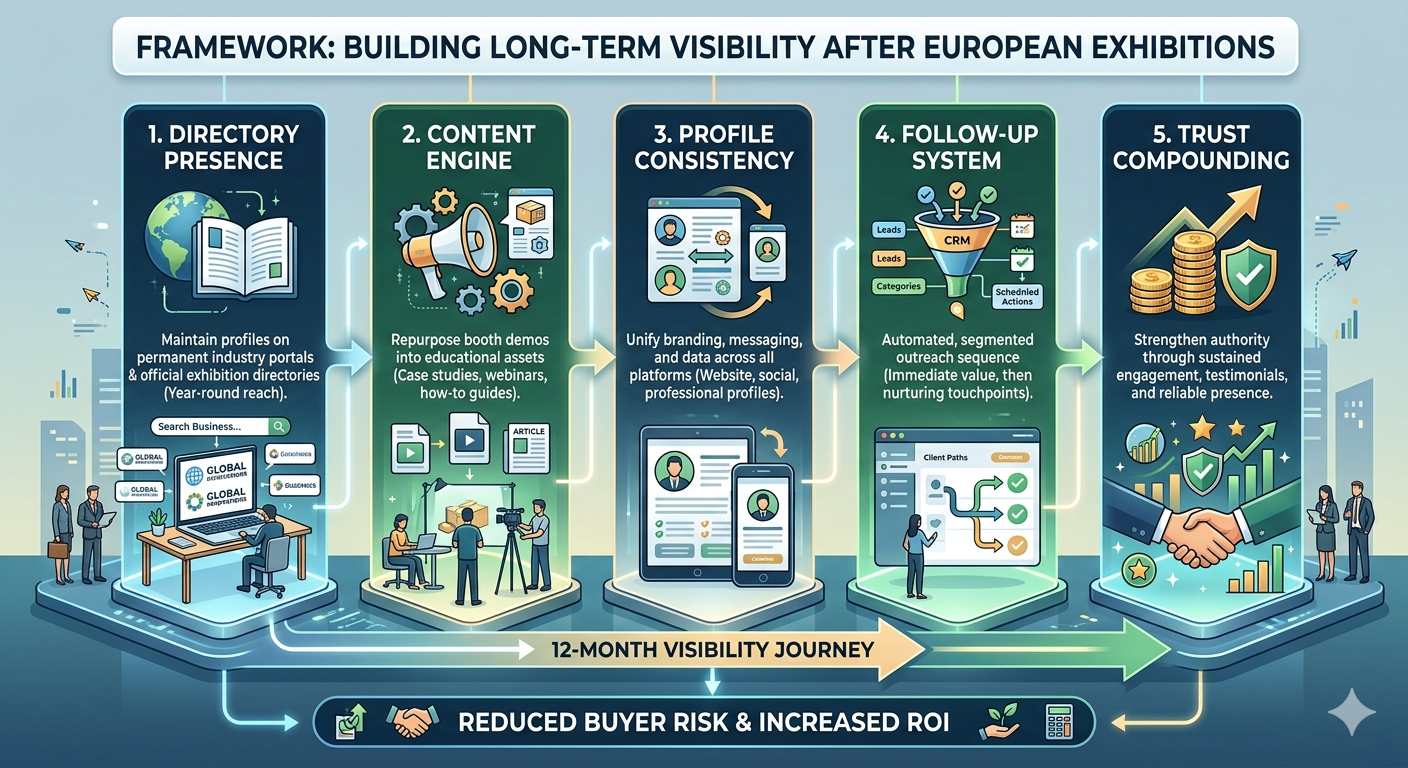
Exhibitors who treat participation as the beginning of a process do something different. They have systems. They have patience. They have permanent discoverability that works year-round. They understand that the trade fair is the introduction. The months after are where the sale happens.
For practical guidance on building this system, see how trade fair visibility works year-round.
The Four Things That Actually Generate Contracts
If trade fair participation alone doesn’t generate contracts, what does? Based on observation of successful international exhibitors, four specific elements consistently separate those who get contracts from those who only get leads.
1. Structured Post-Exhibition Follow-Up
Not a few emails. A structured sequence of touchpoints over an extended period, spaced progressively, with decreasing pressure and increasing value. The first message acknowledges. The second provides value. The third shares context. The fourth checks in without asking for anything.
What to do: Map your follow-up timeline before the trade fair starts. Schedule messages at regular intervals.
2. Permanent Directory Visibility
Buyers evaluate when they’re ready, not when you email. A permanent directory listing ensures they find you during those silent evaluation weeks. Without this, even perfect follow-up fails because buyers search, find nothing recent, and move on.
What to do: Maintain an updated permanent directory listing with current information and regular updates.
3. Evidence of Ongoing Market Engagement
Buyers need to know you’re still active between trade fairs. A company that publishes regular observations, updates profiles, and maintains visibility signals long-term commitment. A company that disappears signals temporary interest.
What to do: Publish short market observations regularly. Update your directory profile monthly, even with small changes.
4. Patience With Procurement Timelines
European procurement cycles extend over weeks or months for simple purchases and longer for complex ones. Exhibitors who expect quick decisions are misaligned with reality. They stop visibility exactly when buyers are starting to evaluate seriously.
What to do: Map your expected procurement timeline before the trade fair. Align your follow-up and visibility plan to that timeline, not your sales urgency.
Before your next trade fair, ensure you’ve completed all preparation steps with the exhibitor checklist for trade fairs.
The Cost of Expecting Contracts at the Booth
When exhibitors expect contracts to generate at the trade fair itself, two expensive things happen. First, they design their booth and conversations around closing rather than relationship-building. This often feels pushy to European buyers, who prefer lower-pressure discovery. Second, they have no post-exhibition infrastructure because they assumed the work was done at the booth.
The result: no contracts from the trade fair. The exhibitor blames the event, the location, the buyer quality. But the real problem was expectation misalignment. The trade fair did its job — creating attention. The exhibitor didn’t do their job — converting attention into trust, and trust into contracts.
For help selecting which trade fairs deserve your participation investment, read how to choose the right trade fair for your strategy.
What Realistic Success Looks Like
Here is what realistic success looks like for an international exhibitor at a European trade fair. Not marketing hype. Not agency promises. Observable reality from experienced exporters.
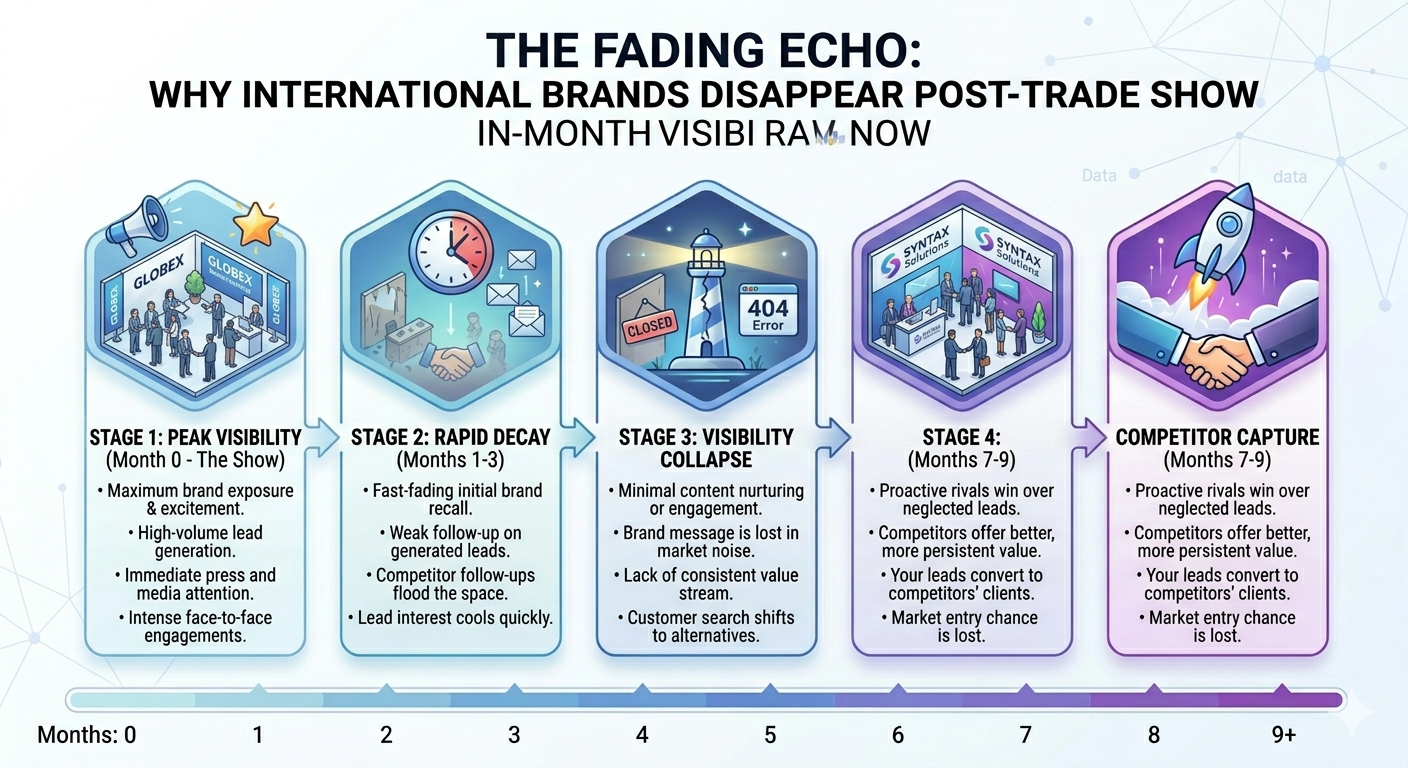
During the trade fair: Good conversations. Quality leads. No contracts signed. No pressure to close.
Weeks after the fair: Acknowledgment messages sent. Directory profile updated with post-show context. First value messages deployed. No responses yet. That’s fine.
Later weeks: Silent evaluation happening. Buyers checking profiles, searching online, observing activity. Some inbound inquiries begin. First small conversations start.
Months later: Serious procurement discussions. Technical questions. Commercial negotiations. Contracts starting to appear from the strongest leads.
Additional months: More contracts from leads that took longer to evaluate. Repeat conversations starting with satisfied customers. The trade fair investment beginning to show real return.
This timeline is not slow. It is normal for cross-border B2B. Exhibitors who accept this timeline build systems that work within it. Exhibitors who fight this timeline burn out and blame the trade fair.
Frequently Asked Questions
Is it normal to get no contracts directly from a trade fair?
Yes, completely normal. Most B2B buyers do not sign contracts at trade fairs. They use exhibitions to identify potential suppliers. The actual contracting happens weeks or months later, after internal evaluation, and only for suppliers who remain visible during that period.
How long after a trade fair do contracts typically come?
Based on observation, contracts from trade fair leads typically appear months after the exhibition. Simple purchases may close within weeks to a few months. Complex procurement cycles often take longer. Some contracts come after extended periods. Patience is not optional — it’s strategic.
What’s the biggest mistake exhibitors make with trade fair participation?
The biggest mistake is treating trade fair participation as the complete strategy rather than the beginning of one. Exhibitors who stop all visibility activity after a few follow-up emails are surprised when no contracts appear. The trade fair did its job. Their post-exhibition system failed.
Can I measure trade fair success without contracts?
Yes. Measure quality conversations, relevant leads, and profile views on your directory listing after the event. Track inbound inquiries over the following months. Measure contract signings at 3, 6, and 12 months. A trade fair is successful if it starts conversations that eventually become revenue — not if it closes deals during the event.
How does BHOWCO help turn trade fair participation into contracts?
BHOWCO provides the permanent visibility and discoverability that works during the months between trade fair and contract. When buyers silently evaluate, your updated BHOWCO profile ensures they find recent activity and current information. See how BHOWCO bridges the gap between participation and contracts.
- Is it normal to get no contracts directly? – Yes. Most B2B buyers don’t sign at trade fairs.
- How long do contracts take? – Months, depending on complexity.
- Biggest mistake? – Treating participation as the complete strategy.
- Can I measure success without contracts? – Yes. Track leads, inquiries, profile views.
- How does BHOWCO help? – Permanent visibility during the evaluation gap.
Conclusion: Participate, Then Persist
Trade fair participation is essential. It creates awareness. It starts conversations. It puts your company on buyer lists. But trade fair participation alone does not generate contracts. Contracts come from what happens after: structured follow-up, permanent visibility, evidence of ongoing engagement, and patience with procurement timelines.
Trade fairs create visibility. Continuous presence creates international trust and long-term business opportunities. The exhibitors who get contracts are not the ones with the largest booths. They are the ones who remain visible, discoverable, and committed through the long, quiet months between the trade fair and the signature.
BHOWCO exists to bridge that gap. Your permanent directory listing works while you wait, while buyers evaluate, and while contracts slowly take shape.
Build your bridge from participation to contracts with a permanent BHOWCO directory listing