Latest Insights
How European Buyers Evaluate International Suppliers After Trade Fairs


How European Buyers Evaluate International Suppliers After Trade Fairs
You met what felt like genuinely interested European buyers at the trade fair. They asked detailed questions. They seemed engaged. Then weeks passed with silence. You assumed they lost interest. But here’s what actually happened: they were evaluating you. Just not the way you expected. Trade fairs create visibility. Continuous presence creates international trust and long-term business opportunities. This article explains how European buyers evaluate international suppliers after trade fairs — and what you need to be visible during their silent evaluation process.
Here’s something many international exhibitors misunderstand: European buyers rarely announce they are researching you. The evaluation happens silently, often without a single email or phone call. By the time they reach out, they have already formed an opinion based on what they found — or didn’t find — online.
Quick Self-Assessment: Are You Visible During Buyer Evaluation?
Answer these questions from a European buyer’s perspective:
- ☐ If a buyer searches your company name today, will they find recent activity? (Yes/No)
- ☐ Is your company profile updated on European exhibition platforms? (Yes/No)
- ☐ Can buyers verify your local market presence without contacting you? (Yes/No)
- ☐ Have you published any market-relevant content in the past 60 days? (Yes/No)
- ☐ Would a buyer find consistent information across all platforms? (Yes/No)
If you answered “No” to multiple questions, European buyers are evaluating you poorly — not because of your product, but because of your invisibility.
The Silent Evaluation Timeline
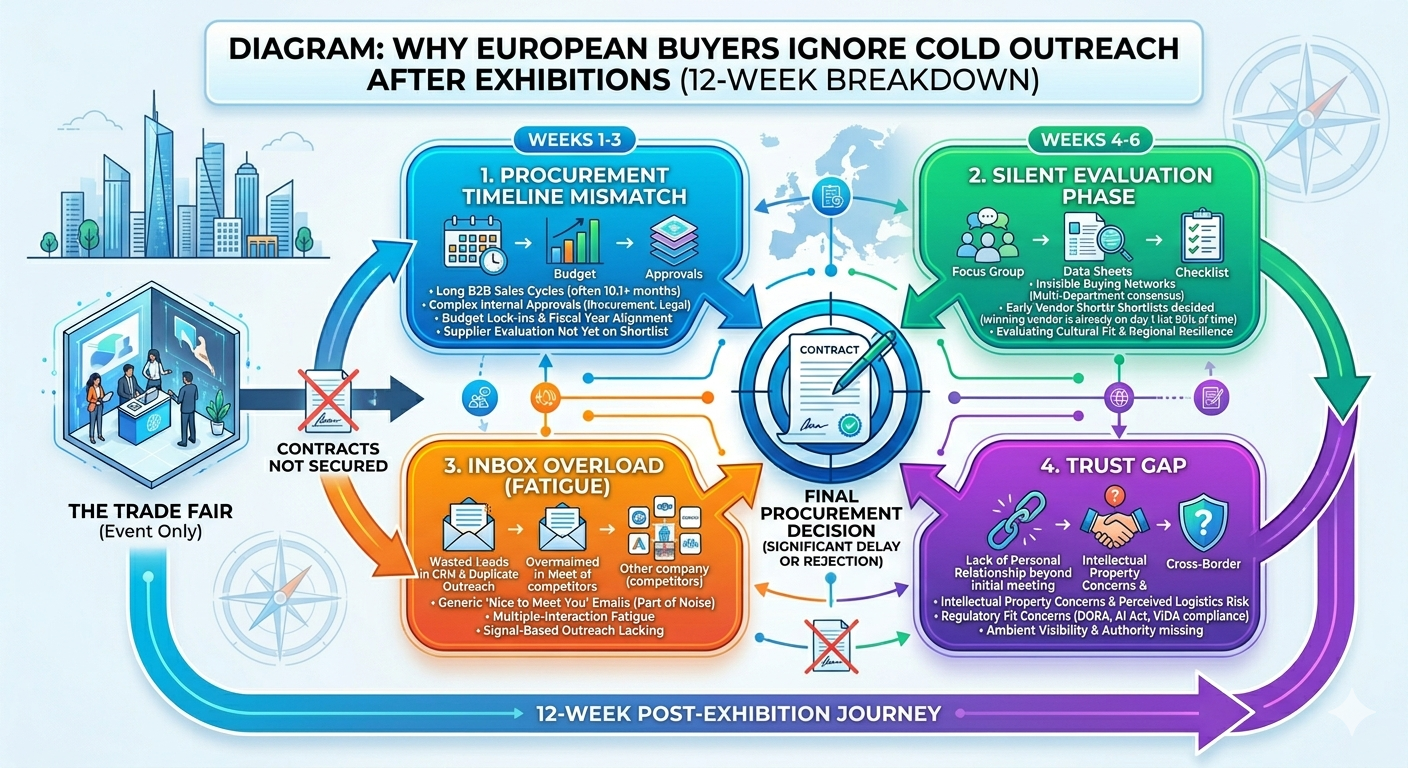
Based on observation of procurement behavior across major European markets, the post-exhibition evaluation follows a predictable pattern. Understanding this timeline is the first step to being visible when it matters.
Weeks 1-2: Initial Sorting
Buyers return from the trade fair and clear operational backlogs. They don’t evaluate suppliers yet. They simply organize notes and scan badges. Most exhibitors assume this silence means disinterest. It doesn’t. It means the buyer is busy with work that existed before the trade fair.
Weeks 3-6: First Online Verification
Buyers begin searching for the most promising suppliers. They check websites, directory profiles, and recent activity. They look for evidence that the supplier is actively present in the European market — not just visiting for a trade fair. If they find outdated profiles or no recent activity, trust decreases significantly at this stage.
Weeks 7-12: Deep Evaluation
Buyers who passed the first verification enter deeper evaluation. They check distributor references, look for case studies from similar markets, and observe ongoing activity. They notice whether the supplier has published anything relevant since the trade fair. Silence from the supplier during this phase is often interpreted as reduced reliability.
Weeks 12-24: Decision or Deferral
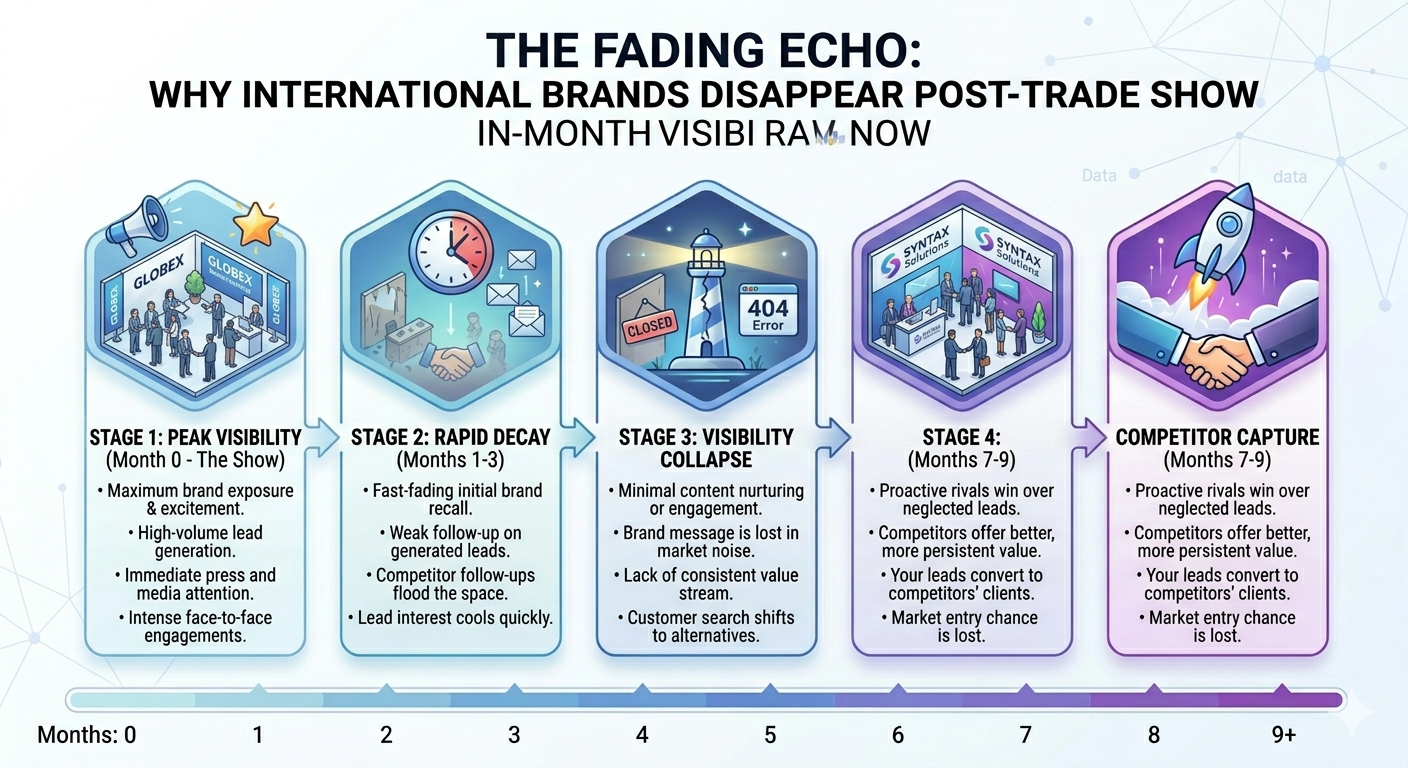
Some buyers make decisions. Others defer to the next procurement cycle. But crucially, buyers remember which suppliers remained visible throughout this entire period. Those who disappeared are rarely reconsidered later.
For a deeper understanding of how buyers think during this process, read this guide to buyer behavior at trade fairs.
What European Buyers Actually Look For
Through observation of dozens of procurement processes, European buyers consistently check for five specific things when evaluating international suppliers after trade fairs.
1. Updated Directory Presence
Buyers check exhibition platforms and B2B directories to verify that a supplier maintains an active presence. An outdated profile with last year’s information signals neglect. A recently updated profile with current products and contact information signals professionalism. A recurring pattern across European procurement is that directory presence significantly influences shortlisting decisions.
What to do: Update your permanent directory listing monthly, even with small changes.
2. Evidence of Local Market Commitment
European buyers want to know that an international supplier is serious about their market. This doesn’t necessarily require a physical office. But it does require visible evidence of commitment: local logistics partners, region-specific certifications, or consistent market activity.
What to do: Display local market information prominently on your profile. Mention any regional partnerships or certifications.
3. Recent Content or Market Observations
Buyers notice when a supplier publishes regular market insights. It signals that the company is actively engaged with the market — not just trying to sell something. Short, practical observations work better than long white papers.
What to do: Publish one short market observation every 30-45 days. It doesn’t need to be long. It just needs to be recent.
4. Consistent Information Across Platforms
European buyers check multiple sources. If your website says one thing and your directory profile says another, trust erodes. Inconsistent information is one of the fastest ways to fail silent evaluation.
What to do: Audit your online presence quarterly. Ensure company descriptions, contact information, and product listings match everywhere.
5. Proof of Active Engagement Between Trade Fairs
Buyers want to know that the supplier exists when there isn’t a trade fair happening. A company that only appears during exhibition weeks looks like a temporary market entrant. A company with year-round visibility looks like a committed partner.
What to do: Maintain visibility between trade fairs through directory listings and regular updates. See how year-round visibility works.
The Difference Between Visible and Invisible Suppliers
Consider two international suppliers who met the same European buyer at the same trade fair. Both had good conversations. Both exchanged business cards. Then the evaluation period began.
Supplier A sent a follow-up email in week one, received no reply, and stopped all activity. Their directory profile shows last year’s information. Their website hasn’t been updated since before the trade fair. When the buyer searches for them in week eight, they find nothing recent. Trust erodes. The buyer moves to another supplier.
Supplier B also sent a follow-up email in week one. But they also updated their directory profile after the trade fair. They published a short observation about a trend they noticed at the exhibition. When the buyer searches in week eight, they find recent activity, updated information, and evidence of ongoing market engagement. Trust accumulates. The buyer initiates contact.
The product quality may be identical. The difference is visibility.
Before your next trade fair, ensure you understand how buyers evaluate suppliers with the exhibitor checklist for trade fairs.
Why Silence Doesn’t Mean Rejection
One of the most important observations about European buyers: silence during evaluation is normal. Procurement teams rarely provide status updates. They don’t send “still thinking about it” emails. They evaluate silently, often for months, before reaching out.
Many international exhibitors interpret this silence as rejection. They stop all activity. They assume the buyer chose someone else. But in many cases, the buyer simply wasn’t ready yet. And when they finally became ready, the exhibitor had disappeared from visibility.
The solution is not more aggressive follow-up. It is continuous visibility that works without requiring buyer replies. Permanent directory profiles, regular content updates, and consistent ecosystem presence ensure you remain findable during the entire silent evaluation window.
For help selecting which trade fairs attract the right European buyers, read how to choose the right trade fair for your strategy.
Frequently Asked Questions
How long do European buyers take to evaluate international suppliers?
Based on observation, European procurement teams typically take weeks to months to evaluate suppliers after a trade fair. The evaluation window varies by industry, company size, and purchase complexity. Crucially, most of this evaluation happens silently without contacting the supplier.
What do European buyers check before contacting a supplier?
European buyers typically check: updated directory profiles, recent online activity, evidence of local market presence, consistent information across platforms, and any published content or market observations. They want to verify that the supplier is actively engaged in their market — not just visiting for a trade fair.
Do European buyers expect follow-up after trade fairs?
Yes, but not aggressive follow-up. A brief acknowledgment within a few days is expected. Value-driven messages over the following weeks are appreciated. Constant sales pressure is not. Most importantly, buyers expect suppliers to remain findable and visibly active during the evaluation period — whether or not they respond to emails.
Can a small international supplier compete with larger companies in European buyers’ eyes?
Yes. European buyers often prefer smaller suppliers who demonstrate genuine commitment to their market. A smaller company with consistent year-round visibility and updated directory profiles frequently outperforms a larger competitor who disappears after the trade fair. Buyer trust is built on reliability and presence — not company size.
What is the biggest mistake international suppliers make with European buyers?
The biggest mistake is assuming that no response means no interest. Many international suppliers stop all visibility activity after sending a few follow-up emails with no reply. In reality, the buyer may be silently evaluating. When the buyer finally reaches decision stage, the supplier has already disappeared from search results and directory platforms.
How does BHOWCO help with European buyer evaluation?
BHOWCO provides a permanent directory presence that remains visible during the entire European buyer evaluation window. When buyers search for suppliers weeks or months after a trade fair, your updated BHOWCO profile ensures they find recent activity and current information. Explore how BHOWCO supports visibility during buyer evaluation.
- How long do buyers take? – Weeks to months. Varies by industry.
- What do buyers check? – Directory profiles, recent activity, local presence, consistency, content.
- Do buyers expect follow-up? – Yes, but patient, value-driven, not aggressive.
- Can small suppliers compete? – Yes. Consistency beats size.
- Biggest mistake? – Assuming silence means rejection.
- How does BHOWCO help? – Permanent visibility during evaluation.
Conclusion: Be Visible When Buyers Are Ready
European buyers evaluate international suppliers silently, often for months after a trade fair. They check directory profiles, search for recent activity, and look for evidence of market commitment. Many international exhibitors disappear exactly when buyers are looking for them — not because they intend to, but because they stop all visibility activity after follow-up emails go unanswered.
Trade fairs create visibility. Continuous presence creates international trust and long-term business opportunities. The suppliers who win European buyers are not always the ones with the best booths. They are the ones who remain discoverable during the silent evaluation window when buyers are actually ready to decide.
BHOWCO exists to bridge that gap. Your permanent directory listing works while you sleep, while you prepare for the next trade fair, and while European buyers silently evaluate their options.
Ensure European buyers find you during evaluation with a permanent BHOWCO directory listing