Latest Insights
Post-Fair Visibility – The Missing Layer Of International Exhibitor Strategy


Post-Fair Visibility – The Missing Layer Of International Exhibitor Strategy
You have a trade fair strategy. You have a follow-up plan. You have a booth design. But you are still losing contracts. The reason is not what you think. You are missing an entire strategic layer. Post-fair visibility is not follow-up. It is not lead nurturing. It is something fundamentally different — and without it, every other strategy fails. Trade fairs create visibility. Continuous presence creates international trust and long-term business opportunities. This article reveals the missing layer of international exhibitor strategy and why post-fair visibility determines whether your trade fair investment generates ROI or evaporates.
Here is a distinction that changes everything: follow-up asks buyers to respond. Post-fair visibility ensures buyers find you when they do not respond. Most exhibitors have the first. Almost none have the second. That is why most fail.
If your post-fair strategy consists entirely of sending emails, this article will help you expand it.
Quick Strategy Audit: Is Post-Fair Visibility Missing From Your Plan?
Answer these questions honestly about your current approach:
- ☐ Can buyers find your updated company information when they ignore your emails? (Yes/No)
- ☐ Does your directory profile show activity from the past 30 days? (Yes/No)
- ☐ Do you have a way to stay visible to buyers who never respond? (Yes/No)
- ☐ Is your post-fair strategy designed for the long term, not just a few weeks? (Yes/No)
- ☐ Do you measure post-fair visibility by inbound inquiries, not email opens? (Yes/No)
If you answered “No” to three or more questions, post-fair visibility is missing from your strategy. Your trade fair investment is leaking value every day.
What to Expect in This Article:
- The critical difference between follow-up and post-fair visibility (most exhibitors confuse them)
- Why most post-fair value comes from passive visibility, not active outreach
- The components of a complete post-fair visibility system
- How to measure visibility success without tracking email opens
- The weekly cadence that keeps you visible while buyers evaluate silently
Follow-Up vs Post-Fair Visibility — The Critical Distinction
Most international exhibitors confuse two completely different activities. They call everything “follow-up.” This confusion destroys their ROI.
| Aspect | Follow-Up | Post-Fair Visibility |
|---|---|---|
| Primary mechanism | Direct outreach (emails, calls) | Passive presence (directory profiles, content) |
| Requires buyer action | Yes — response required | No — works silently |
| Success metric | Email opens, replies, meetings | Profile views, inbound inquiries, search finds |
| Duration | Limited weeks (then ignored) | Extended period (continuous) |
| Works when buyers are silent | No | Yes — that is when it works best |
| Typical exhibitor adoption | Most exhibitors | Few exhibitors |
Post-fair visibility is the passive layer that works when direct outreach fails. Buyers ignore emails during evaluation. They do not ignore directory profiles. They do not ignore search results. They do not ignore updated content. Post-fair visibility reaches buyers when follow-up cannot.
A recurring pattern across international trade fairs is that many buyers do not respond to direct follow-up emails during the evaluation period — they are busy with operational work. However, these same buyers actively check directory profiles and search for suppliers during this exact window. Exhibitors with post-fair visibility tend to receive more inquiries. Those without effectively disappear from consideration.
For a deeper understanding of how buyers behave during this window, read this guide to buyer behavior at trade fairs.
The Value Distribution of Post-Fair Activity
Based on observation of successful international exhibitors, the value distribution of post-fair activity follows a consistent pattern that most exhibitors get backwards:
- A portion of value comes from direct follow-up (emails, calls, meetings). This is what most exhibitors focus on exclusively.
- A larger portion of value comes from passive post-fair visibility (directory presence, content, consistent information). This is what almost no exhibitors have.
Exhibitors who invert this ratio — spending most of their post-fair effort on visibility and a smaller portion on follow-up — often see stronger results. They stop chasing. They become findable. Buyers come to them when ready.
The Components of a Complete Post-Fair Visibility System
To build post-fair visibility that works, you need multiple components. Most exhibitors have none. Successful exhibitors have all.
Component 1: Permanent Directory Presence
Your anchor inside the post-fair visibility ecosystem. A permanent BHOWCO directory listing ensures buyers find you when they search during silent evaluation. Update monthly. Keep information current. This is not optional — it is the foundation.
Component 2: Regular Content Publication
Content signals ongoing engagement. Buyers who find recent content conclude that your company is active and knowledgeable. Publish one short market observation every 30-45 days. It does not need to be long. It just needs to be recent and relevant to your target buyers.
Component 3: Consistent Information Architecture
Inconsistent information destroys visibility. Your website, directory profiles, and social media must match. Company descriptions, contact information, and service claims should be identical everywhere. Inconsistencies signal carelessness or temporary presence — both destroy trust.
Component 4: Patient Follow-Up (The Smaller Portion)
Direct outreach still matters, but as a supplement to visibility, not a replacement. Schedule touchpoints over an extended period. Remove sales pressure. Focus on value. Each message should be brief and relevant.
Component 5: Performance Measurement
Measure what matters for visibility. Email open rates do not predict revenue. Track: inbound inquiries from trade fair leads (upward trend = visibility working), profile views on directory listings (upward trend = findability improving), and response patterns over time (do responses cluster around specific weeks? That reveals buyer evaluation cycles).
For practical guidance on maintaining visibility, read how trade fair visibility works year-round.
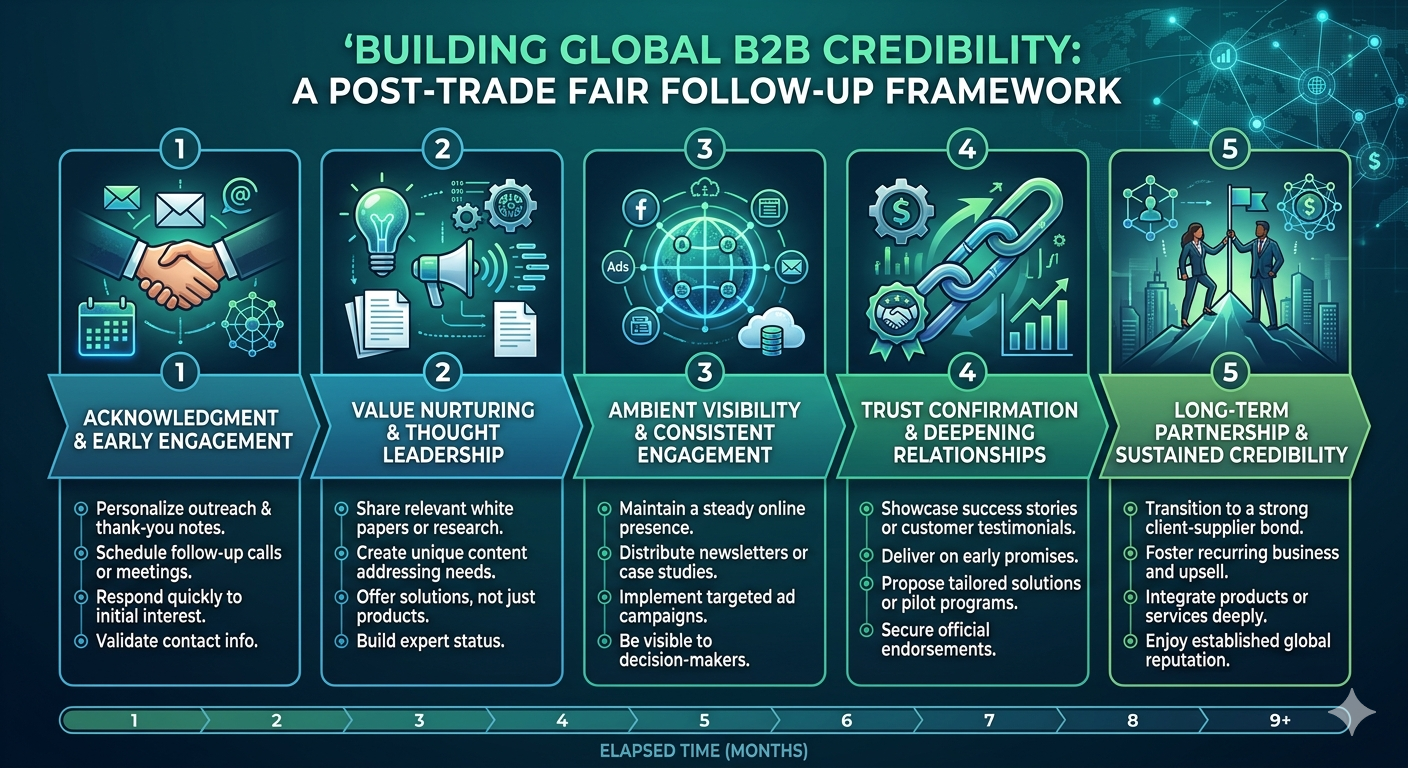
The Weekly Cadence of Post-Fair Visibility
Based on observation of successful exhibitors, here is a weekly cadence that keeps you visible while buyers evaluate silently:
Week 1: Acknowledgment email (brief, personalized, no sales ask). Directory profile updated with post-fair context.
Week 2-3: No direct outreach. Passive visibility continues via directory profile.
Week 4: Value message #1 (market observation, no sales ask). Directory profile refreshed with new update.
Week 5-7: No direct outreach. Publish short content piece (30-45 day cadence).
Week 8: Value message #2 (case study or insight). Directory profile updated again.
Week 9-11: No direct outreach. Content piece published.
Week 12: Check-in message (explicitly “no need to reply”). Directory profile updated.
Week 13-20: Continue monthly directory updates and content publication. Direct outreach every 4-6 weeks.
Week 21-36: Maintain passive visibility. Reduce direct outreach. Buyers who are ready will reach out.
The pattern is clear: direct outreach is periodic. Passive visibility is continuous. Most exhibitors have the first without the second. That is why most fail.
For guidance on maintaining visibility through the full period, read how to stay visible between trade fairs.
What Successful International Exhibitors Do Differently
Here is what successful international exhibitors actually do to implement post-fair visibility — based on observation, not theory:
- They allocate a significant portion of their trade fair budget to post-fair visibility infrastructure, not just booth costs
- They maintain permanent directory profiles updated regularly, year-round
- They publish short content consistently without fail
- They measure success by inbound inquiries and profile views, not email opens
- They never stop being visible, even when no one is responding
- They treat visibility as infrastructure, not a campaign
Before your next trade fair, ensure you have built your visibility infrastructure with the exhibitor checklist for German trade fairs.
The Cost of Missing Post-Fair Visibility
When post-fair visibility is missing from your international exhibitor strategy, the cost is not just low ROI. It is being invisible during the exact window when buyers decide. Consider what happens without post-fair visibility:
- Buyers search for you weeks after the fair. Your directory profile has not been updated since before the fair. They assume you are not active.
- Buyers compare you against competitors. Your competitors have updated profiles and recent content. You have nothing. They move on.
- Buyers finalize shortlists. Your company is not on them. You never know why.
- Contracts go to competitors who remained visible. Your trade fair investment generates little return.
Post-fair visibility is not an additional expense. It is a way to protect your trade fair investment. Without it, even the perfect booth and perfect product will likely disappoint.
For help selecting which trade fairs deserve your visibility investment, read how to choose the right trade fair for your strategy.
Frequently Asked Questions
- What is post-fair visibility? – Passive presence (directory profiles, content) that works without buyer response.
- Why is it missing? – Most exhibitors confuse it with follow-up. They build emails, not infrastructure.
- What are the key components? – Directory presence, content publication, consistent info, patient follow-up, measurement.
- Value distribution? – A larger portion from passive visibility, a smaller portion from direct follow-up. Most exhibitors do the opposite.
- How does BHOWCO help? – Permanent directory presence anchoring visibility infrastructure.
Conclusion: Add the Missing Layer to Your Strategy
Post-fair visibility is not a nice-to-have. It is the missing layer of international exhibitor strategy. Without it, your trade fair investment leaks value continuously. Buyers evaluate silently for an extended period after the fair. Your follow-up emails cannot reach them during this window. But your directory profile can. Your content can. Your consistent presence can.
Trade fairs create visibility. Continuous presence creates international trust and long-term business opportunities. The exhibitors who win are not the ones with the best follow-up sequences. They are the ones who never stop being visible — who build passive presence that works while buyers evaluate silently, while competitors disappear, and while contracts slowly take shape.
BHOWCO exists to provide that missing layer. Your permanent directory listing anchors your post-fair visibility system — working year-round, reaching buyers when your emails cannot.
Add the missing layer to your strategy with a permanent BHOWCO directory listing