Latest Insights
Protecting Trade Fair ROI: Why Exhibitors Lose Value After the Show


Protecting Trade Fair ROI: Why Exhibitors Lose Value After the Show
The booth closes, but the buyer’s evaluation may only be beginning. If your company becomes difficult to find or verify after a German trade fair, part of your trade fair investment loses its opportunity to influence that decision. A German trade fair can create valuable introductions, product discussions and market insight.
Its commercial value, however, cannot be judged only by what happens at the booth. Buyers may continue comparing technical evidence, company reliability and market fit after the event. A documented follow-up process and an accurate, discoverable company presence help exhibitors remain assessable during that period.
The length and outcome of evaluation vary by industry, buyer and procurement process. This guide shows how to protect the opportunity to be evaluated after the exhibition—and how to measure that work without claiming that visibility alone produces contracts.
What Trade Fair ROI Actually Measures
Trade fair ROI compares the attributable commercial return from an exhibition with its total participation cost. Visibility, profile views and buyer engagement are supporting indicators; they are not revenue and should not be reported as financial ROI.
Financial ROI = (Attributable contribution margin − Total exhibition cost) ÷ Total exhibition cost × 100
Contribution margin should be used instead of gross sales. Gross sales are not the real return on an investment. Total exhibition cost is also broader than booth rent. It can include design and construction, travel, shipping, staff time, materials, content production, and post-event follow-up.
If revenue cannot be reliably attributed to the exhibition, the result should be labeled “estimated.” This is not a weakness. It is an honest boundary that separates financial ROI from intermediate indicators.
An explicitly hypothetical example: Suppose total participation cost is €50,000 and attributable contribution margin is €70,000. Sample financial ROI is 40%. Profile views, impressions and the number of business cards collected do not add to the €70,000. They are supporting indicators, not revenue.
Quick ROI Diagnostic: Are You at Risk of Vanishing After the Show?
Answer these questions honestly about your last trade fair:
- ☐ Do you have a follow-up process that extends beyond 60 days? (Yes/No)
- ☐ Can buyers find your updated company information between trade fairs? (Yes/No)
- ☐ Is your company information, capabilities and certifications updated whenever they change? (Yes/No)
- ☐ Do you know the typical procurement timeline for your target buyers? (Yes/No)
- ☐ Do you have a system for year-round visibility, not just trade fair preparation? (Yes/No)
These questions identify gaps in post-fair preparation. They are not an ROI score or a prediction of sales. Prioritize any gap that could prevent a relevant buyer from finding current information or continuing an evaluation.
Where Trade Fair Value Is Built and Measured
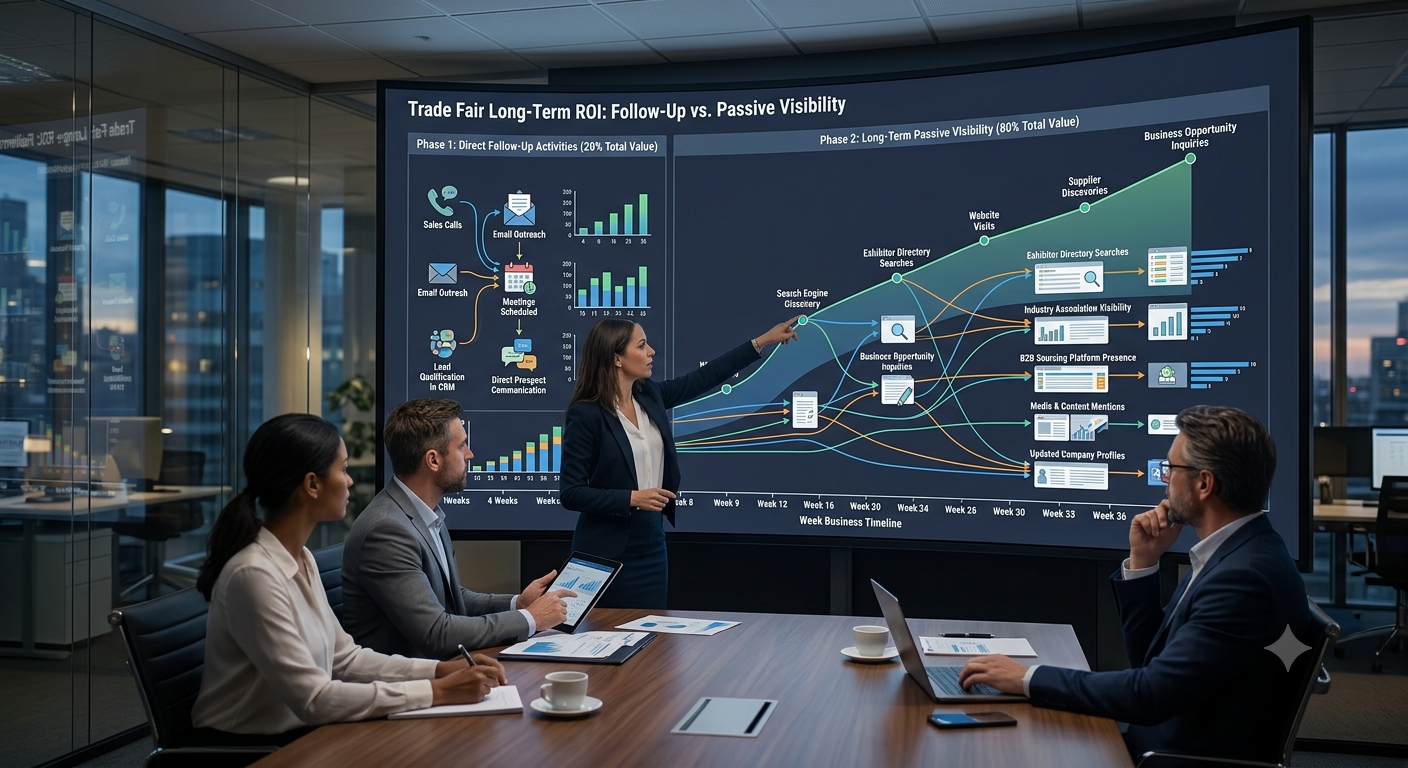
The value of a trade fair investment is not distributed in a fixed proportion. What matters is understanding what each phase contributes and what should be measured in each phase:
| Phase | What it contributes | What to measure |
|---|---|---|
| Before the fair | Preparation and discoverability | Profile completeness, buyer reach, pre-fair visibility |
| During the fair | Meetings and understanding buyer needs | Quality of conversations, lead qualification, needs identified |
| After the fair | Access to evidence, follow-up and evaluation | Follow-up completion, information availability, evaluation progress |
A booth may create the first conversation, but the company still needs to be assessable when that conversation continues. Budget and ownership should therefore cover preparation, the fair itself, and the period of buyer evaluation afterward. Measure each phase separately before judging the return on the full investment.
For a deeper understanding of how buyers behave during the post-exhibition window, read this guide to buyer behavior at trade fairs.
Five Gaps That Can Weaken Post-Fair Value
The following five operational gaps can weaken the value of a trade fair investment:
| Gap | Buyer consequence | Evidence to check | Action |
|---|---|---|---|
| 1. No post-show infrastructure | Buyer may struggle to find current, verifiable company information. | Is there a maintained profile? Is follow-up owned? | Assign an owner and maintain the company website, relevant documents and, where used, a published profile. |
| 2. Misaligned expectations with procurement timelines | Buyer is still evaluating while the exhibitor has stopped activity. | Do you know the target buyer’s typical decision window? | Map realistic evaluation steps and plan extended visibility. |
| 3. No independent visibility system | Buyer has no way to revisit the company without a reply. | Can buyers verify the company between fairs? | Maintain website, relevant content and a published directory profile alongside direct follow-up. |
| 4. No content engine between fairs | Buyer searching for updates finds nothing recent. | Is there any recent, relevant publication? | Publish short market observations regularly year-round. |
| 5. No accountability for post-exhibition visibility | No one maintains information, so it becomes outdated. | Is a specific person or team responsible? | Assign ownership and measure progress at 3, 6 and 9 months. |
Inconsistent information deserves particular attention. The buyer consequence is that the buyer cannot confidently confirm the company’s capability or identity. Evidence to check includes differences between website, directory profile and catalog. The action is to correct the specifications and record the date of the last update.
Post-Fair Evaluation Timing Varies
There is no universal post-fair decision window. A distributor may follow up quickly, while a regulated or technical procurement process can require additional verification and internal approval. Exhibitors should map the actual evaluation steps for their target buyers and keep relevant company, product and compliance information available throughout that process.
Two examples illustrate different evaluation mechanisms, not general timelines or success rates:
- MEDICA: In medical technology, delay may come from document review, quality assessment, clinical use and internal approval. See the MEDICA exhibitor list.
- InnoTrans: In rail and transport technology, technical evaluation, compliance and supplier approval can extend beyond exhibition week. See the InnoTrans exhibitor list.
These examples explain differences in evaluation mechanisms. No timeframe or general success rate is attributed to them.
The 5-Component Framework for Protecting Trade Fair ROI
To protect trade fair ROI and reduce the risk of losing visibility after the exhibition, consider a system with five components. Before your next trade fair, ensure you have completed all preparation steps with the exhibitor checklist for German trade fairs.
1. Permanent Directory Presence
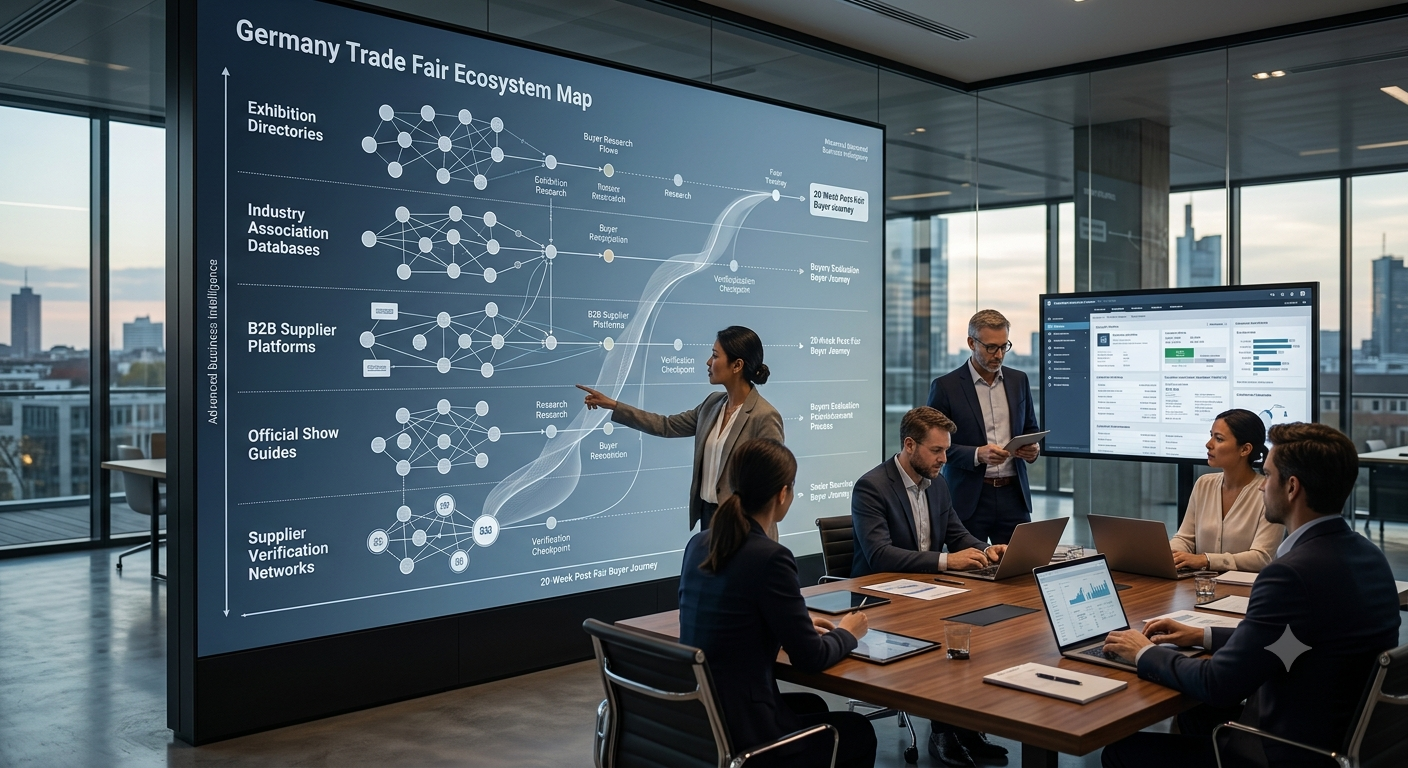
Buyers search between trade fairs. Your profile must be there when they look. A published BHOWCO directory profile, available through an annual public-visibility membership, provides an additional place for buyers to verify your company during the procurement cycle. Update it whenever material information changes.
2. Structured Follow-Up Timeline
Not just a few emails. A structured sequence of touchpoints over an extended period. Each message with decreasing pressure and increasing value. No sales pressure. Value only.
3. Regular Content Publication
Short market observations published regularly. This signals ongoing market engagement and gives buyers fresh content to find when they search. Content does not need to be long. It just needs to be recent and relevant.
4. Consistent Profile Information
Your website, directory profiles, and social media must match. Inconsistent information can weaken trust and reduce ROI. Audit your online presence quarterly. Update all platforms simultaneously when information changes.
Buyers may check more than whether a company appears in search. They also assess credibility, capability, compatibility and risk. See the BHOWCO Pre-Contact Supplier Evaluation Model for a structured way to examine those signals.
5. Patient Procurement Alignment
Align your follow-up and measurement with the evaluation steps of your target buyers. Do not expect decisions quickly. Measure success over the long term. Patience is not passive. It is strategic.
For practical guidance on maintaining visibility, read how trade fair visibility works year-round.
What to Measure at 30, 90, 180 and 365 Days
These are review points, not fixed buyer decision dates. They help separate activity from progress.
- 30 days: Completion of promised follow-ups, delivery of requested documents, correction of company information.
- 90 days: Continuation of relevant conversations, technical requests, repeat visits to documents or profile where reliable data exists.
- 180 days: Progress of evaluation, entry into shortlist or RFQ where it occurs, and obstacles to decision.
- 365 days: Value of attributable opportunities, contribution margin of realized contracts, and continuity of discoverability between two fairs.
Specialist impressions and profile views are indicators of presence during the research phase, not proof of sales. That is exactly the role of the BHOWCO ecosystem.
The Cost of Losing Visibility After the Exhibition
When exhibitors stop all activity after the exhibition, the cost is not a specific number of lost contracts. The real cost is that evaluation and follow-up become harder. Buyers who are still comparing options may find outdated information, no recent evidence, or no clear point of contact. The exhibitor becomes harder to assess, and the buyer may continue the process with less input from that company.
Post-exhibition visibility requires resources, but it protects an important part of the original investment: the buyer’s ability to find current evidence and continue evaluating the company. Its value should be assessed against relevant visibility, profile engagement and the progress of real buyer conversations—not assumed contract wins.
For help selecting which trade fairs deserve your ROI protection investment, read how to choose the right trade fair for your strategy.
Frequently Asked Questions
- How do you calculate trade fair ROI? – (Attributable contribution margin − total exhibition cost) ÷ total exhibition cost × 100. Use contribution margin, not gross sales.
- Which costs belong in a trade fair ROI calculation? – Design and construction, travel, shipping, staff time, materials, content production, and post-event follow-up—not only booth rent.
- Why can trade fair ROI appear low shortly after the event? – Evaluation timelines vary by industry and buyer. Measuring only immediately after the fair can be misleading.
- How do you measure post-fair progress before contracts close? – Review at 30, 90, 180 and 365 days. These are review points, not fixed decision dates.
- What percentage of trade fair ROI comes after the event? – There is no valid general percentage. Visibility and profile engagement are supporting indicators, not revenue.
- How can a year-round company profile support post-fair evaluation? – It gives buyers an additional place to verify the company and supporting information. It does not guarantee contracts.
Conclusion: Protect Trade Fair ROI by Staying Assessable
Trade fair ROI depends on multiple factors: fair selection, buyer fit, the quality of conversations, product and commercial readiness, and what happens after the event. Continued visibility cannot replace capability or evidence. It can make that evidence easier to find while buyers compare options.
BHOWCO does not calculate an exhibitor’s financial return or replace the company’s sales process. It provides a persistent, Germany-based point of reference where international buyers can revisit a published company profile, capabilities and supporting information while their evaluation continues.
Explore annual public visibility with a BHOWCO company profile