


Latest NEWS
1 Week to Wire Düsseldorf: Why Precision Manufacturers Fail the Industrial Buyer’s Test — And How to Pass It

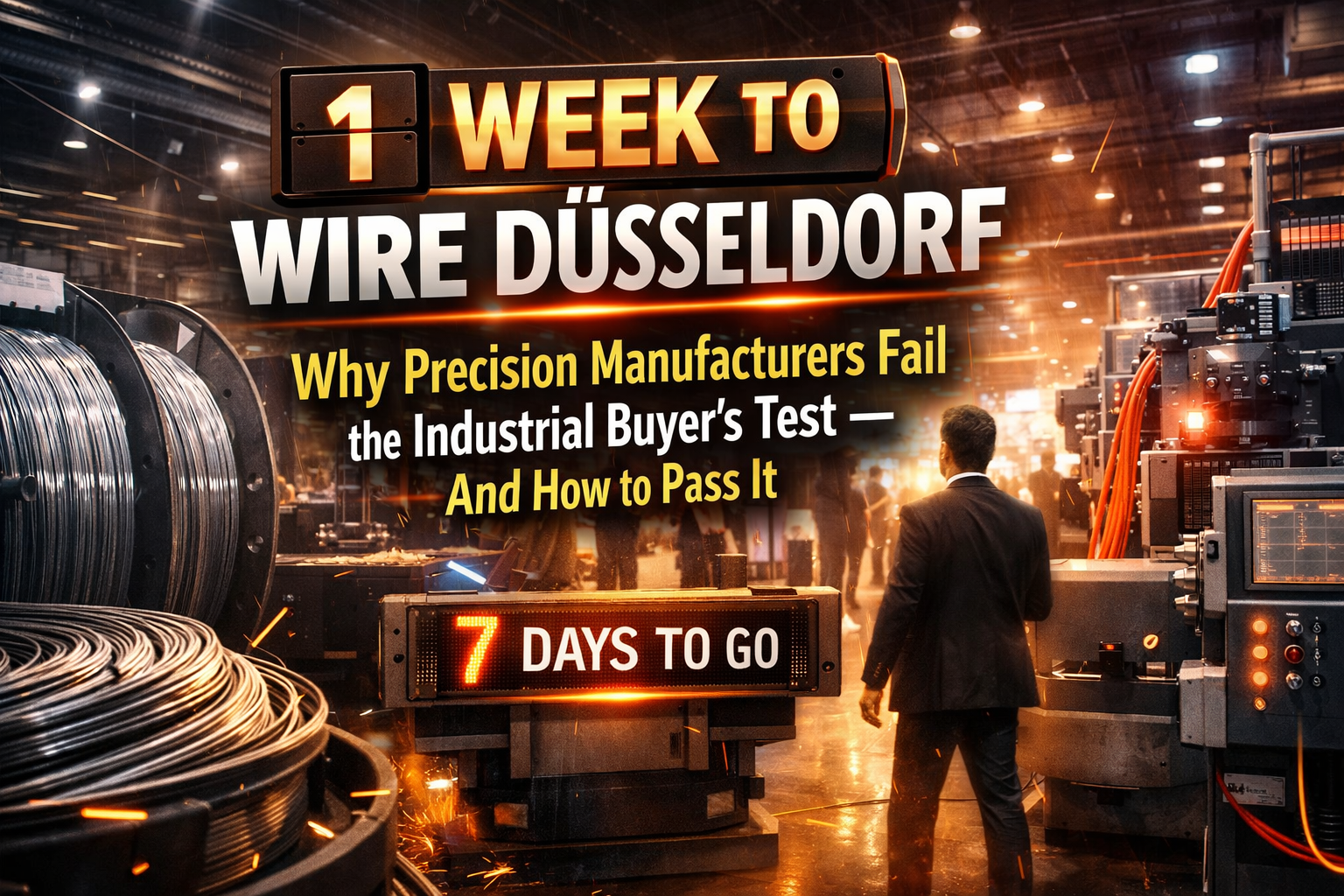
1 Week to Wire Düsseldorf: Pass the Industrial Buyer Test
Wire Düsseldorf 2026
13–17 April 2026 | Messe Düsseldorf | The Global Precision Manufacturing Validation Platform for Wire & Cable
Official website: www.wire-tradefair.com |
AUMA Profile: Official Industry Data
⚠️ Critical Window: 7 Days Remaining
The pre-fair preparation window for Wire Düsseldorf closes in 7 days. After that, buyer attention shifts to on-site validation. What you do this week determines whether you enter as a credible precision partner or an unknown vendor.
The One-Week Reality Check for Wire Exhibitors
With seven days until Wire Düsseldorf opens, most exhibiting companies are finalizing logistics, printing brochures, and rehearsing booth presentations. They are focused on the event itself. This is precisely why most will fail the industrial buyer’s test — not because their wire or cable quality is inadequate, but because they misunderstand what buyers at this fair are actually evaluating.
Wire Düsseldorf is not a product showcase. It is a precision manufacturing validation platform. The buyers attending — from automotive, aerospace, construction, and energy sectors — do not come to browse. They come with pre-qualified shortlists and specific technical requirements. Their evaluation criteria are not subjective. They are measurable, documentable, and unforgiving: tensile strength variation, dimensional tolerance, and certified quality systems.
If your booth cannot immediately demonstrate these three elements, you fail the test before the first conversation ends. The remaining seven days are sufficient to fix this — but only if you stop treating the fair as a marketing event and start treating it as a technical audit.
The Three Precision Tests Every Industrial Buyer Will Conduct at Your Booth
Test #1: Material Consistency Verification
What buyers ask (directly or indirectly): “Does your tensile strength and composition vary across production runs?”
The threshold for passing: Documented variation of less than 3% across batches, with certified test reports available on request.
What to do this week: Prepare a one-page “Material Consistency Summary” showing your test results for the last 12 months. Include the range, mean, and certification references. If you cannot produce this document, do not exhibit — you will fail the audit.
Test #2: Dimensional Accuracy Documentation
What buyers ask: “Can you maintain diameter tolerance within our specifications for full production runs?”
The threshold for passing: Diameter tolerance below 0.02mm with documented quality control procedures.
What to do this week: Create a “Dimensional Control Protocol” document that shows your measurement equipment, calibration schedule, and historical tolerance data. Buyers at Wire Düsseldorf expect to see this. Its absence signals that precision is not your priority.
Test #3: Quality System Certification Evidence
What buyers ask: “Are you ISO 9001 certified? Do you have industry-specific approvals (IATF 16949 for automotive, etc.)?”
The threshold for passing: Current, verifiable certification with no major non-conformities in the last audit cycle.
What to do this week: Print your certificates. Better: Create a QR code on your booth linking to a page with all certifications and audit history. If you are not certified, do not claim you are — industrial buyers verify.
The Critical Mistake: Treating Wire Düsseldorf as a Lead Generation Event
The most expensive error exhibitors make is measuring success by the number of business cards collected or catalog requests received. At Wire Düsseldorf, these metrics are meaningless — and often inversely correlated with real opportunity.
Why: Serious industrial buyers do not browse. They arrive with pre-identified potential suppliers. If you are on their list, the conversation is about validation, not discovery. If you are not on their list, no amount of booth traffic will get you on it during the fair.
The fix (executable this week): Identify 20-30 target companies that will attend Wire Düsseldorf. Research their quality requirements and current supply chain challenges. Send a personalized email (not a template) referencing a specific capability that matches their documented needs. Offer a 15-minute pre-scheduled meeting at the fair. Five such meetings will generate more pipeline than 200 cold badge scans.
What Serious Industrial Buyers Look For — And What They Ignore
Based on documented procurement behavior from automotive and energy sector buyers who regularly attend Wire Düsseldorf, the distinction between success and failure is predictable:
What they actively look for:
- Material test reports with <3% variation data
- Dimensional tolerance documentation (<0.02mm)
- ISO 9001 or industry-specific certifications (IATF 16949, AS9100)
- Evidence of previous industrial supply agreements
- Quality audit scheduling availability
What they ignore or treat as noise:
- Brochures without technical specifications
- Price lists without quality context
- Claims of “high quality” without documentation
- Booth giveaways or promotional items
- Generic follow-up offers
The implication is clear: documentation outperforms decoration. A simple booth with a clear display of your material consistency data and certification will generate more serious interest than an elaborate structure with vague marketing claims.
The 7-Day Pre-Fair Action Plan for Wire Düsseldorf
Day 1 (Today): Audit your documentation. Do you have material test reports for the last 12 months? Are certifications current? If missing, prioritize obtaining or updating these before any other activity.
Day 2-3: Create your target account list of 20-30 companies. Use the official exhibitor and attendee lists (available via the fair organizer). Research each company’s quality requirements from public sources or past interactions.
Day 4-5: Send personalized meeting requests. Keep each email under 100 words. Reference a specific capability or specification relevant to that buyer. Offer a clear value proposition: “We can show you our material consistency data for [specific product type] in 15 minutes.”
Day 6: Prepare booth materials. Print one-page technical summaries for each product category. Create a QR code linking to your full certification and test data online. Train booth staff on the three tests — no marketing scripts, only technical responses.
Day 7: Confirm meetings. Send a reminder with your booth number and a brief agenda. Prepare follow-up templates for after the fair — but do not send anything yet.
This plan is not theoretical. It is extracted from the pre-fair procedures of exhibitors who consistently convert Wire Düsseldorf participation into long-term industrial supply agreements.
The Post-Fair Reality: 5 Days of Visibility vs. 18-Month Decision Cycles
Wire Düsseldorf provides five days of concentrated industrial evaluation. The global wire and cable industry operates on 12–24 month qualification, testing, and procurement timelines for industrial supply agreements.
Evidence of progress after the fair: Inclusion in approved vendor lists or quality audit scheduling within 4–8 months post-fair for long-term supply contracts.
Evidence of failure: No request for material certification or quality documentation within 60 days of the fair.
This gap explains why a 365-day visibility strategy separates wire suppliers from precision manufacturing partners. The companies that win at Wire Düsseldorf do not disappear after pack-down. They continue to provide technical content, certification updates, and quality documentation throughout the multi-quarter buyer evaluation cycle.
The Critical Decision Question for Your Team — Answer Today
With seven days remaining, ask your team:
“If a target buyer requests our material consistency data and dimensional tolerance documentation at Wire Düsseldorf, can we provide it immediately — or will we say ‘we will email it to you after the fair’?”
If your answer requires an email follow-up, you have already lost. Industrial buyers at Wire Düsseldorf make immediate distinctions between prepared suppliers and unprepared ones. The prepared receive follow-up meetings. The unprepared receive polite nods and no further contact.
The next seven days are sufficient to prepare this documentation, pre-schedule 10-15 targeted meetings, and train your booth staff on technical responses. This single shift in approach — from marketing to technical validation — will differentiate you from 80% of exhibitors who remain focused on logistics rather than buyer psychology.
Frequently Asked Questions — Wire Düsseldorf Precision Strategy
What indicates serious industrial buyer interest at Wire Düsseldorf?
Not catalog requests or price inquiries. Serious interest is a request for complete material certification, quality control documentation, and quality audit scheduling within 45–75 days post-fair, accompanied by long-term supply agreement discussions.
How is budget wasted at Wire Düsseldorf?
When suppliers approach Wire Düsseldorf as a commodity trading platform rather than a precision validation platform. The catastrophic cost is failing quality audits after significant certification investment, permanently excluding you from industrial supply chains.
What certification do industrial wire buyers require?
Three non-negotiable requirements: 1) Material test reports with tensile and composition data showing less than 3% variation, 2) Dimensional tolerance documentation below 0.02mm, 3) Quality management certification (ISO 9001 or industry-specific like IATF 16949). Missing any element equals immediate disqualification.
Is Wire Düsseldorf relevant for standard commodity wire suppliers?
Marginally. The fair’s core audience is industrial buyers requiring certified, precision products. Commodity wire faces intense price competition and limited access to decision-makers. Resources may be better allocated to achieving certification and precision capability before exhibiting.
Exhibitor Reality Check — Practitioner Input
For those who have exhibited at Wire Düsseldorf or similar precision manufacturing fairs:
What single document or piece of evidence generated the most serious buyer interest at your booth — and did you have it available immediately or only upon follow-up?
Practitioner input helps turn this page into a living reference rather than a static article.
For a broader strategic perspective on German industrial exhibitions, refer to our detailed analysis of
Wire Düsseldorf
and the comparative framework for
Hannover Messe.