


Latest Insights
Fakuma Exhibitor List | Supplier Search & Evaluation

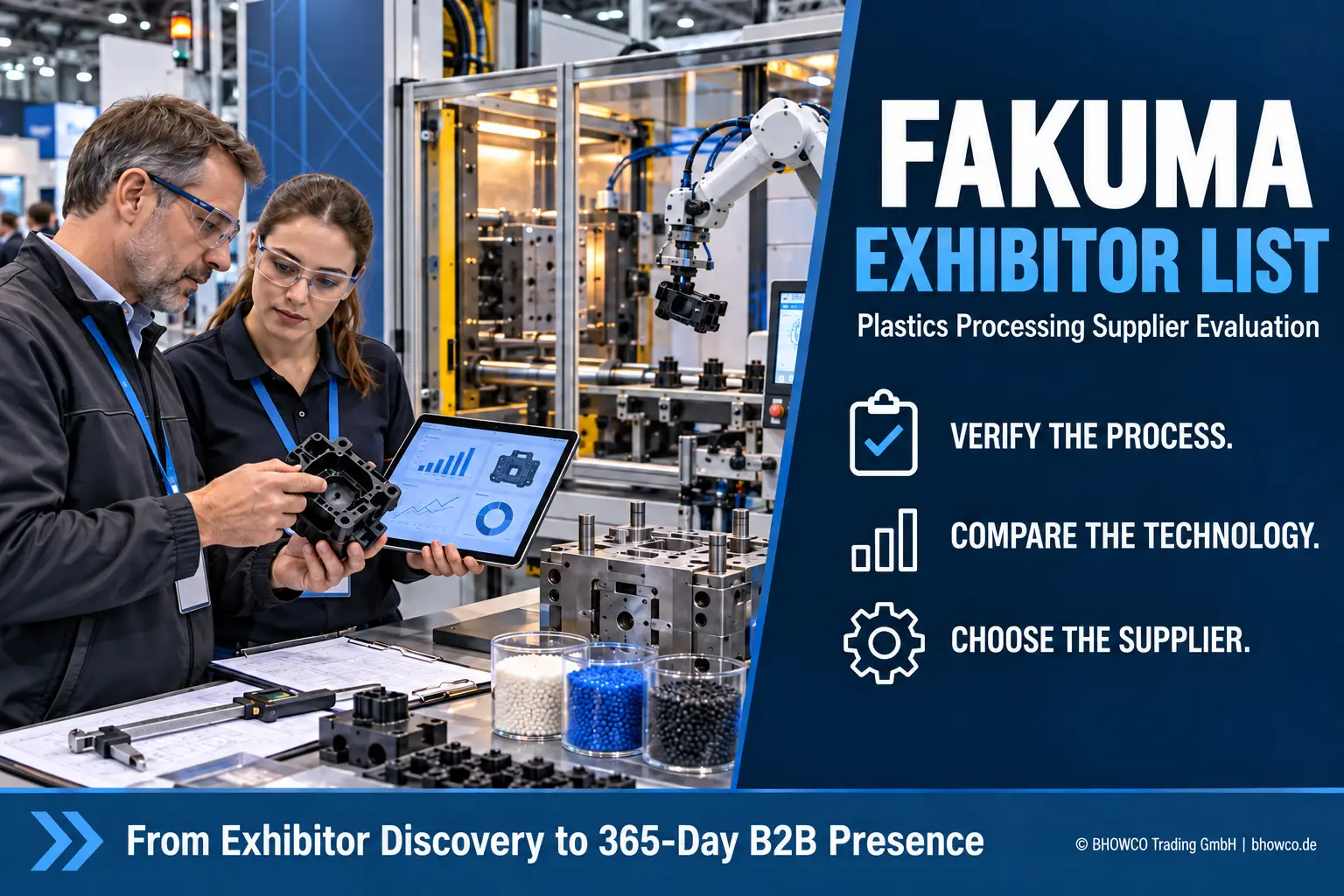
Fakuma Exhibitor List
Fakuma is the international trade fair for plastics processing, bringing together manufacturers, suppliers, processors and professional buyers across the global plastics industry.
 The Fakuma exhibitor list helps production managers, technical buyers, process engineers and procurement specialists discover suppliers of injection moulding machines, extrusion and thermoforming systems, moulds, raw materials, automation solutions and recycling technology.
The next edition takes place at Messe Friedrichshafen from 12–16 October 2026 and marks the 30th edition of Fakuma.
Trade fairs create discovery. Continuous professional presence helps build trust while production teams continue validating process technology.
📌 About This Fakuma Exhibitor Guide: For organiser information, visit the official Fakuma website. The official Fakuma exhibitor list provides company information for the current edition. This independent BHOWCO guide explains exhibitor categories, buyer evaluation criteria and why professional presence remains important beyond the fair.
Planning to exhibit rather than simply research suppliers? For a strategic analysis of Fakuma’s industry themes and exhibitor positioning opportunities, explore the Fakuma Friedrichshafen Strategic Exhibitor Guide.
📊 Quick Facts: Fakuma 2026
| Section | Information |
|---|---|
| Dates | 12–16 October 2026 (Monday – Friday, 5 days) |
| Opening Hours | Monday–Friday: 09:00–17:00 daily |
| Frequency | Regularly held in Friedrichshafen; edition scheduling may vary around major plastics-industry exhibition cycles |
| Venue | Messe Friedrichshafen, Neue Messe 1, 88046 Friedrichshafen, Germany |
| Based on 2024 Figures | 1,639 exhibitors, including 778 international exhibitors, and approximately 36,675 trade visitors. International exhibitors represented 47.5% of the total exhibitor base. (Official Fakuma 2024 Closing Report) |
| Main Product Groups | Injection Moulding Technology, Extrusion Technology, Thermoforming & Forming Technology, Additive Manufacturing / 3D Printing, Tooling & Mould Making, Materials & Masterbatches, Process Technology & Recycling, Automation & Peripherals |
| 2026 Programme Highlights | Startup Area, Technical Presentation Forum, Fakuma Innovation Award, Fakuma Round Table, Career Friday and the inaugural Paul Eberhard Schall Medal |
Source: Official Fakuma website. The official Fakuma exhibitor list provides the latest available company and product information. Because the directory may continue to be updated, buyers should check the live platform before finalising meeting and sourcing plans.
🔍 Accessing the Official Fakuma Exhibitor List
The Fakuma exhibitor list is available through the organiser’s official 2026 directory. Buyers can search by company or keyword and filter exhibitors by products and services, exhibition hall and country. Individual entries may include company details, product categories, hall and stand numbers, contact information and appointment-request options.
The platform also offers XLSX and PDF download options. Because exhibitor data can change as the fair approaches, buyers should use the live platform for final planning. Here are the official access channels:
- Official Portal: Fakuma exhibitor list for researching participating companies
- Hall Plans: Official hall plans for hall navigation and exhibitor location
- Official Website: Fakuma official website for tickets, opening hours, programme and venue information
For exhibitors, being discoverable matters because production managers, technical buyers and process engineers actively search the Fakuma exhibitor list to identify relevant technology suppliers. An independent BHOWCO professional company profile complements official exhibitor information by helping production buyers rediscover the company, understand its product categories and evaluate its technical capabilities before, during and after Fakuma.
🏗️ Fakuma Exhibition Sectors & Supplier Categories
Fakuma covers the complete plastics processing value chain – from raw materials and processing machinery to tooling, automation and recycling. Based on the organiser’s official products-and-services taxonomy, BHOWCO groups Fakuma exhibitors into the following buyer-oriented supplier categories:
| Injection Moulding Technology | Injection moulding machines, moulds, hot runner systems, process control, automation and peripherals for injection moulding production |
| Extrusion Technology | Extruders, extrusion lines, dies, downstream equipment, profile and pipe extrusion, film and sheet extrusion |
| Thermoforming & Forming Technology | Thermoforming machines, forming tools, vacuum forming, pressure forming, packaging forming solutions |
| Additive Manufacturing / 3D Printing | 3D printers, additive manufacturing systems, rapid prototyping, tooling inserts, printed moulds and production parts |
| Tooling & Mould Making | Moulds, dies, tooling systems, mould components, hot runner technology, tool steels, surface treatment |
| Materials & Masterbatches | Thermoplastic materials, engineering plastics, compounds, masterbatches, additives, colourants, bioplastics |
| Process Technology & Recycling | Process monitoring, quality control, recycling technology, material recovery, circular economy solutions |
| Automation & Peripherals | Robotics, automation systems, handling equipment, temperature control, material handling, peripherals and auxiliaries |
Source: Official Fakuma website. Always check the official exhibitor list before your visit.
Who Fakuma Exhibitors Meet: Plastics Industry Buyers & Decision-Makers
Understanding the Fakuma visitor and industry-participant profile helps exhibitors prepare more relevant engagement strategies. The fair attracts a diverse range of plastics industry professionals.
Production and Technical Decision-Makers
- Production Managers: Responsible for manufacturing operations, equipment investment and production efficiency
- Process Engineers: Evaluating process capability, cycle time, quality control and production integration
- Technical Buyers & Procurement: Sourcing machinery, tooling, materials and automation solutions
- Quality Assurance Professionals: Assessing process consistency, documentation and compliance
- Maintenance & Service Engineers: Evaluating reliability, spare parts availability, diagnostics and lifecycle support
Industry Stakeholders and Service Providers
- Plant Managers & Operations Directors: Responsible for production capacity, investment decisions and operational efficiency
- R&D & Engineering Teams: Exploring new materials, processes and technologies
- Automation & Integration Specialists: Evaluating system integration and production automation
- Trade Media and Associations: Covering market developments and industry trends
- Students & Young Professionals: Participating in Career Friday initiatives for talent development
Fakuma 2024 brought together 1,639 exhibitors, including 778 international exhibitors, and approximately 36,675 trade visitors, with international exhibitors representing 47.5% of the total exhibitor base. The 2026 event will mark the 30th edition of Fakuma with new formats including the Fakuma Innovation Award and an expanded supporting programme.
✅ Buyer Insight
Fakuma can start or accelerate supplier evaluation, but plastics processing equipment decisions often continue beyond the fair. Depending on the product and buyer, further stages may include technical documentation review, application testing, integration assessment and production validation.
📊 How Plastics Processing Buyers Evaluate Fakuma Suppliers
Finding a company in the Fakuma exhibitor list is only the first step. When evaluating plastics processing suppliers, professional buyers typically assess the following dimensions:
PROCESS CAPABILITY & APPLICATION FIT
- Process Capability – Does the equipment deliver consistent cycle time, throughput and product quality?
- Application Fit – Does the technology match the material properties and production requirements?
- Scale-Up Readiness – Can the process maintain performance from pilot to production scale?
- Production Environment Suitability – Does the equipment operate reliably under real production conditions?
TECHNICAL PERFORMANCE
- Energy Efficiency – What are the energy consumption and operating costs?
- Reliability & Durability – How does the equipment perform under continuous professional operation?
- Maintenance Requirements – What routine maintenance, spare parts and service are required?
- Automation & Control – What process automation, monitoring and control capabilities are available?
MATERIAL, COMPOUND & MASTERBATCH EVALUATION
- Material Properties – Do mechanical, thermal, chemical and processing properties match the intended application?
- Batch Consistency – Can the supplier maintain stable colour, formulation and processing behaviour across production batches?
- Technical Data & Certificates – Are technical data sheets, safety data sheets, certificates of analysis and regulatory declarations available?
- Processing Window – Is the material compatible with the buyer’s machinery, tooling, cycle time and production conditions?
- Supply Continuity – Can the supplier maintain volume, lead time and raw-material availability across the required markets?
- Application Compliance – Where relevant, is documentation available for food contact, automotive, medical, electrical or other regulated applications?
TOOLING & MOULD VALIDATION
- Dimensional Capability – Can the supplier achieve the required tolerances, repeatability and surface quality?
- Mould Design & Cooling – Does the mould design support cycle-time, cooling and part-quality targets?
- Material & Cavitation – Are tool steel, cavity configuration and expected production volume aligned?
- Validation & Trials – Are mould trials, measurement reports and acceptance procedures clearly defined?
- Maintenance & Modification – Can the supplier support repairs, spare components, engineering changes and future tool modifications?
PRODUCTION ECONOMICS & TOTAL COST OF OWNERSHIP
- Cycle Time & Throughput – What stable production output can be achieved under realistic operating conditions?
- Energy Consumption – What energy consumption is expected per cycle, part or kilogram processed?
- Scrap & Material Efficiency – How does the solution affect scrap rates, start-up waste and material utilisation?
- Changeover & Downtime – How quickly can materials, moulds or production formats be changed?
- Total Cost of Ownership – What are the expected costs of energy, maintenance, consumables, spare parts, training and planned downtime?
INTEGRATION & OPERATIONAL SUPPORT
- Integration Capability – Does the equipment integrate with existing production lines and IT systems?
- Installation Support – What installation planning, on-site support and training are available?
- After-Sales Service – What spare parts, maintenance support and warranty coverage exist?
- Lifecycle Support – What long-term service, upgrades and technical support are provided?
DOCUMENTATION & COMPLIANCE
- EU Machinery Compliance – For machinery intended for the EU market, are the applicable conformity assessment, CE marking, declaration of conformity, risk assessment, safety instructions and technical documentation available? Machinery placed on the EU market before 20 January 2027 remains subject to Directive 2006/42/EC; Regulation (EU) 2023/1230 applies from 20 January 2027.
- Material-Specific Compliance – Are the required declarations and test documents available for the intended application and destination market? Depending on use, these may involve chemical, food-contact, automotive, medical, electrical or customer-specific requirements.
- Technical Documentation – Are specifications, installation guides, safety documentation and test reports available?
- Performance Data – Are performance metrics, energy data and reliability information available?
- References & Track Record – Can the supplier provide relevant production references and application experience?
Signals of Serious Post-Fair Buyer Interest:
- Technical documentation and performance data request
- Application-specific testing or sample processing discussion
- Integration and compatibility review
- Production line integration discussion
- Service and support capability discussion
- Request for quotation or budgetary proposal
- Pilot project or production trial discussion
- Project contract or framework agreement discussion
For a deeper understanding of how production and technical buyers evaluate suppliers, read this guide to buyer behavior at trade fairs.
⚠️ Plastics Processing Procurement Reality
For production managers and technical buyers, process capability, integration and lifecycle support are essential. A compelling equipment demonstration does not compensate for undocumented process performance or unproven integration capability. Requirements vary significantly by product category: injection moulding, extrusion, thermoforming, materials, tooling and recycling may each be subject to different technical and commercial requirements.
🕐 From Fakuma Discovery to Production Integration
For buyers, finding a company in the Fakuma exhibitor list is only the first step. For exhibitors, maintaining a credible professional presence can influence whether the company remains under consideration during the following evaluation stages:
| 1. SUPPLIER DISCOVERY | Machinery, materials or technology suppliers identified at Fakuma or through research, based on process requirements. |
| 2. APPLICATION & REQUIREMENTS DEFINITION | Material properties, cycle time, quality requirements and production environment translated into technical requirements. |
| 3. TECHNICAL & PERFORMANCE EVALUATION | Process capability, integration compatibility and performance data reviewed. |
| 4. SUPPLIER COMPARISON | Alternatives, performance, integration, support and commercial value compared. |
| 5. PROCUREMENT PROCESS | Quotation, negotiation or purchasing process where applicable. |
| 6. IMPLEMENTATION & PRODUCTION SUPPORT | Delivery, installation, integration, commissioning, training and ongoing production support. |
The duration can range from several weeks to many months, depending on equipment complexity, integration scope, production requirements and the buyer’s internal approval process.
This journey explains why post-fair presence can remain strategically important while buyers continue evaluating, comparing and planning.
📌 Why Professional Exhibitor Presence Matters Beyond the Official Fakuma Exhibitor List
Production buyers use the Fakuma exhibitor list to discover potential suppliers, but discovery alone does not guarantee continued consideration. Production managers and technical buyers may return later to review performance data, verify integration capability and compare competing suppliers.
The organiser provides official exhibitor search and product-discovery tools for researching participating companies. An independent BHOWCO company profile offers an additional professional touchpoint within Germany’s wider trade-fair ecosystem; it does not replace, represent or form part of the official platform.
🔎 Fakuma Exhibitors by Category: Machinery, Materials & Technology
Plastics processing buyers search for specific categories within the Fakuma exhibitor list. Each category includes analysis from the buyer’s perspective:
Injection Moulding Technology
Relevant exhibitors may include injection moulding machine manufacturers, mould and hot runner suppliers, process-control specialists and automation providers for injection moulding production.
Buyer insight: Production managers and process engineers compare cycle time, repeatability, energy efficiency, mould compatibility, automation capability and service support before selecting injection moulding technology.
Extrusion Technology
Relevant exhibitors may include extruder manufacturers, extrusion line suppliers, die and downstream equipment providers, profile, pipe, film and sheet extrusion specialists.
Buyer insight: Production teams evaluate throughput, product quality, energy efficiency, line integration, material compatibility and maintenance requirements before selecting extrusion technology.
Thermoforming & Forming Technology
Relevant exhibitors may include thermoforming machine manufacturers, forming tool suppliers, vacuum and pressure forming specialists, packaging forming solution providers.
Buyer insight: Packaging and production buyers compare cycle time, forming accuracy, material compatibility, tooling requirements and automation capability before selecting thermoforming technology.
Additive Manufacturing / 3D Printing
Relevant exhibitors may include 3D printer manufacturers, additive manufacturing system suppliers, rapid prototyping specialists, tooling insert and mould printing providers.
Buyer insight: Production and development teams evaluate print speed, material compatibility, part quality, integration with production workflows and cost per part before selecting additive manufacturing solutions.
Tooling & Mould Making
Relevant exhibitors may include mould manufacturers, die makers, hot runner system suppliers, tool steel providers, surface treatment companies.
Buyer insight: Tooling buyers compare precision, durability, lead time, material compatibility, maintenance requirements and service support before selecting tooling partners.
Materials & Masterbatches
Relevant exhibitors may include thermoplastic material suppliers, engineering plastics producers, compound and masterbatch manufacturers, additive and colourant providers, bioplastic specialists.
Buyer insight: Material buyers evaluate mechanical properties, processing characteristics, batch consistency, regulatory compliance, supply reliability and technical support before selecting material suppliers.
Process Technology & Recycling
Relevant exhibitors may include process monitoring and quality control specialists, recycling technology providers, material recovery companies, circular economy solution providers.
Buyer insight: Production and sustainability teams compare process reliability, material recovery rates, energy efficiency, regulatory compliance and integration capability before selecting process and recycling technology.
Automation & Peripherals
Relevant exhibitors may include robotics and automation suppliers, handling equipment providers, temperature control specialists, material handling companies, auxiliary equipment manufacturers.
Buyer insight: Production teams evaluate automation capability, integration ease, reliability, energy efficiency and service support before selecting automation and peripheral equipment.
🔄 Fakuma and Related Plastics Industry Events
- Fakuma Friedrichshafen: International trade fair for plastics processing, covering the complete value chain from injection moulding and extrusion to materials, tooling and recycling.
- K Düsseldorf: World’s leading trade fair for the plastics and rubber industry, held every three years.
- Chinaplas Shanghai: Leading plastics and rubber trade fair for the Asian market.
- NPE Orlando: Major North American plastics industry trade show.
For help selecting which fairs fit your plastics processing strategy, read how to choose the right trade fair for your strategy.
📊 What Happens After Fakuma?
After the fair closes, two distinct paths emerge for exhibitors. The path you take depends on whether your company remains discoverable during the plastics processing evaluation window:
| ✅ STAYS PRESENT | ❌ LIMITED POST-FAIR PRESENCE |
|---|---|
|
|
The Booth Closes. Production Validation Doesn’t.
Stay Present While the Plastics Industry Keeps Comparing. Production managers, process engineers and technical buyers may continue reviewing suppliers and technology options after Fakuma. Remaining discoverable and verifiable can strengthen a supplier’s position while buyers compare alternatives and develop production plans.
❓ Frequently Asked Questions About the Fakuma Exhibitor List
Where can I find the official Fakuma exhibitor list?
The organiser’s official Fakuma exhibitor list provides access to company information for the current edition.
Is the Fakuma exhibitor list free to search?
The organiser’s exhibitor platform is publicly accessible through the Fakuma website. Professional participants should check the platform for the latest edition-specific company information.
Can I search the Fakuma exhibitor list by product category?
The official platform provides search and filter functions for researching companies by products and services, exhibition hall and country. Use the official Fakuma exhibitor list for optimal preparation.
What types of companies exhibit at Fakuma?
Fakuma brings together injection moulding machine manufacturers, extrusion and thermoforming equipment suppliers, additive manufacturing providers, tooling and mould making companies, materials and masterbatch producers, process technology and recycling specialists, and automation and peripheral equipment suppliers.
What do plastics processing buyers evaluate at Fakuma?
Buyers evaluate process capability, application fit, material properties, tooling validation, production economics, total cost of ownership, integration capability, compliance documentation and service support. Evaluation criteria vary by product category — injection moulding, extrusion, thermoforming, materials, tooling and recycling each face different technical requirements.
How can buyers compare Fakuma exhibitors before the fair?
Buyers can compare relevant exhibitors by reviewing product categories, technical documentation, performance data, application examples and the company’s suitability for specific production requirements.
What happens after buyers discover a supplier at Fakuma?
After discovery, buyers typically verify process capability, assess integration, evaluate alternatives, and begin procurement processes. The duration can range from several weeks to many months, depending on equipment complexity and production requirements.
How can exhibitors remain discoverable after Fakuma?
Exhibitors can support post-fair discoverability through an up-to-date company profile, clear product categorisation, relevant technical and performance information, and a consistent year-round presence. BHOWCO provides an independent 365-day professional company profile environment within the German trade fair ecosystem.
Conclusion: From the Fakuma Exhibitor List to Production Partnership
The Fakuma exhibitor list helps production managers, process engineers and technical buyers identify companies across injection moulding, extrusion, thermoforming, additive manufacturing, tooling, materials, process technology and automation. Yet finding a supplier is only the beginning: process capability, material properties, integration readiness, lifecycle support and total cost of ownership may still need to be evaluated.
For international exhibitors, a consistent professional presence provides production buyers with more opportunities to rediscover the company and reassess its capabilities while supplier comparison continues.
The Booth Closes. Production Validation Doesn’t.
Extend your Fakuma presence with a 365-day professional company profile that helps relevant buyers understand your products, review your business information and reconnect with your brand throughout the year.
Build Your 365-Day B2B Presence
Explore more: International Buyer Behavior at Trade Fairs | German Trade Fair Exhibitor Checklist | Building a Multi-Exhibition Presence Strategy | Fakuma Friedrichshafen Strategic Exhibitor Guide
Disclaimer: BHOWCO is an independent B2B platform and is not affiliated with the organiser of Fakuma. Company information is presented for business networking and international exhibitor positioning.
