


German Trade Fair Glossary: 33 Terms for Exhibitors
BHOWCO · Exhibitor reference
German Trade Fair Terms, Explained for Real Decisions
What is a trade visitor? Does an exhibitor list prove a company has a stand? Is a large visitor figure the same as access to your target buyer? Use this glossary to read event data, compare fairs and prepare a company presence that remains useful after the show.
Quick answer: This trade fair glossary explains who participates, what the organiser measures, how exhibitors appear in event materials and what happens after a meeting. The distinctions that matter most for international exhibitors are trade visitor versus general public visitor, people versus visits, and an official exhibitor directory versus an independent company profile.
How to use this page
Start with the terms behind the decision you are making. If you are choosing a fair, check the audience and reporting terms. If you are already exhibiting, check participation and visibility terms. The short practical question under each definition tells you what to verify.
1. People and roles at a German trade fair
Trade fair / exhibition · Messe / Fachmesse
An organised event where companies present products, services or capabilities to an audience. A Fachmesse is generally positioned toward a professional industry audience; access rules and the actual visitor mix depend on the particular event.
Check: Does this edition serve the industry, buyer roles and countries you want to reach?
Exhibition organiser · Messeveranstalter
The entity that develops and runs an event. The organiser is the source for the current edition’s rules, registration, stand application, official exhibitor listing and event-specific reports.
Check: Is the information on the organiser’s current event site, or on a third-party guide that may need independent verification?
Exhibitor · Aussteller
A company or other entity approved to present an offering at the event under the organiser’s participation rules. FKM distinguishes exhibitors with staffed presentation space from companies whose products are merely represented at someone else’s stand.
Check: Verify the company and edition in the organiser’s official directory before saying it is an exhibitor at that fair.
Main exhibitor · Hauptaussteller
In FKM terminology, the exhibitor with a direct contractual relationship with the organiser. Other approved companies may appear on the same stand under different participation categories.
Check: If several brands share one stand number, identify which company holds the stand contract.
Co-exhibitor · Mitaussteller
A company approved by the organiser to present its own offering with staff on the main exhibitor’s stand. Co-exhibitor status should not be inferred merely because a brand name or product appears in a catalogue.
Check: Confirm the company’s registered participation and how it is labelled in the official directory.
Joint stand / pavilion · Gemeinschaftsstand
A shared presentation area organised for several participating companies. FKM separately defines a joint stand organiser and a joint stand exhibitor. A national pavilion is one possible shared-stand format, subject to that event’s rules.
Check: Find the individual company’s listing and location within the pavilion, not only the pavilion name.
Additionally represented company
Under FKM’s terminology, a company’s goods may be shown on an exhibitor’s stand without that company providing its own stand personnel. Such a company may appear in a directory if clearly marked, but it is not counted as an exhibitor in that category.
Check: A name in an exhibitor search is not always proof of a staffed company stand.
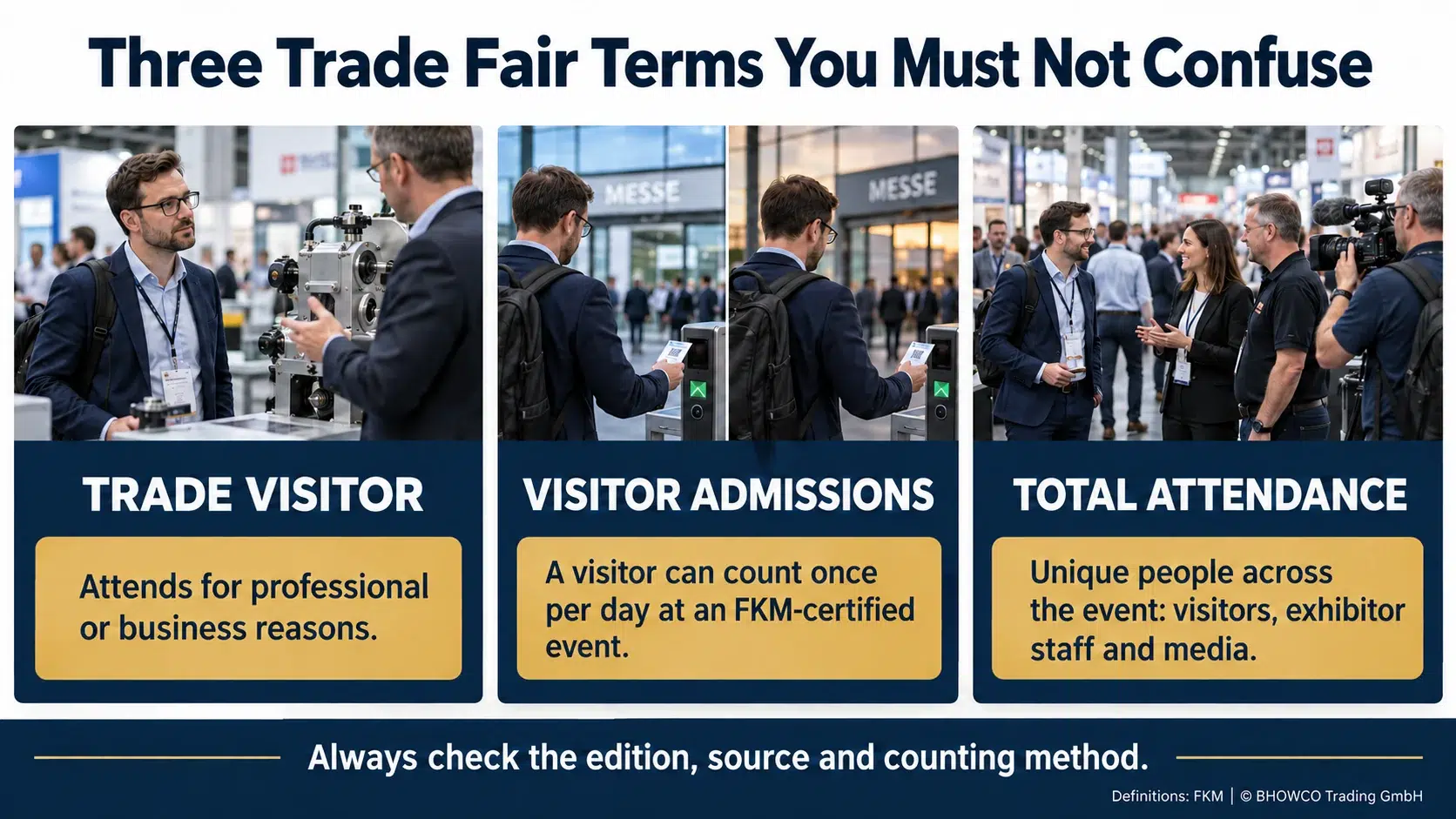
Trade visitor · Fachbesucher
A visitor attending for professional or business reasons. This category can include many roles and industries; it does not mean every trade visitor has purchasing authority or a need for your offer.
Check: Look for role, sector, responsibility and country breakdowns rather than stopping at the trade-visitor percentage.
General public visitor · Privatbesucher
A person attending for private reasons. Some German fairs admit both professional and public audiences, sometimes on different days or under different ticket rules.
Check: Separate the trade audience from the public audience before comparing two events for B2B purposes.
2. Audience figures and event evidence
Visitor profile · Besucherstruktur
A breakdown of visitors by characteristics such as professional role, economic sector, origin or purchasing responsibility. A standardised FKM visitor profile is a particular audited-data product; an organiser’s marketing summary is not automatically equivalent to one.
Check: Does the profile identify the buyer roles and markets you need, and which edition does it describe?
Post-show report · Abschlussbericht / Nachbericht
A report issued after an event, often covering participation, visitor composition and highlights. The scope and method vary; the latest report available may cover an earlier edition than the one you plan to attend.
Check: Record the event year, measurement definitions and source next to every figure you compare.
Visitors versus admissions / visits
One person may attend more than one day. FKM’s visitor-number method counts at most one admission per visitor per day, so a multi-day total can differ from a count of unique people across the entire event. Organisers may present other metrics; read the label and method.
Check: Are you comparing people, daily admissions, ticket sales or another measure? Do not treat them as interchangeable.
Total attendance
Under FKM’s definition, total attendance includes visitors, exhibitor personnel and media representatives present during opening hours, with each person counted once across the event. It is a different measure from the visitor count.
Check: If a headline says “participants” or “attendance,” see who is included before interpreting it as potential buyers.
© BHOWCO Trading GmbH | bhowco.de
FKM-certified exhibition figures
FKM is the German body that independently certifies defined exhibition statistics for participating events. Certified figures improve comparability of reported participation, but they do not certify that an event is the right commercial fit for a particular exhibitor.
Check: Is the specific edition and metric covered, and does the visitor profile answer your buyer-fit question?
Net versus gross exhibition space
In FKM reporting, net exhibition space comprises exhibitor stand space and special-show space. Gross exhibition space also includes supporting areas used for movement and services. Neither figure tells you the number of qualified buyers in your product category.
Check: Compare like with like; do not compare one fair’s gross area with another fair’s net area.
Official exhibitor directory · Ausstellerverzeichnis
The organiser’s listing of companies and brands for a particular event edition. It may contain categories, products, contacts and stand numbers; coverage and update timing depend on the organiser. An independent editorial exhibitor list guide is a different publication and should not present itself as the official directory.
Check: Use the organiser directory to confirm participation and stand details; use independent guides for context and comparison.
Fair fit / buyer fit
A practical judgement about whether an event’s audience, industry scope, geography, timing and cost match an exhibitor’s objectives. It is an assessment, not a standardised metric supplied by every organiser.
Check: Compare evidence for two candidate fairs and mark missing information “unknown.” Use the fair-selection guide.
Three figures that should never be confused
| Term | What it tells you | What it cannot tell you |
|---|---|---|
| Visitor count / admissions | The event’s reported visitor measure | How many matched your buyer profile |
| Trade visitor share | The professional-purpose portion under that method | Who can approve your supplier |
| International share | How much of the audience is classified as foreign | Whether your target markets are represented |
3. Stand planning and participation
Event edition and recurrence
An edition is a specific occurrence of a fair. Some events are annual; others run on different cycles or change dates or venues. Details from an older edition are useful historical context, not proof of this edition’s schedule or participants.
Check: Name the year and confirm dates, venue and application deadlines with the organiser.
Exhibition venue / grounds · Messegelände
The site where a fair is held. Venue, organiser and event are separate entities; a fair’s presence in a city or venue does not mean the venue operates the event or certifies its participants.
Check: Verify the current hall and entrance information on the event’s own site.
Stand / booth · Messestand
The allocated physical area where an exhibitor presents its company during the event. Booking a stand creates a meeting point; it does not by itself create a lasting record of the company that buyers can revisit later.
Check: What will a buyer be able to verify when the stand has been dismantled?
Hall and stand number · Halle / Standnummer
The organiser’s location reference for a stand in a particular edition. It helps visitors find an exhibitor during that event and may change in a later edition.
Check: Publish only confirmed current details; remove or date-label stale stand references afterward.
Shell scheme versus raw space
Common booking terms for a stand package with specified basic construction versus space that the exhibitor must fit out under event rules. What is included, from walls and signage to power and cleaning, varies by organiser and contract.
Check: Read the current stand package and technical manual; do not compare base prices without required services.
Exhibitor manual
The organiser’s event-specific operating instructions, usually covering logistics, deadlines, stand construction, services and access. Its terms and deadlines govern the practical work of participating in that edition.
Check: Assign a person to the current manual and its deadlines, especially before ordering services.
Co-located event
Another event held alongside or near a fair. Shared dates, a venue or admission arrangements do not necessarily mean the events have identical visitor profiles or that visitors attended both.
Check: Ask how each event’s attendance was counted and whether access was shared.
Badge scan / lead retrieval
A way to capture a visitor’s event registration details at a stand, subject to the event’s system and applicable data protection requirements. A scan records contact information; it does not describe the buyer’s need, decision stage or permission for every kind of future message.
Check: Add the question asked, promised document, agreed next step and responsible colleague through your approved process.
4. Buyer evaluation after the fair
Qualified conversation
A meeting that reveals enough relevant context to identify the buyer’s role, application, market, question and useful next step. It is an internal working definition, not an audited trade fair statistic.
Check: Can your colleague explain why this contact matters without relying on the badge scan alone?
Buyer evaluation / supplier comparison
The process by which a buyer and colleagues check potential suppliers against the needs of a purchase. The specific people, evidence and timeline differ by organisation and purchase; attendance at a fair is only one possible starting point.
Check: Can someone who never met your team independently understand and verify your company? See buyer behaviour after the fair.
Evidence pack
A practical set of company facts and relevant supporting material—such as specifications, applicable certifications, case examples and contact details—that a buyer can inspect or share internally. It is a BHOWCO planning term, not an official organiser document.
Check: Is every claim current, permitted to share and tied to the buyer’s actual application?
Post-fair follow-up
The agreed response after a fair conversation: answer the specific question, deliver the promised evidence and make the next contact route clear. A generic sales blast is not a substitute for an individual commitment.
Check: Who owns the response, what evidence was promised and when should it be sent? Build the before/during/after strategy.
Trade fair ROI
Return on investment compares outcomes with the resources committed to an exhibition. What counts as an outcome depends on the objective: a qualified partner discussion, technical validation, supplier consideration or revenue. Brand trust and future purchasing decisions are harder to attribute to one event.
Check: Write the objective and baseline before the event; separate observed results from assumptions. Explore the post-fair ROI framework.
Year-round company presence
Accurate, accessible company information and supporting evidence maintained between events. This is an operating practice, not a guarantee that a buyer will find, contact or purchase from a company.
Check: Could an international buyer verify your role, capabilities and responsible contact months after the fair? See the 365-day presence system.
Public company profile versus private draft
A public profile can provide an enduring place to review company information and supporting links. On BHOWCO, a free account allows a permanent private profile for exploring and preparing the service; public listing requires a paid annual membership and content approval. A BHOWCO profile is not an organiser’s official exhibitor listing.
Check: Confirm whether the profile is actually public before using its link in follow-up material.
German–English trade fair quick lookup
These are useful translations when navigating German event pages. An organiser may use slightly different labels; its own rules and documents remain authoritative.
| German | English | Use it to find |
|---|---|---|
| Messe / Fachmesse | Trade fair / specialist trade fair | The event and its industry focus |
| Aussteller / Mitaussteller | Exhibitor / co-exhibitor | Participation category |
| Ausstellerverzeichnis | Exhibitor directory | Official event company search |
| Fachbesucher / Privatbesucher | Trade visitor / public visitor | Audience type |
| Besucherstruktur | Visitor profile | Buyer role and country breakdowns |
| Messegelände / Messehalle | Exhibition grounds / hall | Venue and hall location |
| Standnummer / Gemeinschaftsstand | Stand number / joint stand | Exhibitor location and shared stand |
| Nachbericht / Abschlussbericht | Post-show report | Previous-edition results and context |
Two common mistakes when reading exhibition information
“A large fair means more suitable buyers.”
A large total can include visitors outside your target sector, country or decision role. Compare the specific audience evidence first.
“A company appears online, so it must have an official stand.”
An independent profile, an editorial list and the organiser’s directory serve different purposes. Check the organiser’s current-edition listing for participation claims.
Questions exhibitors ask
What is the difference between a trade visitor and a buyer?
A trade visitor attends for professional or business reasons. A potential buyer must also have a relevant need or a role in a possible purchasing decision. The first label does not prove the second.
Does an exhibitor directory show every company at a fair?
Coverage, publication timing and listing categories vary. Check the organiser’s current directory and distinguish confirmed exhibitors, shared-stand participants and represented brands.
Can I compare visitor figures from two different fairs directly?
Only after checking edition, metric, collection method and audience breakdown. A comparison of differently defined totals can be misleading.
Does a trade fair in Germany mean my target market is Germany?
No. German fairs can convene international industry audiences. Verify which countries and buyer roles attend the particular fair rather than assuming the venue defines the final market.
What information should remain available after the fair?
Accurate company identity, capability scope, verifiable support material and a responsible contact. An approved public profile can provide a stable reference; the evidence still depends on what the company supplies.
Know the terms. Then test your own plan.
Start with the exhibitor readiness checklist. If you have already shortlisted events, use the two-fair comparison guide. Both turn these definitions into decisions your team can document.
For a public, year-round company reference within BHOWCO, compare annual profile plans. A free account supports a permanent private draft; publication requires a paid annual membership and content approval.
