


Latest Insights
electronica Exhibitor List | Electronic Components & Systems Supplier Guide

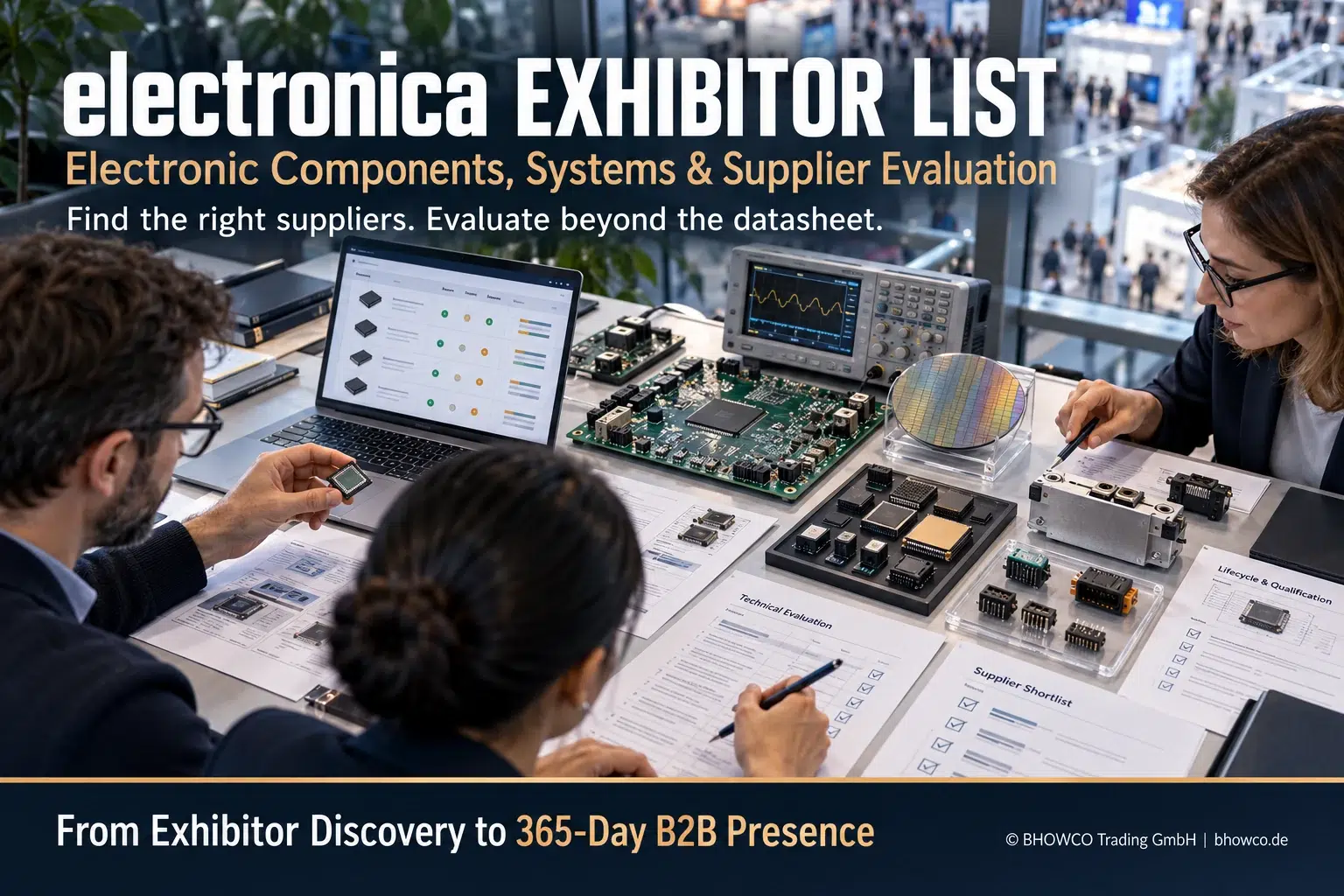
electronica Exhibitor List
Last verified: October 2026
 Looking for the electronica exhibitor list? Use the organiser’s official electronica Exhibitor Directory to research participating companies across semiconductors, embedded systems, sensors, power electronics, PCBs, EMS and electronic design. Check each company profile for current product categories and event participation status before arranging meetings. BHOWCO does not maintain the official exhibitor list.
Finding a supplier in the electronica exhibitor list is only the start of the evaluation. R&D engineers, procurement specialists, quality managers and technical directors may then compare system-level reliability, qualification data, long-term availability, lifecycle commitments, supply chain resilience and total cost of ownership. Which evidence matters depends on the application — automotive, industrial automation, medical technology, energy, telecommunications or consumer electronics. This guide explains what to examine after discovering an exhibitor and how suppliers can remain assessable throughout the longer design-in and qualification cycle that follows electronica.
Explore the guide below: electronica product groups, buyer evaluation questions and the steps between an exhibition meeting and supplier consideration. For the broader investment framework, read how to protect trade fair ROI after the exhibition and how to maintain visibility between trade fairs.
📌 Strategic Note for International Exhibitors: For organiser information, visit the official electronica website. For the exhibitor and product search, use the official Exhibitor Directory. For event facts and figures, see the official Facts & Figures page. The guide below provides strategic intelligence for exhibitors — not just basic information.
Planning to exhibit rather than simply research suppliers? For a strategic analysis of electronica’s industry themes and exhibitor positioning opportunities, explore the electronica Munich Strategic Exhibitor Guide.
📊 Quick Facts: electronica Munich
| Section | Information |
|---|---|
| Dates | 10–13 November 2026 (Tuesday – Friday, 4 days) |
| Opening Hours | Tuesday–Thursday: 09:00–18:00 Friday: 09:00–15:00 |
| Frequency | Every 2 years |
| Venue | Messe München, Am Messesee 2, 81829 Munich, Germany |
| Halls | 18 exhibition halls, including the co-located SEMICON Europa event |
| Based on electronica 2024 Results | 3,486 exhibitors from 58 countries and 80,203 trade visitors from 113 countries and regions across 192,000 square metres of exhibition space in 18 halls. 76% international exhibitors and 54% international visitors. Figures include SEMICON Europa. (Official electronica 2024 Facts & Figures) |
| BHOWCO Buyer-Oriented Supplier Categories | Semiconductors, Embedded Computing, Sensors & Microsystems, Power Electronics & Energy Systems, PCBs & Circuit Carriers, EMS, Electromechanics & System Periphery, Passive Components, Displays & Optoelectronics, Wireless & Connectivity, Automotive Electronics, Electronic Design (ED/EDA), Test & Measurement |
| Focus Topics 2026 | Artificial Intelligence, Cyber Resilience, Energy Efficiency — under the theme “Empowering the All Electric Society” |
| Special Programme | electronica Automotive Conference at ICM on 9 November 2026, followed by electronica Fast Forward, Sensor Pavilion, edge lab LIVE!, EMS Area, LOPEC Innovation Showcase, Career Area and Makeathon Education Hub during the exhibition |
| Admission | Primarily a professional trade event; visitor registration and a valid ticket are required. Student and pupil admission is available on Friday under the organiser’s current ticket conditions. Visitor tickets do not permit same-day re-entry after leaving the exhibition grounds. |
The supplier categories above are independent BHOWCO groupings designed to support buyer research. For the organiser’s complete and current exhibition-sector structure, consult the official electronica trade fair topics and hall plan.
Source: Official electronica website. The official Exhibitor Directory provides the latest available company and product information. Because participation status, company profiles and hall or stand details may be updated, buyers should check the live platform before finalising meeting and sourcing plans.
🔍 Accessing the Official electronica Exhibitor List
The electronica exhibitor list is available through the official Exhibitor Directory. Buyers can use the live directory to research participating companies and review the product-category and stand information currently published by the organiser. Because profiles, participation status and search functions may change, verify current details directly in the official platform before arranging meetings or sourcing activity. Here are the official access channels:
- Official Portal: electronica official website for fair information and year-round content
- Exhibitor Directory: Official electronica Exhibitor Directory for researching participating companies
- Trade Fair Topics: Official focus and trade fair topics for understanding the fair’s structure
- Hall Plan: Official hall plan for orientation and exhibitor location
- Facts & Figures: Official facts and figures for event statistics and key data
For exhibitors, being discoverable matters because R&D engineers, procurement specialists and quality managers actively research potential suppliers. An independent published BHOWCO company profile complements official exhibitor information by giving buyers an additional place to understand the company’s product categories and review the technical and business information it chooses to publish before, during and after electronica.
🏗️ electronica Exhibition Sectors & Supplier Categories
Drawing on the organiser’s official exhibition sectors, BHOWCO groups the electronica supplier landscape into the following buyer-oriented research categories:
| Semiconductors | Microcontrollers, processors, memory, FPGAs, ASICs, power semiconductors (SiC, GaN, IGBT), diodes, transistors, optoelectronics, logic circuits and application-specific ICs |
| Embedded Computing | Single board computers, computer-on-modules, industrial motherboards, embedded PCs, edge AI solutions, embedded vision, real-time operating systems and development tools |
| Sensors & Microsystems | MEMS devices, microsensors, microactuators, inertial measurement systems, micromirrors, micro-optics, sensor and driving technology, printed and flexible sensors |
| Power Electronics & Energy Systems | SiC and GaN power semiconductors, power supplies, AC/DC and DC/DC converters, inverters, power modules, battery management systems, charging electronics and thermal management |
| PCBs & Circuit Carriers | Single-sided, double-sided and multilayer printed circuit boards, flexible and rigid-flex PCBs, substrates, circuit carriers, PCB materials, ceramic PCBs and 3D-MID components |
| EMS (Electronic Manufacturing Services) | PCB assembly, electronics manufacturing, prototyping, contract production, supply chain integration, testing, lifecycle support and obsolescence management |
| Electromechanics & System Periphery | Connectors, switches, relays, cables, wiring systems, housings, enclosure technology, thermal management, EMC components and component protection solutions |
| Passive Components | Resistors, capacitors, inductors, crystals, oscillators, transformers, piezoelectric components, magnetic and ceramic products |
| Displays & Optoelectronics | LCD, OLED, microLED displays, LEDs, optoelectronic components, touch displays, e-paper, printed and flexible displays |
| Wireless & Connectivity | Cellular and 5G modules, Wi-Fi, Bluetooth, GNSS, NFC, RFID, V2X, Matter, antennas, RF components, secure IoT connectivity and wireless power |
| Automotive Electronics | Electrical and hybrid electric vehicles, electrical drives, charging electronics, energy storage, driver assistance systems, sensors for autonomous driving, interior comfort, car lighting and on-board power supply |
| Electronic Design (ED/EDA) | CAD/CAE tools, development software, test software, design and development systems, simulation, libraries, databases and customised software |
| Test & Measurement | Geometric, mechanical, thermal, optical, acoustic, electrical and environmental measurement equipment, inspection systems, test systems and laboratory equipment |
Source: Official electronica trade fair topics. The supplier categories above are independent BHOWCO groupings; for the organiser’s complete exhibition-sector structure, consult the official trade fair topics and hall plan.
👷 Who electronica Exhibitors Meet: Industry Buyers & Decision-Makers
Understanding the electronica visitor and industry-participant profile helps exhibitors prepare more relevant engagement strategies. The fair is open to trade visitors working across electronics and its application industries.
Technical and Commercial Decision-Makers
- R&D Engineers & Electronics Designers: Evaluating components, development tools and system integration for new designs
- Embedded Systems Developers: Assessing processors, modules, real-time operating systems and development environments
- PCB Specialists: Evaluating board materials, manufacturing capability, layer counts and HDI requirements
- Test Engineers & Quality Assurance Professionals: Assessing measurement, inspection and qualification capability
- Component Buyers & Procurement Specialists: Sourcing components, modules, assemblies and manufacturing services
- Supply Chain Professionals: Evaluating availability, lifecycle commitments, obsolescence management and supply chain resilience
- Production Managers: Assessing manufacturing capacity, automation and integration potential
Industry Stakeholders and Application Sectors
- Automotive Industry: OEMs, tier suppliers and system integrators evaluating automotive-grade components and qualification evidence
- Industrial Automation: Machine builders and automation specialists evaluating embedded, sensor and connectivity solutions
- Energy & Power Systems: Power electronics, smart grid and energy storage specialists
- Medical Technology: Medical device developers evaluating high-reliability components and regulatory documentation
- Telecommunications & Data Centres: Network infrastructure and computing hardware specialists
- Aerospace & Defence: High-reliability and mission-critical electronics specialists
- Start-ups & Research Institutions: Emerging technology developers and applied research organisations
According to the organiser, electronica 2024 hosted 3,486 exhibitors and 80,203 trade visitors from 113 countries and regions, with 76% international exhibitors and 54% international visitors. The 2026 edition takes place from 10–13 November under the theme “Empowering the All Electric Society,” with SEMICON Europa running concurrently within the combined 18-hall event.
✅ Buyer Insight
electronica can start or accelerate supplier evaluation, but electronics design-in and qualification decisions often continue beyond the fair. Depending on the component category and application, further stages may include technical documentation review, qualification data assessment, lifecycle commitment verification, supply chain assessment and commercial comparison.
📊 How Industrial Buyers Evaluate electronica Suppliers
Finding a company in the electronica exhibitor list is only the first step. When evaluating electronics suppliers, industrial buyers typically assess the following dimensions. This framework represents independent BHOWCO analysis of electronics procurement practices, not an official organiser methodology.
TECHNICAL CAPABILITY & APPLICATION FIT
- Application Fit – Is the component or system proven for the intended application, operating conditions and environment?
- System-Level Reliability – How does the component contribute to overall system reliability and fail-safe behaviour?
- Integration Support – What development resources, reference designs, evaluation kits and application engineering are available?
- Documentation Quality – Are datasheets, application notes and technical documentation complete for the intended use?
QUALIFICATION & COMPLIANCE
- Qualification Evidence – Are qualification test data, operating limits and reliability reports available for the relevant standards?
- Functional Safety – Where safety-related functions are involved, what functional-safety documentation, development evidence or assessment support is available?
- Application-Specific Standards – Does the product meet the standards required for the target industry, such as AEC-Q100 for automotive or medical-specific validations where applicable?
- Certification Support – Can the supplier support certification processes with documentation and test data?
LIFECYCLE & SUPPLY CHAIN
- Long-Term Availability – Are lifecycle commitments and long-term availability documented?
- Obsolescence Management – How are product change notifications and end-of-life communications handled?
- Supply Chain Resilience – Can the supplier provide credible evidence of capacity planning, continuity measures, manufacturing locations and supply-risk management?
- Total Cost of Ownership – What is the total cost including qualification, integration, lifecycle support and supply risk?
COMMERCIAL & PARTNERSHIP READINESS
- Pricing Transparency – Are pricing structures and volume commitments clear?
- Design-In Support – What technical support is available during design-in and qualification?
- References & Track Record – Are relevant industry references and application case studies available?
- Responsiveness – How quickly does the supplier respond to technical and commercial inquiries?
Signals of Serious Post-Fair Buyer Interest:
- Request for technical documentation and datasheets
- Request for qualification data and reliability reports
- Application-specific evaluation or sample request
- Design-in discussion or evaluation kit request
- Lifecycle commitment and obsolescence policy review
- Supply chain and capacity assessment
- Supplier qualification or audit review
- Commercial or project quotation request
For a deeper understanding of how industrial buyers evaluate suppliers, read this guide to buyer behavior at trade fairs.
⚠️ Electronics Procurement Reality
For R&D engineers and procurement teams, documented technical capability, qualification evidence and lifecycle commitments are essential. A compelling product demonstration does not compensate for incomplete technical documentation, unclear lifecycle support or unverified supply chain capability. Requirements vary significantly by product category: semiconductors, embedded systems, sensors, power electronics, PCBs and EMS each face different qualification and documentation requirements.
🕐 From electronica Discovery to Design-In Decision
For exhibitors, maintaining a credible professional presence can influence whether the company remains visible and assessable during the following evaluation stages:
| 1. SUPPLIER DISCOVERY | Semiconductor, embedded, sensor, power, PCB, EMS or connectivity suppliers identified at electronica or through research. |
| 2. APPLICATION & REQUIREMENTS DEFINITION | Application, performance, environmental and qualification requirements translated into technical specifications. |
| 3. TECHNICAL & QUALIFICATION EVALUATION | Technical documentation, qualification data, reliability evidence and application support reviewed. |
| 4. SUPPLIER COMPARISON | Alternatives, qualification evidence, lifecycle commitments, supply chain resilience and total cost of ownership compared. |
| 5. PROCUREMENT PROCESS | Quotation, negotiation, sample order or purchasing process where applicable. |
| 6. DESIGN-IN & PRODUCTION SUPPORT | Design-in support, integration, qualification support, production ramp-up and ongoing supply collaboration. |
Design-in and qualification timelines vary considerably by component category, application and industry. Standard components may move faster, while automotive, medical and safety-critical applications typically involve extended validation and qualification phases.
This journey explains why post-fair presence can remain strategically important while buyers continue evaluating, comparing and qualifying.
📌 Why Professional Exhibitor Presence Matters Beyond the Official electronica Exhibitor List
Industry buyers use the electronica exhibitor list to discover potential suppliers, but discovery alone does not guarantee continued consideration. R&D engineers, procurement teams and quality managers may return later to review technical documentation, verify qualification data and compare competing suppliers.
The organiser provides the Exhibitor Directory as an official exhibitor search and product-discovery tool. An independent published BHOWCO company profile provides an additional professional touchpoint within Germany’s wider trade-fair ecosystem; it does not replace, represent or form part of the official platform.
🔎 electronica Exhibitors by Category: Semiconductors, Sensors, Power, PCBs & Embedded
Industry buyers search for specific categories within the electronica exhibitor list. Each category includes analysis from the buyer’s perspective:
Semiconductors
Relevant exhibitors may include microcontroller and processor manufacturers, memory suppliers, FPGA and ASIC providers, power semiconductor specialists, analog and mixed-signal IC companies, optoelectronics manufacturers.
Buyer insight: Engineers comparing semiconductor suppliers need to understand operating limits, package options, development resources and compatibility with the intended application. Procurement teams may also examine availability commitments, product change notifications and end-of-life communication. Exhibitors should make the relevant product families and supporting resources easy to identify.
Sensors & Microsystems
Relevant exhibitors may include MEMS manufacturers, sensor specialists, microactuator providers, inertial measurement system suppliers, micromirror and micro-optics companies.
Buyer insight: Sensor selection depends on the measurement task, accuracy, drift, calibration needs, environmental conditions and interface requirements. A useful supplier presentation explains where the sensor has been evaluated, what integration support is available and which performance claims are supported by documented test conditions.
Power Electronics & Energy Systems
Relevant exhibitors may include SiC and GaN power semiconductor manufacturers, power supply and converter suppliers, inverter and power module providers, battery management system specialists, charging electronics companies.
Buyer insight: Buyers evaluating power devices, modules and converters need performance data under relevant operating conditions. Useful evidence includes efficiency curves, thermal characteristics, switching behaviour, protection features and application support. Headline specifications become more meaningful when the test conditions and intended use are clear.
PCBs & Circuit Carriers
Relevant exhibitors may include rigid PCB manufacturers, flexible and rigid-flex PCB suppliers, HDI and multilayer specialists, ceramic PCB providers, 3D-MID component companies.
Buyer insight: PCB supplier selection involves more than a list of production services. Buyers may need to understand material and process capabilities, inspection and testing, traceability, change control, production capacity and the transition from prototypes to repeat production. Exhibitors should distinguish in-house capabilities from outsourced activities.
EMS (Electronic Manufacturing Services)
Relevant exhibitors may include PCB assembly service providers, contract electronics manufacturers, prototyping specialists, testing and lifecycle support companies, obsolescence management providers.
Buyer insight: EMS buyers evaluate manufacturing capability, quality control, supply chain integration, testing and inspection, traceability, change control and the ability to support the transition from prototype to repeat production.
Embedded Computing
Relevant exhibitors may include single board computer manufacturers, computer-on-module suppliers, industrial motherboard providers, embedded PC specialists, edge AI solution developers, RTOS and development tool companies.
Buyer insight: Embedded platforms and wireless solutions are evaluated through hardware compatibility, software resources, interface support and maintenance arrangements. Suppliers should clarify available development tools, integration assistance, update policies and relevant security documentation for the intended application.
Electromechanics & Passive Components
Relevant exhibitors may include connector manufacturers, relay and switch suppliers, cable and wiring system providers, housing and enclosure specialists, capacitor, inductor and resistor manufacturers, transformer and piezoelectric component suppliers.
Buyer insight: Connector, relay, capacitor and other component choices depend on electrical, mechanical and environmental requirements. Buyers need clear specifications, available variants and evidence relevant to the application. Manufacturing consistency, change notifications and continuity of supply also matter when components enter repeat production.
Wireless & Connectivity
Relevant exhibitors may include 5G and cellular module providers, Wi-Fi and Bluetooth specialists, GNSS and NFC component suppliers, RFID and V2X solution developers, antenna manufacturers, RF component companies.
Buyer insight: Connectivity buyers evaluate regulatory approvals, cybersecurity, integration requirements, geographic certification coverage and long-term software support. Where the solution contributes to a safety-related function, relevant functional-safety evidence may also be required.
Electronics Applications Buyers Research at electronica
Buyers do not evaluate electronics technology in isolation. They assess whether components, systems and software can meet specific application and qualification requirements. The application clusters below are independent BHOWCO groupings for research convenience.
Automotive & Mobility
Automotive buyers evaluate relevant component qualification evidence, functional-safety support where applicable, long-term availability, change-control discipline and supply-chain resilience. Depending on the buyer and supplier role, PPAP and related automotive quality documentation may also be required. The electronica Automotive Conference at ICM on 9 November 2026 addresses automotive electronics trends and challenges.
Industrial Automation & Industry 4.0
Industrial buyers assess system-level reliability, real-time capability, long-term support, EMC compliance and integration with existing control systems for automation and IoT applications.
Medical Technology
Medical-device developers evaluate component reliability, traceability, change control, lifecycle support and documentation needed for the applicable device classification and regulatory process. Biocompatibility evidence may be relevant only where materials or assemblies have direct or indirect patient contact.
Energy & Smart Grid
Energy buyers research power electronics, battery management, smart grid components and energy-efficient system solutions for electrification and renewable energy applications.
Aerospace & Defence
Aerospace and defence buyers evaluate high-reliability components, radiation tolerance where applicable, qualification standards and traceability for mission-critical systems.
Data Centres & Telecommunications
Data centre and telecom buyers assess power efficiency, high-speed connectivity, thermal management and reliability for network infrastructure and computing hardware.
🔄 electronica and Other Electronics Events
electronica serves a different strategic purpose from regional electronics exhibitions, national trade fairs and sector-specific technology events. Exhibitors comparing events should evaluate buyer roles, application industries and qualification requirements rather than relying only on visitor totals. Read the BHOWCO guide to selecting the right German trade fair.
📊 What Happens After electronica?
After the fair closes, two distinct paths emerge for exhibitors. The path you take depends on whether your company remains discoverable during the design-in and qualification window:
| ✅ STAYS PRESENT | ❌ LIMITED POST-FAIR PRESENCE |
|---|---|
|
|
The Demonstration Ends. Design-In Evaluation Continues.
Stay Present While the Industry Keeps Qualifying. R&D engineers, procurement teams and quality managers may continue reviewing suppliers and qualification evidence after electronica. Remaining discoverable and verifiable can strengthen a supplier’s position while buyers compare alternatives and develop design-in plans.
❓ Frequently Asked Questions About the electronica Exhibitor List
Where can I find the official electronica exhibitor list?
The organiser’s official electronica Exhibitor Directory provides access to company information across semiconductors, embedded systems, sensors, power electronics, PCBs, EMS and electronic design.
Is the electronica exhibitor list free to search?
The official Exhibitor Directory is publicly accessible through the electronica website. Available search, filtering and profile features may change as the directory is updated.
Can I search electronica exhibitors by product category?
The official platform allows buyers to browse participating companies and explore product categories. Available search and filter functions may change as the live directory is updated.
What types of companies exhibit at electronica?
electronica brings together semiconductor manufacturers, embedded computing providers, sensor and MEMS specialists, power electronics companies, PCB manufacturers, EMS providers, electromechanics and passive component suppliers, display and optoelectronics companies, wireless and connectivity specialists, EDA and development tool providers, and testing and measurement companies.
What do industrial buyers evaluate at electronica?
Buyers evaluate system-level reliability, qualification data, application fit, long-term availability, lifecycle commitments, supply chain resilience and total cost of ownership. Evaluation criteria vary by product category — semiconductors, embedded systems, sensors, power electronics, PCBs and EMS each face different qualification and documentation requirements.
How can buyers compare electronica exhibitors before the fair?
Buyers can compare relevant exhibitors by reviewing product categories, qualification documentation, technical data, lifecycle commitments and the company’s suitability for specific application requirements.
What happens after buyers discover a supplier at electronica?
After discovery, buyers typically verify technical documentation, assess qualification data, evaluate alternatives, and begin design-in and procurement processes. The duration varies substantially by component category and application.
How can exhibitors remain discoverable after electronica?
Exhibitors can support post-fair discoverability through an up-to-date company profile, clear product categorisation, relevant qualification and technical information, and a consistent year-round presence. BHOWCO provides an independent published company profile environment within the German trade fair ecosystem through an annual membership.
Conclusion: From the electronica Exhibitor List to Design-In Partnership
The electronica exhibitor list helps R&D engineers, procurement specialists, quality managers and technical directors identify companies across semiconductors, embedded systems, sensors, power electronics, PCBs, EMS, electromechanics, passive components, displays, wireless, automotive, electronic design and test & measurement. Yet finding a supplier is only the beginning: system-level reliability, qualification evidence, lifecycle commitments and supply chain resilience may still need to be evaluated.
For international exhibitors, a consistent professional presence provides industry buyers with more opportunities to rediscover the company and reassess its capabilities while design-in and qualification processes continue.
The Demonstration Ends. Design-In Evaluation Continues.
Extend your electronica presence with a published professional company profile that helps relevant buyers understand your products, review the technical and business information you provide and reconnect with your brand throughout the year.
Build Your Published B2B Presence
Explore more: International Buyer Behavior at Trade Fairs | German Trade Fair Exhibitor Checklist | Building a Multi-Exhibition Presence Strategy | electronica Munich Strategic Exhibitor Guide | electronica Visitor Guide
Disclaimer: BHOWCO is an independent B2B platform and is not affiliated with, endorsed by or acting on behalf of Messe München GmbH or electronica. Official exhibitor participation, event dates, opening hours and programme information should always be verified through the organiser’s current website and Exhibitor Directory. Buyer-evaluation frameworks on this page represent independent BHOWCO analysis.