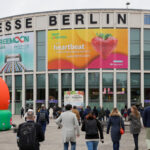
MESSE BERLIN CENTER
Messe Berlin | Berlin, Germany
Where 200 Years of Trade Fair History Meet the World's Most Vibrant Capital — Hosting the World, And You.
Not merely a venue. A 365/24/7 business ecosystem in the heart of Europe's most dynamic city — where global buyers, politicians, scientists, and cultural leaders converge.
To approach Messe Berlin as simply a physical location for temporary events ignores its function as a permanent business and cultural infrastructure. With over 200 years of trade fair history, 190,000 square meters of exhibition space, and a portfolio that includes world-leading events like ITB (global travel trade show), InnoTrans (world's leading transport technology fair), Fruit Logistica (global fresh produce trade), and Grüne Woche (international food and agriculture fair) — this is where global industries meet in Europe's most exciting capital. Success here demands a 365-day visibility strategy that leverages Berlin's unique appeal as a "sexy, loud, and always awake" business destination.
Venue Overview: Global Business Infrastructure
- Founded: Over 200 years of trade fair tradition — one of Europe's oldest and most prestigious exhibition venues.
- Total Exhibition Space: 190,000 m² across 27 trade fair/event halls and additional multi-purpose venues — flexible spaces for events of all sizes.
- Global Standing: State-owned enterprise organizing hundreds of events annually — millions of visitors, exhibitors, and organizers from around the world.
- World-Leading Events: ITB (world's largest travel trade show), InnoTrans (world's leading transport technology fair), Fruit Logistica (global fresh produce trade), and Grüne Woche (international food and agriculture fair).
These metrics confirm Messe Berlin as a validation platform for international B2B credibility — where your participation signals global reach, industry relevance, and the ability to attract buyers in the world's most cosmopolitan city.
Data source: Messe Berlin – Official Website
Strategic Advantages: Why Global Exhibitors Choose Messe Berlin
Messe Berlin is not just a venue; it is a strategic business decision infrastructure. The advantages extend far beyond square meters:
- Unmatched Location: Berlin — the creative, political, and cultural capital of Germany. A city that never sleeps (365/24/7) with the most hotel beds in Germany, spectacular dining scene, and cosmopolitan lifestyle that attracts global decision-makers.
- Perfect Accessibility: Centrally located at Messedamm 22, 14055 Berlin — excellent transport links via the A100/A115 motorways (Funkturm interchange) and close proximity to Berlin's urban road network.
- Exceptional Venue Flexibility: 190,000 m² spread across 40+ exhibition halls and event areas — plus additional multi-purpose venues. Every event becomes an experience in itself.
- Full-Service Partner: "A team just for you" — location scouting, expertise, positive energy, and attention to detail before, during, and after your event. Sustainability support for "green meetings."
- Political & Scientific Hub: Berlin as a city of politics and science attracts high-level decision-makers from government, research institutions, and international organizations.
World-Leading Trade Fairs
- ITB Berlin: World's largest travel trade show — the leading platform for global tourism, attracting buyers from 180+ countries.
- InnoTrans: World's leading transport technology fair — the premier global platform for railway technology, public transport, and infrastructure.
- Fruit Logistica: World's leading trade fair for the fresh produce business — the global meeting point for the fruit and vegetable industry.
- Grüne Woche: International Green Week Berlin — world's largest food and agriculture fair, combining B2B trade with consumer engagement.
- Boot & Fun: Outdoor boat show — a key European platform for marine and water sports industry.
International Market Relevance
- Global Buyer Access: Millions of visitors annually from all continents — concentrated decision-makers in travel, transport, food, and agriculture.
- Cross-Sector Innovation: Where travel meets technology, where food meets sustainability, where transport meets digital transformation.
- Berlin Factor: The unique appeal of Berlin — "sexy, loud, and always awake" — attracts a younger, more diverse, and culturally influential buyer demographic compared to other German venues.
- State-Owned Stability: Owned by the State of Berlin — providing long-term reliability and public sector trust.
Brand authority lock: Being an exhibitor at ITB, InnoTrans, or Fruit Logistica signals your company's global ambition and ability to attract buyers in the world's most cosmopolitan markets.
Exhibitor Value Analysis: Who Benefits Most?
Messe Berlin is not suitable for every exhibitor. It is ideal for those ready to leverage Berlin's unique combination of business, politics, culture, and lifestyle to build global brand presence.
- Tourism & Travel Companies: ITB offers unparalleled access to global travel buyers, tour operators, and destination marketers — but requires a strong international presence and compelling marketing storytelling.
- Transport & Mobility Suppliers: InnoTrans attracts the world's railway and public transport industry — ideal for companies with proven technology and European certification.
- Fresh Produce & Food Exporters: Fruit Logistica and Grüne Woche connect global producers with European and international buyers — essential for export-oriented agri-business.
- Startups & Innovators: Berlin's vibrant startup ecosystem and cultural appeal attract investors, media, and early adopters. Perfect for B2B startups with scalable solutions and compelling narratives.
- Brands Seeking Lifestyle & Cultural Positioning: Berlin's unique "sexy, loud, and always awake" reputation allows exhibitors to position their brand within a broader cultural and lifestyle context — not just business functionality.
Competitive environment warning: Booth space at flagship fairs (ITB, InnoTrans, Fruit Logistica) is highly competitive and premium-priced. Without pre-fair visibility, post-fair lead nurturing, and a compelling brand story that resonates with Berlin's dynamic atmosphere, your investment may not yield measurable ROI. This is why BHOWCO's 365-day visibility framework is critical.
Year-Round Visibility: Beyond Physical Exhibition Days
A 3-5 day presence at Messe Berlin cannot establish lasting brand authority in the global B2B market. The decision cycles of international procurement managers range from 6 to 18 months. Additionally, Berlin's unique appeal means that media and buyer attention extends beyond the exhibition days — the city itself becomes part of your brand experience. Therefore:
Pre-Event Visibility (Months -12 to -1): Establish digital presence in German and international search results, gain media coverage in tourism/transport/food industry publications, and pre-qualify buyers through targeted campaigns. Leverage Berlin's global media appeal in your marketing.
On-Site Activation (3-5 days): Validate your claims. Demonstrate product reliability and innovation. Create memorable brand experiences that leverage Berlin's cultural and lifestyle appeal. Network with pre-scheduled decision-makers from 180+ countries.
Post-Event Credibility (Months +1 to +12): Convert leads using published fair participation as social proof. Leverage Berlin's unique "hosting the world" positioning in your ongoing marketing campaigns. The city itself becomes part of your brand narrative.
Evidence of strategic failure: Treating Messe Berlin appearances as isolated campaigns without integrating them into a 12-month continuous visibility and lead nurturing strategy that leverages Berlin's 365/24/7 appeal.
Strategic Recommendation: Is Messe Berlin Right for You?
Recommendation: Exhibit if your business meets 3 of these 4 criteria — (1) You sell to travel, transport, food, or agricultural buyers, (2) You have verifiable export readiness and global logistics capability, (3) You can leverage Berlin's unique cultural and lifestyle appeal in your brand story, (4) You can commit to 12+ months of integrated pre/post-fair marketing that connects your brand to Berlin's global image.
Best suited industries: Tourism and travel, railway and transport technology, fresh produce and food industry, agriculture, outdoor and water sports, and B2B brands seeking lifestyle/cultural positioning.
Brand positioning strength: Excellent for companies seeking to combine global business credibility with a modern, cosmopolitan, and culturally sophisticated brand image. The "Berlin" brand association adds unique value.
International market expansion value: High. With world-leading fairs covering travel, transport, and food — Messe Berlin offers unique access to global buyers in these sectors. The city's cosmopolitan appeal attracts decision-makers from emerging markets and developed economies alike.
Long-term strategic advantage: Repeated participation in Messe Berlin flagship fairs builds cumulative trust. The combination of trade fair presence and Berlin's global media appeal creates a powerful brand ecosystem. Buyers and media remember consistent presence in Europe's most exciting capital.
Strategic Contact & Venue Information
- 📍Address: Messedamm 22, 14055 Berlin, Germany
- 📞Phone: +49 30 3038-0
- ✉️Email: central@messe-berlin.de
- 🌐Official Website: messe-berlin.de
- 🏛️Ownership: State-owned enterprise (Land Berlin) — stability and public sector trust.
Strategic FAQs for International Exhibitors
Is Messe Berlin suitable for first-time international exhibitors?
Yes, but with careful preparation. Berlin's unique appeal makes it more accessible for lifestyle, tourism, and food brands. First-timers should use a moderate booth + professional host + pre-booked meetings to test market fit. The city's cosmopolitan atmosphere helps attract a diverse buyer base even for newcomers.
Which industries gain the most from Messe Berlin?
Tourism (ITB), transport technology (InnoTrans), fresh produce and food (Fruit Logistica, Grüne Woche), and agriculture. If your target buyers are not in these sectors, evaluate other venues. However, Berlin's cultural appeal can benefit any B2B brand seeking a modern, lifestyle-oriented positioning.
Is Messe Berlin useful for global brand positioning, not just sales?
Absolutely. The combination of world-leading fairs and Berlin's global cultural appeal creates unique brand positioning opportunities. Being a repeat exhibitor at Messe Berlin signals cosmopolitan sophistication and global ambition — particularly valuable for travel, food, and lifestyle brands.
How can exhibitors maximize ROI?
Three non-negotiable actions: (1) 12-month pre-fair SEO & LinkedIn targeting of international buyers in your sector, (2) On-site brand experience that leverages Berlin's creative and cultural energy, (3) Post-fair nurture sequence using Messe Berlin media mentions and Berlin's global reputation as social proof.
Final decision filter: Exhibit at Messe Berlin or elsewhere?
Choose Messe Berlin if: Your target buyers are in travel, transport, food, or agriculture — or if you want to leverage Berlin's unique lifestyle, cultural, and political appeal to differentiate your brand. Consider other venues if: You need highly specialized industrial/technical audiences (construction, electronics, heavy machinery) or your budget cannot support 12 months of integrated visibility and creative brand activation.
Ready to transform Messe Berlin participation into long-term global brand authority?
Membership includes strategic consultation and verified exhibitor intelligence. Not all applicants are approved.
Professional Reference Notice
Information related to Messe Berlin, including figures and industry focus, is based on official public data. International exhibitors should always verify current details directly with the organizer. Strategic recommendations reflect BHOWCO's independent B2B analysis based on the venue's unique positioning in Berlin's cultural and political ecosystem.
BERLIN TRADE FAIRS CALENDAR
INTERNATIONAL EXHIBITIONS
July 2026
No Events
August 2026
No Events
September 2026
Event Details
Event Details

IFA Berlin
04. – 08. September 2026 | Berlin, Germany
Official Website: https://www.ifa-berlin.com/
Overview
IFA Berlin serves the global consumer electronics and home appliance ecosystem, connecting manufacturers, technology providers, component suppliers, and software platforms with European retailers, distributors, telecom operators, and media. The exhibition attracts over 200,000 visitors from more than 100 countries annually, including retail buying committees from Europe’s largest electronics chains, telecom operators, insurance companies, media representatives, and technology evaluators.
International exhibitors participate to launch flagship products, secure retail distribution, and establish market presence for the European holiday season and beyond. The relevance of participation depends on whether exhibitors can meet the expectations of professional buyers who evaluate product differentiation, retail readiness, regulatory compliance, data privacy capability, and sustainability positioning.
Why This Trade Fair Matters
Commercial decisions in the consumer electronics industry are influenced by retail buying committees, telecom operators, insurance companies, and strategic technology partners — many of whom attend IFA to assess new product categories, evaluate supplier capability, and make seasonal buying decisions. These stakeholders evaluate suppliers based on product differentiation, retail readiness, supply chain reliability, regulatory compliance, data privacy frameworks, and sustainability credentials. The exhibition provides a concentrated environment where suppliers can engage with multiple decision-influencing roles across the European retail and technology ecosystem simultaneously.
Beyond immediate retail commitments, IFA offers long-term value through market intelligence, media positioning, partnership identification, and competitor monitoring. International exhibitors can follow discussions around AI integration, smart home ecosystems, connected health, and sustainability trends that shape product development and market positioning. The exhibition should be viewed as one stage in a longer market development and retail execution process rather than a standalone launch event.
Is This Trade Fair Right for You?
Ideal For
Major brands launching flagship products that define category direction for the coming year are relevant exhibitors when they have broad European retail distribution plans, marketing support for retail partners, and sufficient inventory for holiday season demand. These companies are commercially prepared because retail buyers expect to see strong go-to-market strategies, compelling retail marketing materials, and reliable supply chain capability.
Innovators in AI-powered appliances, connected health devices, and smart home ecosystems are well-positioned for conversations with telecom operators, insurance companies, and utility providers exploring new service-based revenue models and ecosystem integration. Technology enablers — chipmakers, sensor providers, and software platforms — demonstrating how they solve key industry challenges like interoperability, battery life, or on-device AI typically find productive engagement with brand technical teams and product development leads.
Companies with strong narratives on repairability, recycled materials, and energy efficiency that align with EU regulations and consumer sentiment are increasingly relevant as sustainability becomes a competitive differentiator and regulatory requirement in the European market.
May Not Be Suitable For
Brands competing solely on low price points without technological differentiation or a sustainable brand story may find the German and European market challenging, as buyers prioritize quality, durability, and environmental credentials. Early-stage hardware startups without proven supply chain reliability, CE certification, or a clear path to retail shelf presence typically need substantial preparation and partnership development before exhibiting.
Companies with highly conceptual prototypes or products without demonstrable retail readiness may find it difficult to convert media or retail interest into commercial commitments. Suppliers without clear data privacy narratives, sustainability documentation, or EU regulatory compliance may struggle to meet the expectations of professional buyers and media representatives.
Business Opportunities
- Secure holiday season distribution commitments with European retail buying committees evaluating product categories and brand positioning
- Present technology roadmaps and integration capabilities to telecom operators exploring smart home and connected device partnerships
- Connect with insurance companies and utility providers exploring new service-based revenue models and ecosystem partnerships
- Identify technology partnership opportunities with brands seeking integration capability and component supply relationships
- Evaluate competing approaches to AI integration, smart home ecosystems, and sustainability positioning
- Monitor media coverage and consumer sentiment to inform product positioning and marketing strategy
- Explore cross-brand platform integration discussions with smart home ecosystem providers
- Understand retail buyer expectations regarding marketing support, inventory planning, and consumer trust
Exhibitor Perspective
Effective participation at IFA depends more on retail readiness, regulatory compliance, and go-to-market capability than on booth size alone. Professional buyers arrive with specific questions about product differentiation, supply chain reliability, retail marketing support, data privacy frameworks, and sustainability credentials. They expect exhibitors to demonstrate understanding of European consumer expectations, regulatory requirements, and retail execution challenges.
A visually impressive product without clear retail marketing support, reliable delivery capability, or data privacy documentation may generate media attention but rarely secures retail distribution commitments. Before investing in exhibition space, suppliers should evaluate whether their go-to-market strategy can meet European retail execution expectations.
Exhibitors should treat IFA as the beginning of a retail execution and market development process rather than expecting immediate distribution commitments during exhibition days. The commercial cycle typically involves initial retail interest, follow-up presentations, marketing support discussions, inventory planning, and seasonal ordering — with supply chain reliability and retail execution capability determining whether initial interest develops into long-term retail partnerships. Maintaining consistent engagement throughout this cycle and providing clear retail marketing support, inventory information, and regulatory documentation can help suppliers develop professional relationships with retail partners.
For international exhibitors, IFA should be integrated into a 365-day visibility strategy where exhibition conversations are supported by ongoing retail marketing development, regulatory compliance maintenance, and relationship building with retail partners, telecom operators, and ecosystem platforms. The value should be measured through retail distribution progress, partnership development, media positioning, and consumer trust building rather than immediate sales volume during the event.
Before You Exhibit
Define specific objectives for each stakeholder group. Retail buying committees, telecom operators, media representatives, and technology partners have different evaluation criteria. Prioritize organizations where your product addresses an identifiable market opportunity or strategic partnership need rather than approaching the visitor list as a general promotional opportunity.
Prepare comprehensive retail and regulatory documentation. Product differentiation evidence, retail marketing support materials, supply chain reliability documentation, CE certification, data privacy frameworks, and sustainability credentials are common evaluation criteria that professional buyers expect to review during assessment discussions.
Research attending retailers, telecom operators, and media representatives. Identify target organizations and relevant decision-makers connected to IFA. Schedule pre-fair meetings rather than relying on chance encounters during the event.
Develop stakeholder-specific messaging. Different stakeholders ask different questions. Retail buyers focus on sell-through potential and marketing support, telecom operators on integration capability and service models, and media representatives on innovation and consumer relevance. Preparing distinct talking points for each persona improves communication effectiveness.
Plan a structured post-event retail and partnership follow-up timeline. Preparing retail marketing materials, inventory information, and partnership proposals in advance allows faster response to post-event interest. This responsiveness is critical given the seasonal timing requirements typical in consumer electronics retail cycles.
Continue Your Research
European retail buyers and technology partners evaluate consumer electronics suppliers through a structured commercial and regulatory assessment process that international companies often misunderstand. Understanding retail culture, seasonal timing expectations, and European regulatory requirements is essential before investing in IFA exhibitor participation. Understanding German and European Retail Buying Cycles explains how retail decisions are made and what international suppliers should prepare.
Many exhibitors focus all their resources on exhibition days and lose momentum afterward. However, retail distribution development and market execution typically extend across many months. Building Long-Term Visibility After a German Trade Fair explains how to maintain communication and commercial credibility throughout the extended market development cycle.
International exhibitors often underestimate the preparation required for German and European consumer electronics exhibitions. From retail marketing development to regulatory documentation, structured planning significantly influences participation quality. Consumer Electronics Exhibitor Checklist for German Trade Fairs helps technology and consumer goods companies prepare retail documentation, regulatory evidence, and post-event follow-up before entering German exhibitions.
FAQ
Strategic FAQs for Exhibitors
For a component or technology supplier, what is the most effective way to engage with brands at IFA?
Move beyond the spec sheet. Showcase reference designs or complete technology modules that solve a specific consumer pain point (e.g., “instant-on” voice interface, ultra-low-power always-on sensors). Your goal is to make it faster, cheaper, and less risky for brands to integrate your innovation into their next-generation products.
How has the role of European retail buyers at IFA changed in the age of direct-to-consumer sales?
They have become curators and risk mitigators. They don’t just buy products; they invest in retail real estate and consumer trust. They seek brands with strong marketing support, reliable supply, and products that drive footfall or online basket value. Demonstrating a holistic go-to-market plan that supports their business is more important than ever.
How should a brand balance consumer excitement with B2B partnership goals at the same event?
Segment your presence strategically. Use the public halls for brand building and consumer engagement. Simultaneously, host private meetings in dedicated business lounges or nearby venues to discuss technical integration, exclusive retail deals, or B2B2C partnerships with telecoms, insurers, or property developers. The messages and teams for these audiences should be distinct.
What is the common pitfall when promoting sustainability to the IFA audience?
Making vague “green” claims. You need concrete, verifiable information: percentage of recycled materials, energy consumption ratings under real-use conditions, repairability scores, availability of spare parts, and end-of-life take-back programs. Sustainability is a technical specification at IFA.
Why is having a clear data and privacy narrative essential, even for simple connected devices?
European consumers and retailers are highly sensitive to data governance. You must be able to clearly communicate where data is processed (on-device vs. cloud), for what purpose, and how users control it. Transparency here is a competitive advantage and a prerequisite for partnerships with major European retailers or telecoms.
Messe Berlin Center
Messedamm 22, 14055 Berlin, Germany.Messe Berlin Center

Best Image
Welcome to details
Organizer
Time
Strategic Consultation
Worried About Vanishing After the Trade Show?
Most international exhibitors disappear after 3-5 days. We help you use German trade fairs as a strategic launchpad to build a 365-day visibility system that builds lasting credibility.
Transform exhibitions into a measurable strategic process.
Event Type
Health Guidelines for this Event
Event Reviews
There are no reviews for this event
Event Details
Event Details

InnoTrans
22. – 25. September 2026 | Berlin, Germany
Official Website: https://www.innotrans.de/en
Overview
InnoTrans serves the global rail and public transport ecosystem, connecting rolling stock manufacturers, infrastructure specialists, digital technology providers, and component suppliers with national railway procurement boards, metropolitan transport authorities, government transport ministries, and systems integrators. The exhibition attracts procurement directors from national railways, transport commissioners from global megacities, ministers of transport, and technical evaluators from the rail sector. International exhibitors participate to present rolling stock, signalling systems, infrastructure technology, and digital solutions for rail and public transport. The relevance of participation depends on whether exhibitors can meet the expectations of professional buyers who evaluate safety certification, systemic interoperability, multi-decade lifecycle reliability, and integration capability with existing transport networks.
Why This Trade Fair Matters
Strategic decisions in the rail and public transport sector are influenced by national railway procurement boards, metropolitan transport authorities, government transport ministries, and technical evaluators — many of whom attend InnoTrans to assess new rolling stock, evaluate infrastructure technology, and make procurement decisions for multi-billion-euro transport investments. These stakeholders evaluate suppliers based on safety certification, systemic interoperability, lifecycle reliability, integration capability, environmental performance, and the ability to support multi-decade operational commitments. The exhibition provides a concentrated environment where suppliers can engage with multiple decision-influencing roles across the global rail value chain simultaneously.
Beyond immediate interest, InnoTrans offers long-term value through market intelligence, partnership identification, competitor monitoring, and industry positioning. International exhibitors can follow discussions around digitalization, decarbonization, autonomous rail operations, intermodal connectivity, and regulatory developments that shape national rail strategies and urban transport planning. The exhibition should be viewed as one stage within a longer homologation and lifecycle integration process rather than a standalone sales opportunity.
Is This Trade Fair Right for You?
Ideal For
Rolling stock manufacturers presenting battery-electric, hydrogen, and high-efficiency vehicles with compelling total cost of ownership models are relevant exhibitors when they have proven reliability, safety certification, and documented operational track records from existing fleets. These companies are commercially prepared because procurement boards expect to see demonstrated performance, safety evidence, and long-term support capability.
Specialists in rail infrastructure and digitalization — signalling systems, traffic management, predictive maintenance, and passenger information solutions — can engage with railway operators and infrastructure managers seeking operational efficiency and reliability improvements. Innovators in intermodal connectivity and Mobility-as-a-Service platforms that integrate rail with other transport modes are increasingly relevant as public transport authorities focus on seamless passenger experience.
Providers of components and subsystems with proven reliability over multi-decade lifecycles and clear cybersecurity certification for connected systems are well-positioned for discussions with rolling stock manufacturers and railway operators. Suppliers who can demonstrate understanding of rigorous safety standards, homologation processes, and lifecycle support requirements are better equipped for the detailed technical evaluations that characterize rail procurement decisions.
May Not Be Suitable For
Suppliers of generic industrial or automotive components without specific certification for the rigorous safety, vibration, and operational requirements of the rail sector may find it difficult to establish credibility with professional buyers. Technology startups with purely conceptual solutions, lacking the rigorous validation, documentation, and understanding of the multi-year homologation and approval processes mandatory in rail, may need substantial preparation before exhibiting.
Companies focused on consumer-facing mobility apps or services without a clear B2G or B2B partnership model with transport operators and authorities may find the professional audience’s expectations misaligned with their offering. Suppliers without safety certification, lifecycle support planning, or integration evidence may find procurement discussions limited to price competition rather than value demonstration.
Business Opportunities
- Present rolling stock and rail systems to national railway procurement boards evaluating safety certification and total cost of ownership
- Discuss signalling and infrastructure digitalization with railway operators and infrastructure managers focused on operational efficiency and reliability
- Connect with metropolitan transport authorities exploring new rolling stock and urban mobility solutions
- Identify partnership opportunities with system integrators, infrastructure specialists, and technology providers
- Evaluate competing approaches to decarbonization, digitalization, and autonomous rail operations
- Monitor regulatory and policy discussions affecting national rail strategies and procurement frameworks
- Explore global project opportunities through direct engagement with international transport authorities
- Understand homologation and lifecycle support expectations through direct engagement with procurement professionals
Exhibitor Perspective
Effective participation at InnoTrans depends more on safety certification, lifecycle support capability, and integration readiness than on booth size alone. Professional visitors arrive with specific questions about safety certification, systemic interoperability, maintenance requirements, parts availability, and long-term support commitment. They expect exhibitors to demonstrate understanding of rigorous safety standards, homologation processes, and the operational realities of rail infrastructure deployment. A technically impressive rolling stock without documented safety certification, lifecycle support planning, or integration evidence may generate interest but rarely secures procurement commitments. Before investing in exhibition space, suppliers should evaluate whether their organization is ready for the rail industry’s extreme focus on safety, longevity, and process compliance.
Exhibitors should treat InnoTrans as the beginning of a homologation and lifecycle integration process rather than expecting immediate procurement commitments during exhibition days. The evaluation cycle typically involves multiple stakeholders — technical teams, safety authorities, procurement, operations, and executive leadership — with distinct criteria for safety, reliability, and lifecycle value. Maintaining consistent engagement throughout this cycle and providing detailed safety certification, lifecycle support information, and integration evidence can help suppliers continue discussions and develop professional relationships with potential buyers.
For international exhibitors, InnoTrans should be considered within a year-round market presence strategy where exhibition conversations are supported by ongoing technical credibility, relationship development, and industry engagement. The value should be measured through qualified procurement discussions, certification progress, partnership development, and lifecycle support evidence rather than immediate sales volume during the event.
Before You Exhibit
Define specific objectives for each stakeholder group. National railway procurement boards, transport authorities, government ministries, and technical evaluators have different evaluation criteria. Prioritize organizations where your solution addresses an identifiable operational requirement or strategic priority rather than approaching the visitor list as a general lead database.
Prepare comprehensive safety, technical, and lifecycle documentation. Safety certification, homologation records, lifecycle support planning, maintenance requirements, parts availability information, and integration capability documentation are common evaluation criteria that professional buyers expect to review during assessment discussions.
Research attending railways, transport authorities, and system integrators. Identify target organizations and relevant decision-makers connected to InnoTrans. Schedule pre-fair meetings rather than relying on chance encounters during the event.
Develop stakeholder-specific messaging. Different stakeholders ask different questions. Procurement boards focus on safety certification and lifecycle cost, technical teams on integration and interoperability, transport authorities on public service outcomes and environmental performance, and government ministries on strategic alignment and regulatory compliance. Preparing distinct talking points for each persona improves communication effectiveness.
Plan a structured follow-up timeline for homologation and procurement cycles. Preparing detailed safety documentation, lifecycle support information, and integration evidence in advance allows faster response to post-event inquiries. This responsiveness is critical given the homologation, certification, and procurement cycles typical in rail infrastructure decisions.
Continue Your Research
European rail and public transport buyers evaluate suppliers through a structured safety and procurement qualification process that international companies often misunderstand. Understanding homologation culture, certification expectations, and lifecycle support requirements is essential before investing in InnoTrans exhibitor participation. Understanding German B2B Buyer Behaviour in Rail and Public Transport explains how procurement decisions are made and what international suppliers should prepare.
Many exhibitors focus all their resources on exhibition days and lose momentum afterward. However, rail procurement and homologation cycles typically extend across many months. Building Long-Term Visibility After a German Trade Fair explains how to maintain communication and technical credibility throughout the extended procurement and certification cycle.
International exhibitors often underestimate the preparation required for German and European rail exhibitions. From safety documentation to lifecycle evidence, structured planning significantly influences participation quality. Rail Technology Exhibitor Checklist for German Trade Fairs helps rolling stock, infrastructure, and technology companies prepare safety documentation, certification evidence, and post-event follow-up before entering German exhibitions.
FAQ
Strategic FAQs for Exhibitors
For a digital/software company, how do you overcome the industry’s inherent conservatism towards new IT?
Focus on interoperability and incremental value. Don’t sell a “revolutionary platform”; sell a modular software module that integrates with existing control systems to solve one acute problem—like optimizing energy consumption in real-time or predicting specific component failures. Provide airtight cybersecurity certification and guarantee backwards compatibility.
How can a smaller, agile company effectively engage with the slow, hierarchical procurement of a national railway?
Target specific, urgent operational challenges rather than aiming for a core fleet renewal contract. Approach the railway’s innovation or digitalization department with a pilot project to solve a known pain point (e.g., automated visual inspection of infrastructure). Use a successful pilot as a Trojan horse to demonstrate value and build internal advocates for wider adoption.
How should a technology provider articulate value to a public transport authority focused on public service obligations?
Connect your innovation directly to core public policy outcomes: increased ridership, social inclusion, emissions reduction, and urban efficiency. Demonstrate how your real-time passenger information system reduces perceived wait times, or how your energy-efficient train cuts the authority’s carbon footprint and operational costs. Frame your solution as an enabler of their public mandate.
What is more critical than technical innovation for a component supplier entering the rail market?
Certification and process documentation. Achieving IRIS (ISO/TS 22163) certification and having flawless, auditable documentation for your quality and project management processes is the price of entry. Rail buyers prioritize risk mitigation over marginal performance gains; your process maturity is their primary risk indicator.
Why is demonstrating circular design and end-of-life value recovery increasingly important?
With trains having 30-40 year lifespans, public authorities are mandated to consider full lifecycle costs and environmental impact. Showing designs for easy disassembly, material recovery, and refurbishment of high-value components (like motors) is becoming a key criterion in tenders, as it reduces long-term liability and aligns with green procurement policies.
Messe Berlin Center
Messedamm 22, 14055 Berlin, Germany.Messe Berlin Center

Organizer
Time
Strategic Consultation
Worried About Vanishing After the Trade Show?
Most international exhibitors disappear after 3-5 days. We help you use German trade fairs as a strategic launchpad to build a 365-day visibility system that builds lasting credibility.
Transform exhibitions into a measurable strategic process.
Event Type
Health Guidelines for this Event
Event Reviews
There are no reviews for this event
October 2026
Event Details
Event Details

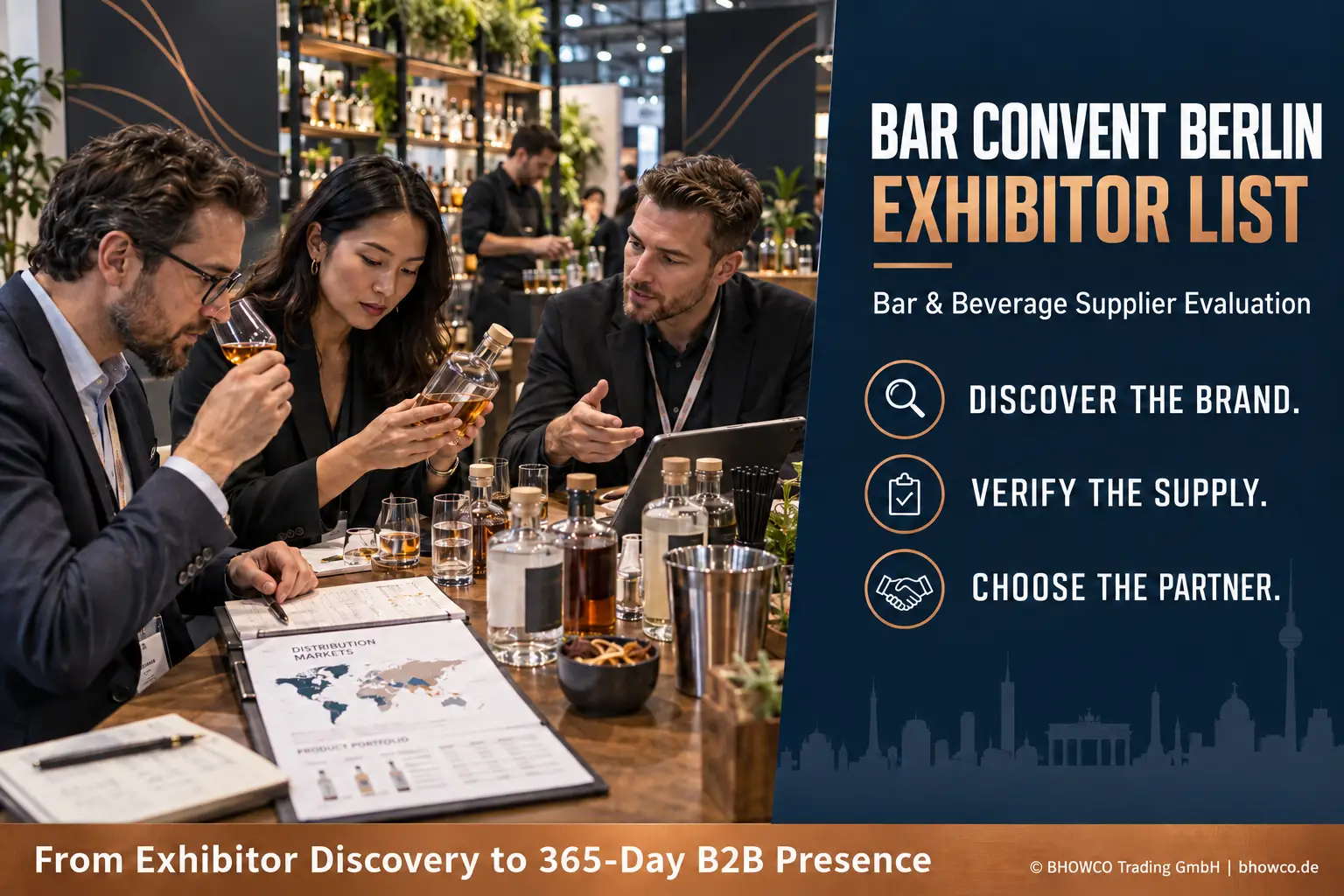
Bar Convent Berlin (BCB)
12. – 14. October 2026 | Berlin, Germany
Official Website: https://www.barconvent.com/en-gb.html

Strategic Snapshot
Bar Convent Berlin is the premier European platform for brands to build cultural capital within the professional bar community. It is where liquid innovation meets business, serving as a critical launchpad for spirit brands, mixers, and bar tools seeking validation and distribution through the influence of top bartenders, bar owners, and importers.
Why This Fair Matters in Germany’s Exhibition Ecosystem
Hosted in Berlin, Europe’s epicenter of avant-garde culture and nightlife, BCB leverages a city synonymous with trendsetting. It attracts the most influential audience in the beverage trade: creative directors of top cocktail bars, owners of influential venues, and key decision-makers from specialized distributors across the continent. For a brand, especially a new or craft entrant, securing visibility and advocacy here is a fast-track to credibility. Validation from this community—through awards, inclusion in masterclasses, or social media buzz—acts as a powerful signal to the broader market, often determining which products move from niche to mainstream.
Who This Fair Is For — and Who Should Skip It
Ideal for:
- Craft and artisanal spirit producers (gin, rum, whiskey, agave spirits, liqueurs) with a compelling story of origin, production method, or sustainability.
- Innovators in the non-alcoholic & low-ABV category, offering complex, bartender-friendly alternatives for the growing mindful drinking movement.
- Producers of specialized mixers, syrups, bitters, and fresh ingredients that enable signature cocktails and operational efficiency behind the bar.
- Brands with a focus on education and advocacy, ready to invest in masterclasses, tastings, and building genuine relationships with bartenders as partners.
Not ideal for:
- Large-scale producers of mainstream, commoditized beverages competing solely on price and volume, without a story or product suited for the craft cocktail market.
- Companies with a purely transactional approach, unprepared to engage in the experiential, educational, and relational dynamics that drive this community.
- Brands targeting the mass retail or direct consumer market without a clear “on-trade” (bar/restaurant) strategy.
The 3–5 Day Moment vs. the 365-Day Reality
BCB generates an unparalleled concentration of industry influence, providing a stage for product launches, trend validation, and face-to-face relationship building that can define a brand’s trajectory for the year ahead.
The strategic rupture occurs in the “advocacy conversion and supply chain gap.” A brand may create tremendous buzz and sample thousands of bartenders, but if it lacks a reliable route to market—through established distributors who can service bars, provide consistent supply, and offer sales support—the interest evaporates. The true work begins after the show: converting sampled bartenders into menu placements by ensuring they can easily order the product, and supporting them with cocktail recipes and POS materials. Lasting success belongs to those who follow through on the relationships built on the show floor.
Strategic Next Step
Before exhibiting, define a clear post-show action plan for distribution and on-trade support. For a framework on converting experiential engagement into sustainable commercial partnerships, review our perspective on trade fair visibility in Germany.
Explore the Ecosystem
German Trade Fair Exhibitor Checklist
How to Choose the Right German Trade Fair
Strategic FAQs for Exhibitors
How should a brand structure its presence to appeal to both bartenders and distributors simultaneously?
Create a dual-zone stand. Have an open, engaging area for tastings and interactions with bartenders, led by charismatic ambassadors. Simultaneously, have a more private, appointment-only meeting space for detailed discussions with distributors, focusing on commercial terms, market strategy, and support plans. Tailor the message and experience to each audience’s primary motivation.
What is more valuable than giving away free samples at BCB?
Providing education and utility. Offer a masterclass on using your product in cocktails, share a technique, or present a unique serving suggestion. Give bartenders a tangible skill or idea they can take back to their bar. This builds a deeper, more memorable connection than a sample they may quickly forget.
For a non-alcoholic spirit brand, how do you compete for attention in a spirits-dominated show?
Lead with mixability and professional challenge. Don’t just talk about what’s missing (alcohol); showcase what’s present—complexity, bite, aroma. Host challenges or collaborative sessions where bartenders create the best “bartender’s cocktail” with your product. Position it as a new, exciting ingredient that expands their creative palette, not as a limitation.
Why is participation in the education programme or stages a critical strategic move?
It positions your brand and team as thought leaders and peers, not just vendors. Speaking on a stage grants authority and attracts a highly engaged audience. It’s an opportunity to shape the conversation around a trend your product exemplifies, building brand equity that far outweighs the cost of a larger booth.
How can a smaller brand with a limited budget achieve significant impact at BCB?
Focus on extreme focus and partnership. Instead of a broad stand, create an unforgettable micro-experience for a single, perfect serve of your product. Alternatively, partner with a complementary brand (e.g., a tonic with a gin) to share costs and cross-pollinate audiences. Sometimes, being a highly curated part of a compelling story is more effective than telling a mediocre story alone.
Messe Berlin Center
Messedamm 22, 14055 Berlin, Germany.Messe Berlin Center
Best Image
Welcome to details
Time
Strategic Consultation
Worried About Vanishing After the Trade Show?
Most international exhibitors disappear after 3-5 days. We help you use German trade fairs as a strategic launchpad to build a 365-day visibility system that builds lasting credibility.
Transform exhibitions into a measurable strategic process.
Event Type
Health Guidelines for this Event
Event Reviews
There are no reviews for this event
Event Details
Smart Country Convention (SCCON) 13. – 15. October 2026 | Berlin, Germany Official Website: https://www.smartcountry.berlin/en
Event Details

Smart Country Convention (SCCON)
13. – 15. October 2026 | Berlin, Germany
Official Website: https://www.smartcountry.berlin/en

Strategic Snapshot
The Smart Country Convention is the definitive cross-sector platform where the digital transformation of the state is commissioned. It convenes public administration leaders, federal and state-level politicians, municipal CIOs, and approved technology providers to translate political mandates for “digital living conditions” into actionable, compliant, and interoperable technology procurement and implementation strategies.
Why This Event Matters in Germany’s Exhibition Ecosystem
Hosted in Berlin, the political capital and a leading European tech hub, SCCON is uniquely positioned at the intersection of German federal policy (e.g., the Online Access Act – OZG) and its local implementation. It attracts ministerial-level officials, heads of municipal IT departments, and public procurement officers operating under extreme scrutiny for compliance, data sovereignty (e.g., GAIA-X), and budgetary justification. For a technology provider, being present here is not about selling a product; it’s about demonstrating alignment with the strategic goal of digital sovereignty and proving your solution’s ability to navigate the labyrinth of public procurement law (VgV, VOL, SektVO). Success signals you are a viable, long-term partner for the state.
Who This Event Is For — and Who Should Skip It
Ideal for:
- Enterprise software and platform providers specializing in core administration modernization, citizen service portals, and secure cloud infrastructure compliant with public sector standards (e.g., IT-SiG 2.0, BSI-Grundschutz).
- Consultancies and system integrators with deep expertise in public procurement processes, digitalization project management for municipalities, and change management within public administrations.
- Innovators in smart city infrastructure (IoT, smart lighting, traffic management) who understand the need for integration into overarching digital city platforms and have a clear public-private partnership (PPP) model.
- Providers of specialized solutions for critical public functions: digital healthcare (eHealth), education tech for schools, and solutions for rural area connectivity and services.
Not ideal for:
- Companies offering consumer-grade apps, generic SaaS solutions, or hardware without a dedicated public sector division, compliance certifications, and references from government clients.
- Start-ups with purely conceptual solutions, lacking the financial stability, data protection certifications, or the ability to endure procurement cycles that often span 12-24 months.
- Exhibitors with a purely technical sales approach, unable to engage in strategic dialogues about legal frameworks, interoperability standards, and total cost of ownership from a public budget perspective.
The 3-Day Congress vs. the 365-Day Reality
SCCON provides the critical forum for aligning roadmaps with political priorities, networking across different levels of government, and understanding the evolving regulatory landscape that will dictate public IT spending for years to come.
The strategic rupture occurs in the “procurement and implementation valley of death.” A solution may be celebrated as a best practice on stage, but the journey to a signed contract involves navigating complex tendering procedures, proving adherence to a hundred specific technical directives (Technische Richtlinien), and surviving the scrutiny of data protection officers and works councils. The real work—and the true test of a vendor—lies in the grueling, post-event process of responding to detailed tender documents, providing proof of concept in pilot municipalities, and establishing the local support structures that public clients require. Lasting partnerships are forged in this valley, not on the expo floor.
Strategic Next Step
Before committing to SCCON, rigorously audit your organization’s public sector readiness, from compliance to tender response capabilities. For a framework on building the sustained credibility and visibility required to succeed in this long-cycle environment, review our analysis of trade fair visibility in Germany.
Explore the Ecosystem
How to Choose the Right German Trade Fair
Trade Fair Marketing Strategy for Germany
Strategic FAQs for Exhibitors
How should a technology provider’s messaging differ for a municipal CIO versus a state-level ministry official?
For the municipal CIO, focus on operational resilience, ease of integration with legacy systems, and reducing daily administrative burden. For the ministry official, emphasize how your solution advances statewide policy goals, ensures interoperability across jurisdictions, and provides scalable templates that can be rolled out to hundreds of municipalities, achieving political impact.
What is the single most important document to have when engaging with public buyers at SCCON?
A comprehensive compliance and certification dossier. This should go beyond marketing to include BSI-Grundschutz audits, data processing agreements compliant with GDPR/state laws, and proof of adherence to relevant technical standards (e.g., XÖV, OZG-umsetzungsverbund specifications). It demonstrates you speak the language of public procurement.
For a smart city IoT provider, why is having a clear data governance model more critical than the sensor technology itself?
Cities are legally and politically responsible for citizen data. You must have unambiguous answers on data ownership, processing locations, access rights, and anonymization techniques. A perfect sensor that creates a data liability is worthless. Your governance framework de-risks the project for the public client.
Why is participating in workshops and presenting best practices more valuable than a large booth?
It positions your company as a thought leader and peer, not just a vendor. Sharing genuine implementation experience (including challenges overcome) in a workshop builds immense credibility with an audience skeptical of sales pitches. It’s an opportunity to educate and shape the conversation around the problems you solve.
How can a smaller, agile tech company compete with entrenched enterprise vendors for public contracts?
Specialize in solving a specific, acute pain point within a larger process (e.g., digital signature integration for a specific permit). Partner with larger system integrators who need your niche expertise to complete their tender offering. Frame your agility as an advantage for pilot projects and innovation partnerships, which can later scale to broader frameworks.
Messe Berlin Center
Messedamm 22, 14055 Berlin, Germany.Messe Berlin Center

Organizer
Time
Strategic Consultation
Worried About Vanishing After the Trade Show?
Most international exhibitors disappear after 3-5 days. We help you use German trade fairs as a strategic launchpad to build a 365-day visibility system that builds lasting credibility.
Transform exhibitions into a measurable strategic process.
Event Type
Health Guidelines for this Event
Event Reviews
There are no reviews for this event
Event Details
SEPAWA 14. – 16. October 2026 | Berlin, Germany Official Website: https://www.sepawa.com/congress/en/
Event Details

SEPAWA
14. – 16. October 2026 | Berlin, Germany
Official Website: https://www.sepawa.com/congress/en/

Strategic Snapshot
SEPAWA is the pivotal European nexus for the science, regulation, and market application of surfactants, detergents, cosmetics, and fragrances. It bridges deep academic research in green chemistry with the commercial imperative to develop high-performance, sustainable, and compliant consumer products for a global market.
Why This Fair Matters in Germany’s Exhibition Ecosystem
Hosted in Berlin, a hub for regulatory bodies and environmental policy, SEPAWA operates at the intersection of German engineering precision and the European Union’s global regulatory influence. It attracts R&D directors, regulatory affairs managers, and senior product developers from multinationals and ambitious niche players. These professionals are not just sourcing ingredients; they are de-risking their innovation pipelines against the world’s most demanding safety (REACH), biodegradability, and carbon footprint standards. Success here signals that a formulation or ingredient is not only effective but also future-proof for the European market—a critical benchmark for Asia and the Americas.
Who This Fair Is For — and Who Should Skip It
Ideal for:
- Developers and marketers of bio-based, biodegradable, or circular economy surfactants and ingredients with robust life-cycle assessment (LCA) data.
- Specialists in performance testing, regulatory compliance (EU), and certification services for the home care and personal care industries.
- Providers of advanced formulation technologies (e.g., for concentrated doses, cold-water efficacy) and sustainable packaging solutions compatible with chemical products.
- Brands with a strong scientific narrative capable of engaging in peer-level discussions on toxicology, environmental fate, and clinical efficacy.
Not ideal for:
- Suppliers of generic, non-differentiated bulk chemicals without a clear value proposition on sustainability, traceability, or regulatory support.
- Companies offering purely marketing-driven “green” claims without the scientific substantiation required to pass scrutiny from European regulatory experts.
- Exhibitors looking for quick, transactional sales. The cycle is long, validation is multi-layered, and relationships are built on technical credibility.
The 3-Day Congress vs. the 365-Day Reality
SEPAWA provides the essential forum to present breakthrough research, influence regulatory discourse, and establish scientific thought leadership.
The strategic rupture occurs in the “regulatory and scale-up gap.” A novel, green ingredient may show brilliant lab results, but its commercial value remains theoretical until it passes full regulatory approval, demonstrates stability in large-scale production, and is proven effective in final consumer formulations. The buyer invests in a de-risked innovation pathway; the supplier’s deep technical service, regulatory dossier preparation support, and proven ability to scale sustainably are what convert scientific promise into a marketable product. Long-term partnerships are forged on the supplier’s role as a reliable extension of the customer’s R&D and compliance department.
Strategic Next Step
Before exhibiting, ensure your innovation is framed within the context of Europe’s Green Deal and the global regulatory trends it sets. For a framework on building this essential technical and strategic credibility, review our perspective on trade fair visibility in Germany.
Explore the Ecosystem
Browse German Trade Shows by Industry Sector
Understanding German & European B2B Buyer Behavior
Strategic FAQs for Exhibitors
For an ingredient supplier, what matters more: performance data or sustainability credentials?
In the European market, they are now inseparable. You must lead with a performance-backed sustainability story. Present data showing your bio-based surfactant matches or exceeds the efficacy of its petrochemical counterpart, and provide a complete environmental footprint. The winning argument is: “It’s greener, and it works as well or better—here is the proof.”
How do you engage the dual audience of scientists and marketing/brand managers at SEPAWA?
Create a two-tier narrative. For R&D, dive deep into mechanistic studies, compatibility data, and regulatory pathways. For marketing, translate that science into compelling, compliant consumer benefits: “clinically proven mildness,” “plastic-free formulation,” or “carbon-neutral production.” Your booth and materials must speak both languages fluently.
Why is SEPAWA in Berlin a critical venue for shaping future EU regulations?
The congress portion features keynotes from and panels with EFSA, ECHA, and German regulatory agency (BfR) officials. Presenting peer-reviewed research here can influence the regulatory conversation at its source. It’s a platform for proactive engagement, not just reactive compliance.
What is the biggest barrier for a new ingredient seeking adoption by major European FMCG companies?
Supply chain security and consistent quality at scale. A major brand cannot risk a global product launch on an ingredient from a single, small-scale plant. Demonstrating partnerships with reliable, large-scale producers or having a clear, funded scale-up plan is often more critical than the initial lab sample.
For a non-European company, what is the strategic value of SEPAWA beyond direct sales?
It is the ultimate credibility accelerator for global market entry. Validation from the demanding European scientific and regulatory community serves as a powerful reference for entering other markets. It signals that your product meets the highest global standards, reducing perceived risk for buyers in North America, Asia, and beyond.
Messe Berlin Center
Messedamm 22, 14055 Berlin, Germany.Messe Berlin Center

Organizer

SEPAWA e.V.
Time
Strategic Consultation
Worried About Vanishing After the Trade Show?
Most international exhibitors disappear after 3-5 days. We help you use German trade fairs as a strategic launchpad to build a 365-day visibility system that builds lasting credibility.
Transform exhibitions into a measurable strategic process.
Event Type
Health Guidelines for this Event
Event Reviews
There are no reviews for this event
November 2026
No Events
December 2026
No Events
January 2027
Event Details
Event Details

International Green Week Berlin (IGW)
15. – 24. January 2027 | Berlin, Germany
Official Website: www.gruenewoche.de/en

Strategic Snapshot
The International Green Week Berlin (IGW) is the world’s preeminent strategic interface where agriculture, food politics, and consumer trends converge. Far more than an agricultural trade show, it functions as a global stage where industry legitimacy is negotiated not just with buyers, but with policymakers, NGOs, and the media, making it a critical venue for companies whose long-term viability depends on aligning with macro food system trends.
Why This Fair Matters in Germany’s Exhibition Ecosystem
Held in the German capital, the IGW holds a unique, dual identity as both a public-facing consumer exhibition and a behind-the-scenes B2B and political summit. This grants exhibitors access to an unparalleled mix: international trade delegations, retail buying groups, political decision-makers, and millions of end consumers whose perceptions drive market demand. Germany’s leading role in shaping EU agricultural policy and its consumer market’s sensitivity to quality, origin, and sustainability standards means that a credible presence here can amplify a producer’s standing across the continent, lending powerful validation to their claims.
Who This Fair Is For — and Who Should Skip It
Ideal for:
- Regional producer associations, national export boards, and companies leveraging “origin” as a key value proposition (e.g., PDO, PGI).
- Food brands with a strong narrative around sustainability, ethical sourcing, innovation (e.g., alternative proteins), or unique artisanal quality.
- Companies operating at the intersection of agriculture, technology, and policy, seeking to engage with stakeholders across the entire food value chain.
Not ideal for:
- Producers of undifferentiated, bulk commodity goods without a distinct brand, origin, or sustainability story.
- Companies unprepared for intense public and media scrutiny of their production methods and supply chain claims.
- Exhibitors seeking a quick-sales, transactional B2B environment without the broader public and political engagement.
The 3–5 Day Moment vs. the 365-Day Reality
The fair generates massive, concentrated visibility across consumer, trade, and political audiences. However, the commercial and reputational impact of this exposure unfolds over the subsequent year. Positive reception can lead to inclusion in retail programs, partnership discussions, and policy dialogues. Conversely, a poor showing or inability to substantiate claims can cause lasting reputational damage. The event is a powerful catalyst, but the long-term reaction depends on a company’s sustained ability to deliver on the promises and narratives introduced in Berlin, maintaining engagement with contacts made across all levels.
Strategic Next Step
Assess whether your strategy is designed for a ten-day showcase or for a year-long campaign to convert the diverse contacts made—from consumers to ministers—into tangible market position and partnership capital. The framework for managing this complex, multi-audience follow-up is explored in Trade Fair Visibility Germany: 365-Day Strategy.
Explore the Ecosystem
To see the IGW within the context of Germany’s specialized trade fairs, browse the Trade shows by sector of activity. For a deeper understanding of engaging with professional buyers in this market, review German Buyer Behavior at Trade Fairs.
Strategic FAQs for Exhibitors
Given the IGW’s unique hybrid nature (B2C, B2B, political), how should an exhibitor allocate resources and design their stand strategy?
The strategy must be multi-layered. The stand needs public-facing areas for sampling and brand experience to generate buzz and direct consumer feedback. Simultaneously, it requires dedicated, professional meeting spaces (separated from the public chaos) for conducting serious B2B and political discussions. Staff must be segmented into charismatic brand ambassadors for the public and knowledgeable business development or public affairs specialists for professional visitors. A one-size-fits-all approach fails to engage any audience effectively.
For a food producer, what is the strategic value of participating in a national or regional collective stand versus having an independent booth?
A collective stand (e.g., “Taste of [Region]”) provides immediate credibility through association, shared costs, and greater visibility in a vast hall. It’s ideal for smaller producers leveraging a strong regional identity. An independent booth offers full control over branding and messaging, crucial for companies with a distinct, disruptive narrative (e.g., plant-based innovation). The choice hinges on whether your primary story is about collective origin or individual brand breakthrough. For many, the collective stand offers a more powerful and cost-effective platform for validation.
How should a company navigate the intense focus on “sustainability” and “animal welfare” at the IGW without appearing to greenwash?
Credibility demands specificity and transparency. Avoid vague terms like “green” or “natural.” Instead, present third-party certifications (e.g., organic, Animal Welfare Approved), measurable data (carbon footprint reduction, water usage), and transparent supply chain stories. Showcasing partnerships with recognized NGOs or research institutions adds weight. The narrative should be humble, focused on continuous improvement, and openly address challenges. Press and informed visitors will probe deeply; unpreparedness can lead to public relations damage.
Is the IWG a viable platform for B2B-focused AgriTech companies, or is it too consumer-oriented?
It is a highly viable platform, but the engagement must be strategically targeted. The concurrent Global Forum for Food and Agriculture (GFFA) attracts ministers and industry leaders. AgriTech companies should focus on this professional segment, using the public fair perhaps for demonstrating technology’s end-benefit to consumers (e.g., “see how this sensor ensures animal comfort”). The goal is to use the public visibility as a backdrop for high-level B2B and policy meetings, demonstrating both technological application and its social license.
What is a critical post-fair mistake for companies that received significant media or consumer attention at the IGW?
The critical mistake is failing to capitalize on the “Berlin Momentum.” A surge in website traffic, social media mentions, and sample requests post-fair is a fleeting opportunity. The strategic follow-up involves immediately engaging with trade contacts made, converting consumer interest into newsletter sign-ups or direct online sales channels, and providing the media with further angles or expert commentary to sustain coverage. Letting this wave of interest dissipate without a structured capture and nurture plan wastes the significant investment made to generate it.
Messe Berlin Center
Messedamm 22, 14055 Berlin, Germany.Messe Berlin Center

Best Image
Welcome to details
Organizer
Time
Strategic Consultation
Worried About Vanishing After the Trade Show?
Most international exhibitors disappear after 3-5 days. We help you use German trade fairs as a strategic launchpad to build a 365-day visibility system that builds lasting credibility.
Transform exhibitions into a measurable strategic process.
Event Type
Health Guidelines for this Event
Event Reviews
There are no reviews for this event
February 2027
Event Details
Event Details

FRUIT LOGISTICA Berlin
04. – 06. February 2026 | Berlin, Germany
Official Website: www.fruitlogistica.com/en

Strategic Snapshot
FRUIT LOGISTICA 2026 is the definitive strategic command center for the global fresh fruit and vegetable industry, where commercial agreements are fundamentally contracts on the ability to master biology, time, and distance. This trade fair is the critical annual platform where suppliers are evaluated not just on the sample in Berlin, but on the robustness and transparency of their entire value chain—from seed and cultivation practices to packaging, logistics, and ripening protocols—ensuring the product performs equally well at its final destination.
Why This Fair Matters in Germany’s Exhibition Ecosystem
As the world’s leading trade fair for fresh produce marketing, it holds an unparalleled position at the intersection of global agriculture, logistics technology, and European retail demand. Located in Berlin, it attracts the highest concentration of international decision-makers: sourcing managers for supermarket chains, import/export specialists, and logistics providers from over 130 countries. Germany’s central role in the EU single market and its reputation for logistical excellence and rigorous quality standards mean that credibility established here acts as a powerful passport for suppliers seeking access to the high-value, scale-driven, and quality-conscious European retail market.
Who This Fair Is For — and Who Should Skip It
Ideal for:
- Producers, exporters, and marketers of fresh produce with certified growing programs, traceability systems, and guaranteed logistical partnerships.
- Companies offering technologies that reduce waste, improve shelf-life, or enhance supply chain transparency (e.g., tracking, packaging, ripening).
- Brands with a strong story on sustainability, food safety, and consistent quality that can be communicated and verified throughout the chain.
Not ideal for:
- Small-scale growers without the volume, certification, or logistical capability to serve international retail or foodservice channels reliably.
- Suppliers of processed, frozen, or canned fruits and vegetables (the fair is focused on fresh).
- Exhibitors viewing the event as a generic food show, unprepared for the deeply technical and logistics-focused conversations that define this sector.
The 3–5 Day Moment vs. the 365-Day Reality
The fair provides a critical, high-density environment for sampling new varieties, meeting partners, and negotiating the coming season’s contracts. However, the true test of a partnership is the delivery of the first container—and every one after. Success depends on a supplier’s ability to execute flawlessly against the agreed specs: brix levels, caliber, color, and firmness upon arrival, weeks after the Berlin handshake. A single shipment with quality issues, documentation errors, or phytosanitary problems can destroy a relationship built over years. The fair is where the promise is made; the 365-day reality of disciplined, transparent execution is where it is kept.
Strategic Next Step
Evaluate if your operations are designed for the static display of perfect samples or for the dynamic, high-stakes challenge of delivering living, perishable products across global supply chains with zero defects. The framework for building this operational trust is detailed in Trade Fair Visibility Germany: 365-Day Strategy.
Explore the Ecosystem
To contextualize FRUIT LOGISTICA within Germany’s trade fair landscape, browse the Trade shows by sector of activity. For insights into the technical and risk-averse buyer’s mindset, review German Buyer Behavior at Trade Fairs.
Strategic FAQs for Exhibitors
How does the extreme focus on logistics and supply chain efficiency fundamentally shape the nature of business discussions at this fair?
It makes logistics a primary competitive advantage, not a secondary topic. Discussions quickly move beyond “how does it taste?” to “how is it packed, shipped, and ripened?” Your narrative must detail your cold-chain partnerships, your use of modified atmosphere packaging (MAP), your track-and-trace capabilities, and your protocols for pre-cooling and vessel booking. Demonstrating control and visibility over these logistical variables is often more decisive in securing a contract than the fruit’s flavor profile alone, as it directly addresses the buyer’s core financial risk: shrinkage and waste.
For a producer, what provides more strategic leverage: offering a unique, novel variety or guaranteeing absolute consistency and volume for a mainstream product?
While novel varieties can secure premium placements and media attention, guaranteeing absolute consistency and volume for mainstream products (like apples, bananas, or berries) is the foundation of most large-scale business. Retailers need to fill shelf space predictably, week after week. A supplier who can offer a reliable, high-quality supply of a core item, backed by data on harvest windows and quality consistency, becomes a strategic asset. The most successful exhibitors often lead with a novel product to attract interest but build their core business on their ability to be a dependable, high-volume partner for staple commodities.
How should a company substantiate its sustainability claims (“carbon-neutral,” “water-wise,” “regenerative”) to be credible to major European retailers?
Credibility requires third-party verification and specific data, not marketing slogans. Be prepared to present certifications (GlobalG.A.P., GRASP, Rainforest Alliance), water footprint calculations, carbon emission reports from verified logistics, and evidence of ethical labor practices. Retailers have ESG (Environmental, Social, Governance) targets and need this data for their own reporting. Storytelling about “green” practices must be backed by a transparent, auditable framework that allows the buyer to confidently promote your product’s sustainable credentials to their consumers.
Is FRUIT LOGISTICA relevant for technology providers in areas like precision agriculture, post-harvest tech, or supply chain software?
Extremely relevant, as technology is a key enabler for solving the industry’s core challenges of waste reduction and efficiency. For these providers, the strategy is to demonstrate a clear ROI by solving a specific, costly problem. For example, a precision ag company should show how its technology increases yield or reduces chemical use; a post-harvest tech firm should demonstrate how its solution extends shelf-life by X days. The booth should function as a solutions hub, with case studies and data proving tangible value for growers, shippers, or retailers.
What is the single most important document or data point a buyer will request post-fair, and how should a supplier be prepared?
Beyond the commercial quote, the most critical request is for a comprehensive quality and phytosanitary protocol, and often a pre-shipment sample approval process. Buyers need to lock in the exact quality parameters (size, color, brix, firmness) and understand the inspection regime. Being prepared with a detailed, professional protocol document that outlines these specs, the certification of the packing house, and the step-by-step process for pre-shipment inspection and documentation demonstrates professionalism and significantly reduces the buyer’s perceived risk, accelerating the path to a first order.
Messe Berlin Center
Messedamm 22, 14055 Berlin, Germany.Messe Berlin Center

Best Image
Welcome to details
Organizer
Time
Strategic Consultation
Worried About Vanishing After the Trade Show?
Most international exhibitors disappear after 3-5 days. We help you use German trade fairs as a strategic launchpad to build a 365-day visibility system that builds lasting credibility.
Transform exhibitions into a measurable strategic process.
Event Type
Health Guidelines for this Event
Event Reviews
There are no reviews for this event
March 2027
","location":[{"@type":"Place","name":"Messe Berlin Center","address":{"@type": "PostalAddress","streetAddress":"Messedamm 22, 14055 Berlin, Germany."}}],"organizer":[{"@type":"Organization","name":"Messe Berlin GmbH","url":"http://www.messe-berlin.de/"}],"performer":[{"@type":"Person","name":"Messe Berlin GmbH"}],"offers":{"@type":"Offer","price":"0.00","priceCurrency":"EUR","availability":"http://schema.org/InStock","validFrom":"2027-3-3T09:00+2:00","url":"https://bhowco.de/events/itb/var/ri-1.l-L1"}}
Event Details
Event Details

ITB Berlin – Strategic Guide for Exhibitors
ITB Berlin Official Page
03. – 05. March 2026 | Berlin, Germany
Official Website: https://www.itb.com/en

The core strategic miscalculation at ITB Berlin is viewing it as a mega-marketplace for selling travel packages. Exhibitors who focus on transactional brochures and discount offers often bypass its true function as the global governance table for the tourism industry. Here, the critical discussions shaping future travel—sustainable destination management, digital distribution shifts, aviation policy, and evolving traveler demographics—take place. Success hinges on contributing to these strategic dialogues, positioning your brand not as a vendor, but as a stakeholder shaping the industry’s future, which in turn builds unparalleled long-term credibility with policymakers, investors, and major buyers.
Strategic Snapshot
ITB Berlin is the undisputed global summit for the tourism and hospitality ecosystem. Its strategic essence is that of a pivotal platform for industry governance, trendsetting, and forging the high-level commercial and political partnerships that define global travel flows. It is where market access is negotiated, destinations are benchmarked, and the strategic narratives for the coming year are collectively authored.
Why This Fair Matters in Germany’s Exhibition Ecosystem
Hosted in Berlin, Germany’s political and strategic hub, ITB leverages the country’s central role in European and global tourism policy and outbound travel spending. The fair’s credibility is amplified by Germany’s reputation for organizational rigor and its vast, high-spending travel market. ITB attracts the industry’s architectural decision-makers: national tourism ministers and boards, global hotel chain CEOs, airline network planners, and institutional investors—all engaged in long-term portfolio and strategy development. Its value lies in high-level validation and strategic alignment, not last-minute bookings.
Who This Fair Is For — and Who Should Skip It
Ideal for:
- National and regional tourism organizations (NTOs, RTOs) shaping destination policy and seeking international investment or airline connectivity.
- Major hotel groups, resort developers, and tourism technology providers engaging with global investors and distribution partners.
- Travel service providers with a transformative or sustainable business model aiming to set new industry standards.
- Companies prepared to engage in macro-level discussions about industry trends, regulation, and future travel ecosystems.
Not ideal for:
- Small, independent travel agencies focused on direct consumer sales for the immediate season.
- Exhibitors without a clear, high-level narrative about their role in the future of travel (e.g., on sustainability, digitalization, community impact).
- Businesses seeking primarily to write immediate, low-margin package tour business on the show floor.
- Organizations unprepared for political and policy-oriented conversations alongside commercial ones.
The 3–5 Day Moment vs. the 365-Day Reality
ITB Berlin orchestrates an unparalleled concentration of global industry influence. For three days, your destination or company’s vision, data, and partnership proposals are scrutinized by the individuals and organizations that control capital, air routes, and policy. This peak of access is critical for initiating high-stakes dialogues.
The strategic failure point is the policy-commercial disconnect. Entities engage in promising ministerial or corporate meetings but fail to sustain a coherent, public-facing narrative in the months when follow-up committees meet, feasibility studies are commissioned, and annual budgets are set. In an industry driven by long planning cycles and public-private partnerships, disappearing after the fair signals a lack of operational seriousness or strategic continuity, weakening your position in ongoing negotiations.
Therefore, the true return is not measured in brochure pick-up, but in your ability to use ITB as a launchpad for a year-round campaign of thought leadership, data publication, and consistent engagement that keeps your strategic agenda active in global forums.
Strategic Next Step
Before securing booth space, define your organization’s authoritative point of view on a key industry challenge (e.g., regenerative tourism, workforce development, digital asset distribution). Your goal at ITB should be to own that conversation. For a framework on converting a short-term event presence into sustained industry authority, review the principles in our analysis of the 365-Day Trade Fair Visibility Strategy.
Explore the Ecosystem
German Buyer Behavior Trade Fairs
Choose Right Trade Fair Germany
Strategic FAQs for Exhibitors
For a Destination (NTO/RTO), what is more important at ITB: meeting tour operators or engaging with media and influencers?
While operator meetings secure immediate capacity, media and influencer engagement builds the long-term demand that makes your destination attractive to those same operators. A sophisticated strategy treats ITB as a global press conference. Generating authoritative content and narratives through top-tier travel media shapes consumer desire for months, giving you leverage in commercial negotiations and justifying your presence beyond simple transaction-seeking.
How can a tourism tech startup (B2B) gain traction at such a large, established fair?
Success requires extreme focus. Target one specific, painful inefficiency in the industry (e.g., direct bookings for small hotels, dynamic pricing for attractions, sustainable footprint measurement). Secure speaking slots in the convention’s tech tracks, partner with a relevant association for a micro-event, and target your outreach to the 50 most relevant potential pilot partners or investors, not the 50,000 general attendees. Quality of conversation trumps quantity of scans.
What is a common mistake hotels or resorts make in their ITB presentation?
Leading with generic beauty shots and room rates. At the B2B level, buyers (tour operators, corporate bookers, investors) seek partnership narratives. They want data on guest demographics, seasonality performance, expansion plans, and your strategy for sustainability and staff welfare. Presenting your property as a robust, data-backed business operation, not just a beautiful place, attracts serious long-term partners.
With the rise of sustainability, how should a destination balance promotion with responsibility messaging?
The balance has tipped; responsibility is now the core of credible promotion. The narrative must shift from ‘come and enjoy our untouched beauty’ to ‘join us in protecting and regenerating our destination’. This involves presenting concrete metrics (carrying capacities, community benefits, conservation projects), not just aspirations. This frames your destination as a forward-thinking, investable partner for the future, attracting quality-conscious operators and visitors.
How do successful exhibitors extend ITB’s impact throughout the year?
They use ITB to launch an annual strategic theme. All content—speeches, meetings, press releases—is aligned to this theme (e.g., The Future of Cultural Travel). Post-fair, they produce a steady stream of supporting content: white papers, webinar series, case study updates, and data reports that reference their ITB presence. This establishes them as the ongoing headquarters for that specific conversation, ensuring they remain relevant long after the Berlin event ends.
Messe Berlin Center
Messedamm 22, 14055 Berlin, Germany.Messe Berlin Center
Organizer
Time
Strategic Consultation
Worried About Vanishing After the Trade Show?
Most international exhibitors disappear after 3-5 days. We help you use German trade fairs as a strategic launchpad to build a 365-day visibility system that builds lasting credibility.
Transform exhibitions into a measurable strategic process.
Event Type
Health Guidelines for this Event
Event Reviews
There are no reviews for this event
April 2027
Event Details
Overview DMEA is one of the key European meeting points for companies developing healthcare IT solutions for hospitals, healthcare organizations, and digital health ecosystems. The exhibition attracts hospital IT leadership, health
Event Details
Overview
DMEA is one of the key European meeting points for companies developing healthcare IT solutions for hospitals, healthcare organizations, and digital health ecosystems. The exhibition attracts hospital IT leadership, health insurance technology teams, and public health stakeholders actively involved in healthcare digitization projects. International suppliers participate to present solutions addressing interoperability, regulatory compliance, and clinical data exchange — areas where European requirements such as GDPR, EHDS, and gematik specifications create specific market demands. The relevance of participation depends on whether exhibitors can meet the technical, regulatory, and commercial expectations of the professional audience evaluating healthcare technology across German and European markets.
Why This Trade Fair Matters
Purchasing decisions in European healthcare are influenced by multiple stakeholder roles — hospital CIOs, data protection officers, procurement consortium representatives, and clinical technology evaluators — many of whom attend DMEA to assess solutions against interoperability requirements, security standards, and compliance frameworks. These visitors evaluate suppliers based on technical integration capability, regulatory documentation, implementation track records, and long-term supplier reliability. The exhibition provides a concentrated environment where suppliers can engage with different decision-influencing roles across multiple healthcare organizations simultaneously.
Beyond immediate conversations, DMEA offers long-term value through market intelligence, partnership identification, competitor monitoring, and industry positioning. International exhibitors can follow discussions around healthcare technology standards, explore relationships with German system integrators, and understand regulatory directions that may affect product requirements in coming years. The exhibition should be viewed as one stage in a longer market-development process rather than a standalone sales opportunity.
Is This Trade Fair Right for You?
Ideal For
Health IT providers with hospital information systems, electronic health record platforms, telehealth solutions, and interoperability technologies are relevant exhibitors when they have established reference installations or demonstrated integration capabilities with European healthcare infrastructure. These companies are commercially prepared because visitors expect to see proven implementations, compliance documentation, and technical expertise during evaluation discussions.
Cybersecurity providers targeting hospitals, AI diagnostics companies with MDR regulatory pathways, and digital transformation consultancies serving public healthcare are also well-positioned for technical conversations. Suppliers who can demonstrate integration with gematik specifications, ISO 27001 certification, GDPR compliance documentation, and clear interoperability evidence are better equipped for the detailed technical evaluations that characterize healthcare technology procurement across European markets.
Organizations prepared for conversations about conformity assessments, data protection impact assessments, and cross-border data flows are more likely to find relevant discussions with the professional audience.
May Not Be Suitable For
Consumer-focused wellness applications without healthcare integration or institutional adoption may find it difficult to connect with the professional buyers typically attending DMEA. Companies at an early market-entry stage without European compliance preparation, healthcare references, or integration documentation typically need substantial preparation before exhibiting. Suppliers without references within the European public healthcare sector require additional effort to address visitor evaluation requirements.
Companies offering point solutions that do not contribute to a broader interoperable health information architecture may find the exhibition less commercially relevant. Buyers at DMEA prioritize solutions that integrate with existing healthcare infrastructure and support long-term digitization strategies across the DACH region and broader European market.
Business Opportunities
- Discuss interoperability requirements with hospital technology leaders evaluating FHIR implementation and integration capabilities
- Present compliance documentation to data protection officers reviewing GDPR alignment and EHDS readiness
- Connect with health insurance technology teams exploring digital health applications and reimbursement pathways
- Identify implementation partners familiar with German hospital workflows, healthcare regulations, and integration requirements
- Evaluate competing approaches to healthcare interoperability, hospital digitization, and European health data architecture
- Monitor regulatory and technology discussions that may influence future product requirements and market-entry strategies
- Explore procurement conversations with organizations actively evaluating technology suppliers for digitization projects
- Understand market-entry requirements through direct engagement with healthcare professionals and ecosystem partners
Exhibitor Perspective
Effective participation at DMEA depends more on preparation quality and technical knowledge than on booth size alone. Healthcare visitors arrive with specific questions about interoperability, security, and compliance. They expect exhibitors to demonstrate understanding of relevant specifications, data exchange standards, and regulatory requirements. A technically impressive booth without compliance documentation or integration expertise may generate conversations but rarely advances procurement discussions. Before investing in exhibition space, suppliers should evaluate whether they can support the technical discussions that follow initial interest.
Exhibitors should treat DMEA as the beginning of a technical evaluation process rather than expecting immediate sales conversion during exhibition days. The evaluation cycle typically involves multiple stakeholders — IT departments, data protection officers, clinical teams, and procurement functions — each with distinct criteria and concerns. Maintaining consistent engagement throughout this cycle and providing detailed technical documentation can help suppliers continue discussions and develop professional relationships with potential buyers.
For international exhibitors, DMEA should be integrated into a 365-day visibility strategy where exhibition conversations are supported by ongoing market presence, content, and relationship development. The value should be measured through qualified conversations, partnership opportunities, market intelligence, and progress within long procurement cycles rather than immediate sales volume during the event.
Before You Exhibit
Define specific objectives for each stakeholder group. Hospital CIOs, data protection officers, clinicians, and procurement managers have different evaluation criteria. Prioritize organizations where your solution addresses an identifiable operational challenge rather than approaching the visitor list as a general lead database.
Prepare documentation addressing European compliance requirements. GDPR alignment, EHDS readiness, ISO 27001 certification, and gematik specification compliance are common evaluation criteria that procurement teams expect to review during the assessment process.
Research attending hospitals and insurance companies. Identify target healthcare organizations and relevant decision-makers connected to DMEA 2026. Schedule pre-fair meetings rather than relying on chance encounters.
Develop role-specific messaging. Different stakeholders ask different questions. CIOs focus on architecture and integration, data protection officers on compliance, and procurement managers on total cost of ownership and supplier reliability. Preparing distinct talking points for each persona improves communication effectiveness.
Plan a structured follow-up timeline. Preparing compliance documentation, security assessments, and interoperability statements in advance allows faster response to post-event requests. This responsiveness is critical given the extended procurement timelines typical in healthcare technology decisions.
Continue Your Research
German and European healthcare organizations evaluate suppliers through a structured process that international companies often misunderstand. Understanding procurement culture, documentation expectations, and evaluation criteria is essential before investing in DMEA 2026 exhibitor participation. Understanding German Healthcare Buying Behaviour Before Market Entry explains how procurement decisions are made and what international suppliers should prepare.
Many exhibitors focus all their resources on exhibition days and lose momentum afterward. However, healthcare technology procurement cycles typically extend across many months. Building Long-Term Visibility After a German Trade Fair explains how to maintain communication and technical credibility throughout the extended decision cycle.
International exhibitors often underestimate the preparation required for German and European healthcare exhibitions. From compliance documentation to technical messaging, structured planning significantly influences participation quality. Healthcare IT Exhibitor Checklist for German Trade Fairs helps healthcare technology companies prepare compliance documentation, visitor targeting, and post-event follow-up before entering German exhibitions.
Messe Berlin Center
Messedamm 22, 14055 Berlin, Germany.Messe Berlin Center

Organizer
Time
Event Type
Health Guidelines for this Event
Event Reviews
There are no reviews for this event
Event Details
Pipeline Technology Conference (ptc) 27. – 30. April 2026 | Berlin, Germany Official Website: www.pipeline-conference.com
Event Details

Pipeline Technology Conference (ptc)
27. – 30. April 2026 | Berlin, Germany
Official Website: www.pipeline-conference.com
The fundamental strategic miscalculation at the Pipeline Technology Conference (ptc) is viewing it as a technical seminar for niche engineering problems. This fails to recognize its critical role as the central governance and future-proofing forum for the entire global energy and fluids transmission infrastructure. Asset integrity managers, major project directors, and regulatory specialists attend not to discuss isolated maintenance techniques, but to architect the long-term operational resilience, safety, and adaptation strategies for critical networks that must withstand decades of use, geopolitical shifts, and the transition to new energy carriers. Success hinges on presenting your solution not as a product for a single issue, but as a foundational component of a systemic, data-driven asset integrity and risk management philosophy that protects multi-billion-euro investments over their entire lifecycle.
Strategic Snapshot
The Pipeline Technology Conference (ptc) is Europe’s definitive knowledge and networking summit for the global pipeline engineering and operations sector. Its strategic function is to serve as the primary arena where the technological, safety, and strategic roadmap for pipeline infrastructure is debated and set, combining a high-level technical conference with a focused exhibition of enabling technologies.
Why This Event Matters in Germany’s Exhibition Ecosystem
Hosted in Berlin, the political and regulatory heart of Europe, ptc is strategically positioned at the nexus of industry operation and energy policy. The event leverages Germany’s leadership in engineering rigor, environmental standards, and its pivotal role in Europe’s energy security. It attracts senior engineers, technical directors, and executives from pipeline operators, engineering firms, and service providers globally—the individuals responsible for the safety and performance of critical infrastructure. Germany’s influential position makes validation and discussion here essential for technologies aiming to set new industry standards and access major international projects.
Who This Event Is For — and Who Should Skip It
Ideal for:
- Providers of integrity management solutions: in-line inspection (ILI) tools, corrosion monitoring, leak detection systems, and data analytics platforms.
- Manufacturers of high-specification pipeline materials, valves, fittings, and coating systems.
- Specialized engineering and consulting firms focused on pipeline design, risk assessment, and rehabilitation.
- Companies offering technologies for the transport of hydrogen, CO2, and other future energy carriers within existing or new infrastructure.
Not ideal for:
- Suppliers of generic industrial equipment without certification or application history in high-pressure, regulated pipeline operations.
- Companies focused solely on upstream extraction or downstream refining without a dedicated midstream/infrastructure division.
- Exhibitors unprepared for deeply technical, specification-driven conversations with engineers holding decades of field experience.
- Brands without a clear narrative on enhancing safety, extending asset life, or reducing operational risk.
The 3–5 Day Moment vs. the 365-Day Reality
ptc generates a concentrated, high-level summit of industry expertise. For four days, your technology’s validation data, case study outcomes, and compatibility with evolving standards are scrutinized by the custodians of the world’s pipeline networks. This peak of peer review is critical for entering global vendor lists and technical specifications.
The strategic rupture occurs in the “asset lifecycle disconnect.” A technology is presented as solving a specific flaw detection challenge, but the provider fails to engage as a long-term data and decision-support partner throughout the continuous cycle of inspection, assessment, and maintenance that defines pipeline integrity management. In an industry where failure consequences are catastrophic, a vendor who disappears after selling hardware is a liability. Trust is built on becoming an integral part of the operator’s ongoing safety and risk mitigation culture.
Thus, the true value is not in conference paper citations, but in using the event to initiate a decades-long partnership, providing continuous data analysis, regulatory insight, and lifecycle support that proves your role as a guardian of infrastructure integrity.
Strategic Next Step
Before planning your participation, define your solution’s contribution to “uninterrupted operability”: Does it prevent unplanned outages, enable predictive maintenance, or facilitate the safe transport of new energy vectors? To understand how to build this continuous authority as an integrity partner, review the framework in our analysis of the meticulous preparation required for German technical fairs.
Explore the Ecosystem
German Buyer Behavior Trade Fairs
Choose Right Trade Fair Germany
Strategic FAQs for Exhibitors
How should a technology provider position itself in the context of hydrogen and CO2 pipeline discussions?
Move beyond theoretical compatibility to demonstrated performance. For hydrogen, present data on material resistance to embrittlement under cyclic loads. For CO2, especially with impurities, show validation for corrosion control under supercritical conditions. Frame your technology as a de-risking enabler for repurposing existing infrastructure or building new networks for the energy transition, providing the hard evidence operators need to make billion-euro investment decisions.
For an inspection or monitoring company, is raw data resolution or actionable intelligence more valuable?
Actionable intelligence is paramount. Operators are inundated with data. The value is in interpretation: Can your system not only detect a feature but classify its severity, predict its growth rate, and prioritize it within a risk-based assessment model? Demonstrate how your output directly feeds into integrity management software to recommend specific maintenance actions, turning data into clear operational decisions and regulatory compliance evidence.
What is a critical mistake regarding the regulatory and standards environment?
Assuming international standards (e.g., ASME, API) are universally sufficient. Projects in Europe and particularly Germany must navigate a complex overlay of national regulations, safety case requirements, and often stricter environmental rules. Demonstrate familiarity with relevant EU directives (e.g., SPSE) and German technical rules (e.g., from DVGW). Having local certification or a history of successful projects in the region is a significant credibility factor.
How can a smaller, specialized service or software company compete with large integrated engineering firms?
Become the undisputed best-in-class specialist in a critical niche. Whether it’s advanced signal analysis for ILI data, AI-driven anomaly detection, or a specific repair technology, dominate that domain. Position yourself as the expert that the large EPCs or operators themselves bring in to solve their most challenging problems. Your partnership model with larger firms, where you provide the cutting-edge specialty, can be more effective than competing head-on.
How do successful participants leverage the conference format beyond just having an exhibition booth?
They use speaking slots to establish thought leadership on systemic challenges, not to pitch products. Presenting a peer-reviewed case study on a novel integrity assessment methodology or a collaborative research paper on hydrogen transport builds immense credibility. This positions your team as problem-solvers and innovators. The leads generated from a respected presentation are far more qualified and valuable than general booth traffic.
Messe Berlin Center
Messedamm 22, 14055 Berlin, Germany.Messe Berlin Center
Organizer

EITEP Euro Institute for Information & Technology Transfer in Environmental Protection GmbH
Time
Event Type
Health Guidelines for this Event
Event Reviews
There are no reviews for this event
May 2027
No Events
June 2027
No Events
Berlin
Exhibition
Center
Trending Articles
ILA Berlin Exhibitor List 2026 – Aerospace & Defense Industry Guide
ILA Berlin Exhibitor List 2026 – Complete Guide for Aerospace & Defense Professionals Last updated:…