Latest Insights
The 4 Trust Signals International Buyers Look for After Trade Fairs


International Buyer Trust Signals: What Buyers Check
You have packed up your booth. Your team has returned home. The business cards are sitting on your desk. The fair felt successful. Conversations were productive. Interest seemed genuine.
Then silence.
Weeks pass. Follow-up emails go unanswered. The promising leads have gone cold. You wonder what happened. Was your product not competitive? Was your pricing too high? Was the wrong person on your team?
Probably none of the above.
The real reason buyers go silent after trade fairs is not rejection. It is verification. International buyers are not ignoring you. They are evaluating you. And your post-fair presence — or absence — is sending signals that determine whether you pass or fail their trust assessment.
This article reveals the four trust signals international buyers actively look for after trade fairs, how each signal reduces perceived risk, and the specific infrastructure required to send the right signals. Understanding these signals is essential for building international buyer trust that converts fair conversations into long-term contracts.
Why Buyers Keep Evaluating After the Fair Ends
The trade fair is not the finish line. It is the starting line. Buyers who seemed interested at your booth are not ready to buy. They are ready to verify.
The Post-Fair Verification Phase
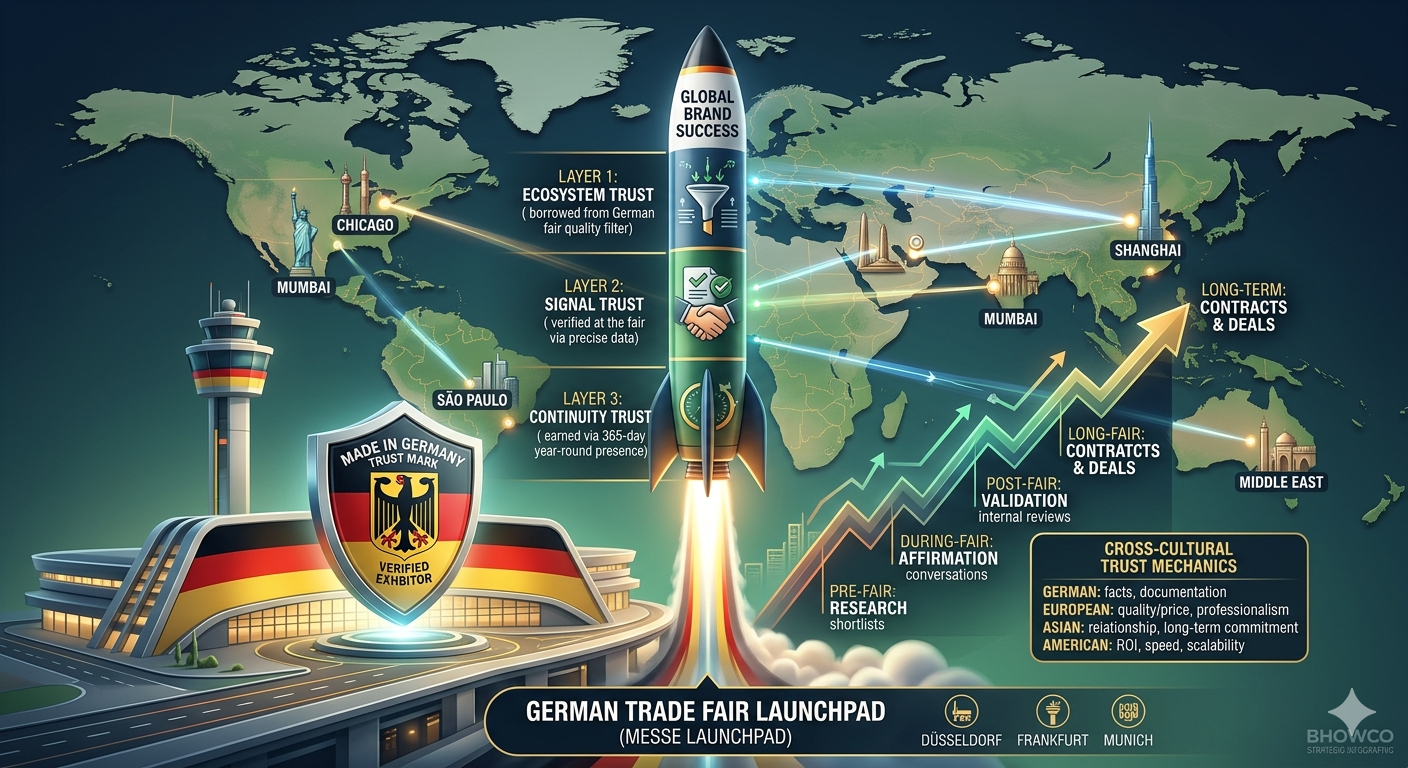
After returning from a trade fair, buyers enter a systematic evaluation phase. They compare notes with colleagues. They research shortlisted suppliers. They check references. They validate claims. This phase typically extends over months — far longer than most exhibitors maintain visibility.
During this phase, buyers actively look for trust signals. These signals answer their hidden question: “Can we trust this supplier with our business?” The strength of your international buyer trust signals determines whether you advance to negotiation or are eliminated from consideration.
The Cost of Weak Trust Signals
Suppliers who fail to send strong international buyer trust signals after the fair face severe consequences:
Extended evaluation cycles: Buyers take longer to verify weak signals. Each additional week of evaluation delays revenue and increases the chance of competitive displacement.
Higher perceived risk: Weak signals trigger risk premiums. Buyers discount prices or demand favorable terms to compensate for perceived uncertainty.
Internal justification difficulty: Buyers cannot easily justify weak-signal suppliers to internal stakeholders. The invisible supplier loses to the visible competitor.
Elimination from consideration: Suppliers who fail all trust signals are simply removed from the shortlist. No notification. No explanation. Just silence.
As the German Buyer Behavior guide explains: “In Germany, interest signals need for verification.” Buyers are not rejecting you. They are verifying you. Your international buyer trust signals determine whether you pass verification.
Trust Signal 1: Responsive, Personalised Follow-Up
The first trust signal buyers evaluate is the quality and timing of your post-fair follow-up. This signal is the most immediate and the easiest to get wrong.
What Buyers Look For
Within days of the fair ending, buyers expect to hear from the suppliers who interested them. They are looking for specific indicators:
Timeliness: Follow-up within days signals organisation and priority. Delayed follow-up signals indifference or disorganisation.
Personalisation: Reference to specific conversation points signals attention and genuine interest. Generic “nice to meet you” emails signal template-based outreach and lack of care.
Value addition: Follow-up that provides requested information or relevant case studies signals helpfulness. Follow-up that simply asks “do you have any questions?” signals minimal effort.
Clear next steps: Follow-up that suggests specific actions signals process orientation. Vague follow-up signals uncertainty.
How This Signal Reduces Risk
Responsive, personalised follow-up reduces relationship risk. Buyers infer that if you are responsive now, you will be responsive after the contract is signed. Generic or delayed follow-up signals that responsiveness will disappear when problems arise.
This signal also reduces performance risk. Buyers infer that attention to follow-up details predicts attention to delivery details. Careless follow-up signals careless operations.
Common Mistakes That Destroy This Signal
Delayed follow-up: Waiting too long sends a strong negative signal. Buyers assume you are not organised or not interested.
Generic templates: Using the same email for every contact signals that you did not pay attention to any of them. Buyers feel like numbers, not partners.
No clear value: Follow-up that asks for something (a meeting, a decision) without providing something first signals extraction, not relationship-building.
Too aggressive: Follow-up that pushes for immediate commitment signals desperation. Desperation signals low market demand. Low demand signals poor capability.
As the Trade Fair Marketing Strategy guide explains: “In global B2B networking, pressure is interpreted as insecurity, not enthusiasm.” Your follow-up must build trust, not demand it.
Trust Signal 2: Findable, Current Digital Presence
The second trust signal buyers evaluate is your digital presence — specifically, whether they can find you easily and whether what they find is current. This signal is the most passive and the most commonly neglected.
What Buyers Look For
After the fair, buyers will search for you online. They are looking for specific indicators:
Discoverability: Can they find your company profile on credible platforms? Do you appear in search results for relevant keywords? Invisibility is a negative signal.
Completeness: Is your profile fully populated with contact information, capability descriptions, and evidence? Empty or incomplete profiles signal low commitment.
Currency: Are your case studies current? Is your content recent? Outdated presence signals that you are not actively operating.
Professionalism: Does your digital presence look professional? Poor design, broken links, or inconsistent messaging signal amateurism.
How This Signal Reduces Risk
A strong, findable digital presence reduces all four risk types. Performance risk decreases when buyers find recent case studies. Delivery risk decreases when buyers see consistent presence. Relationship risk decreases when buyers find clear contact information. Reputational risk decreases when buyers find third-party validation.
Invisible digital presence increases all risk types. Buyers cannot verify you. They assume the worst. They move to visible competitors.
Common Mistakes That Destroy This Signal
No directory presence: Buyers cannot find you on credible B2B platforms. Your brand exists only on your own website, which buyers consider biased.
Outdated case studies: Your most recent case study is old. Buyers assume you have no recent successes to share.
Incomplete profiles: Your profile has missing sections, empty fields, or placeholder text. Buyers assume you are not serious about your presence.
Inconsistent messaging: Your value proposition differs across platforms. Buyers assume you are confused about your own positioning.
The 365-Day Visibility System is designed specifically to address this trust signal. As the guide explains: “You can buy visibility for 3 days at Messe Frankfurt. Credibility takes 365.” Your findable, current digital presence is the foundation of international buyer trust signals.
Trust Signal 3: Verifiable Third-Party Validation
The third trust signal buyers evaluate is evidence that someone else has already vetted you. This signal is the most powerful and the most difficult to fake.
What Buyers Look For
Buyers actively seek independent verification of your claims. They are looking for specific indicators:
Exhibition ecosystem participation: Do you exhibit at major German trade fairs? The ecosystem’s filter provides third-party validation.
Industry certifications: Do you maintain relevant certifications (ISO, industry-specific)? Certifications signal quality systems.
Professional association memberships: Are you a member of relevant industry bodies? Membership signals commitment to professional standards.
Client testimonials: Can you provide references from similar clients? Testimonials signal that others have trusted you successfully.
Platform verification: Are you verified on credible B2B platforms? Platform badges signal that someone checked you.
How This Signal Reduces Risk
Third-party validation is the most powerful risk-reduction signal because it transfers trust from the validator to you. The buyer does not need to verify you independently. The validator has already done some of that work.
This signal is particularly effective for reducing reputational risk. Buyers can justify their supplier choice by pointing to third-party validation. “They exhibit at Hannover Messe” is a compelling justification that requires no further explanation.
Common Mistakes That Destroy This Signal
No third-party presence: Your brand exists only on your own channels. Buyers have no independent verification of your claims.
Expired certifications: Your certifications are outdated. Buyers assume you no longer meet the standards.
Fake or irrelevant badges: You display validation from unknown or irrelevant sources. Buyers are not fooled. Fake signals are worse than no signals.
Unverifiable claims: You claim certifications but provide no proof. Buyers cannot verify, so they assume the claims are false.
A recurring pattern across German trade fairs is that the exhibition ecosystem provides the most credible third-party validation available to international B2B suppliers. Your participation signals that you have passed meaningful filters.
The BHOWCO 365-Day Profile provides third-party validation within this ecosystem. Your profile signals that you are a verified participant in Germany’s exhibition infrastructure — a powerful trust signal for international buyers.
Trust Signal 4: Consistent, Ongoing Presence Across Time
The fourth trust signal buyers evaluate is whether your presence is consistent over time or appears only around trade fairs. This signal is the most revealing and the hardest to fake.
What Buyers Look For
Buyers check whether your brand remains active between fairs. They are looking for specific indicators:
Profile longevity: Has your directory profile existed for an extended period? Longevity signals stability.
Content continuity: Do you publish content consistently across the year? Regular publishing signals ongoing operation.
Update frequency: Is your presence actively maintained or abandoned? Recent updates signal current activity.
Response patterns: Do you respond to inquiries promptly year-round? Consistent responsiveness signals reliable support.
How This Signal Reduces Risk
Consistent, ongoing presence is the strongest signal of long-term commitment. Buyers infer that if you maintain presence across time, you will maintain the relationship across time. Sporadic presence signals that you may disappear after the contract is signed.
This signal also reduces performance risk. Consistent presence signals operational stability. A brand that maintains visibility is assumed to maintain quality. Inconsistent presence signals chaos.
Common Mistakes That Destroy This Signal
Spike-and-collapse pattern: Your visibility spikes during fairs and collapses between them. Buyers notice the absence. Absence signals instability.
Abandoned profiles: Your directory profiles exist but are outdated. Buyers assume you are no longer actively operating.
No content between fairs: You publish only around exhibition dates. Buyers assume you have nothing to say when you are not selling.
Inconsistent responsiveness: You respond quickly near fairs but slowly between them. Buyers assume responsiveness will disappear after the contract is signed.
As the 365-Day Visibility System explains: “Silence after the fair is not neutral. It signals lack of commitment to the relationship.” Consistent, ongoing presence is the antidote to this negative signal. It is the foundation of strong international buyer trust signals.
The Four Signals in Action: A Post-Fair Trust Audit
To assess your current international buyer trust signals, conduct a post-fair trust audit. This audit evaluates your performance on all four signals and identifies gaps that need attention.
Signal 1 Audit: Responsive Follow-Up
□ Was follow-up sent within days of the fair ending?
□ Was each follow-up personalised with specific conversation references?
□ Did follow-up provide value before asking for anything?
□ Were clear next steps suggested?
□ Has follow-up continued beyond the first email?
Signal 2 Audit: Findable Digital Presence
□ Can buyers find your BHOWCO profile easily through search?
□ Is your profile complete with all relevant sections populated?
□ Are your case studies current?
□ Is your content recent?
□ Does your messaging remain consistent across platforms?
Signal 3 Audit: Third-Party Validation
□ Do you exhibit at major German trade fairs consistently?
□ Are your industry certifications current and visible?
□ Are you a member of relevant professional associations?
□ Can you provide client references from similar buyers?
□ Does your BHOWCO profile display verification badges?
Signal 4 Audit: Consistent Ongoing Presence
□ Has your directory profile existed for an extended period?
□ Do you publish content consistently across the full year?
□ Is your profile actively maintained with recent updates?
□ Do you respond to inquiries promptly year-round?
□ Does your visibility remain consistent between fairs?
Each “no” answer represents a trust signal gap that international buyers will notice. Each gap increases perceived risk. Each risk increase reduces your win rate and pricing power.
The BHOWCO 365-Day Profile is designed to help you pass all four audits. It provides the infrastructure for strong international buyer trust signals that convert fair conversations into long-term contracts.
Building Your Trust Signal Infrastructure
Understanding the four trust signals is essential. Building the infrastructure to send them consistently is how you win.
Infrastructure for Signal 1: Responsive Follow-Up
Document your post-fair follow-up process before the fair begins. Create personalisation templates that allow you to reference specific conversation points efficiently. Build a case study library organised by industry and buyer type. Assign clear responsibility for follow-up timing.
Infrastructure for Signal 2: Findable Digital Presence
Establish a BHOWCO 365-Day Profile as your permanent credibility home. Ensure your profile is complete, current, and professionally presented. Maintain active search visibility for relevant keywords. Update case studies regularly.
Infrastructure for Signal 3: Third-Party Validation
Commit to consistent exhibition participation at major German trade fairs. Maintain current industry certifications. Display validation badges prominently on your profile. Collect and publish client testimonials (with permission).
Infrastructure for Signal 4: Consistent Ongoing Presence
Maintain your BHOWCO profile across the full year, not just around fairs. Publish content on a regular schedule. Respond to inquiries promptly regardless of season. Update your profile continuously, not sporadically.
A recurring pattern across German trade fairs is that the exhibition ecosystem provides the most credible platform for building these trust signals. Your participation signals that you have passed meaningful filters. Your year-round presence signals that you are a committed, reliable partner.
Frequently Asked Questions About International Buyer Trust Signals
What are the four trust signals international buyers look for after trade fairs?
The four trust signals are: responsive, personalised follow-up (timely, specific, value-adding communication); findable, current digital presence (discoverable, complete, up-to-date profiles); verifiable third-party validation (exhibition participation, certifications, testimonials); and consistent, ongoing presence across time (longevity, continuity, active maintenance). Buyers evaluate all four signals during their post-fair verification phase.
Why do buyers keep evaluating after trade fairs instead of deciding at the event?
Trade fairs are information-dense environments where buyers cannot make final decisions. After returning to their offices, buyers enter a systematic verification phase that can extend over months. During this phase, they research shortlisted suppliers, check references, validate claims, and build internal consensus. Post-fair trust signals determine which suppliers advance to negotiation.
How quickly should I follow up after a trade fair to send the right trust signal?
Follow-up should be sent within days of the fair ending. Timeliness signals organisation and priority. Delayed follow-up signals indifference or disorganisation. Personalisation matters as much as timing — generic follow-up sends negative signals regardless of speed.
Why is third-party validation such a powerful trust signal?
Third-party validation transfers trust from the validator to you. The buyer does not need to verify you independently because someone else has already done some of that work. Exhibition ecosystem participation, industry certifications, and client testimonials all provide third-party validation. This signal is particularly effective for reducing reputational risk — buyers can justify their supplier choice by pointing to credible third parties.
How does BHOWCO help exhibitors send strong trust signals after fairs?
BHOWCO provides the permanent infrastructure for all four trust signals. Your 365-Day Profile ensures findable, current digital presence and consistent ongoing presence. Ecosystem participation provides third-party validation. The platform enables the credibility that makes responsive follow-up more effective. BHOWCO transforms post-fair presence from a vulnerability into a competitive advantage.
What is the cost of sending weak or no trust signals after trade fairs?
Weak trust signals result in extended evaluation cycles, higher perceived risk, internal justification difficulty, and elimination from consideration. The cumulative cost of weak signals across multiple fairs far exceeds the investment required for strong trust signal infrastructure.
International buyers do not decide at the fair. They decide after the fair — based on the trust signals you send.
The four trust signals — responsive follow-up, findable digital presence, third-party validation, and consistent ongoing presence — determine whether you advance to negotiation or are eliminated from consideration. Each signal reduces buyer risk. Each risk reduction builds trust. Each trust increment enables premium pricing and long-term partnerships.
Your competitors will send weak signals or no signals at all. They will wonder why their promising fair conversations never convert. They will blame the fair, the industry, the economy — anything except their own post-fair presence.
You can choose differently. You can build the infrastructure that sends strong international buyer trust signals after every fair. You can be the brand that buyers remember, verify, trust, and choose.
Stop disappearing after the fair. Start sending trust signals that convert.
→ Understand buyer verification psychology
→ Master strategic trade fair marketing
→ Build your 365-day visibility system
→ Establish your trust signal infrastructure